
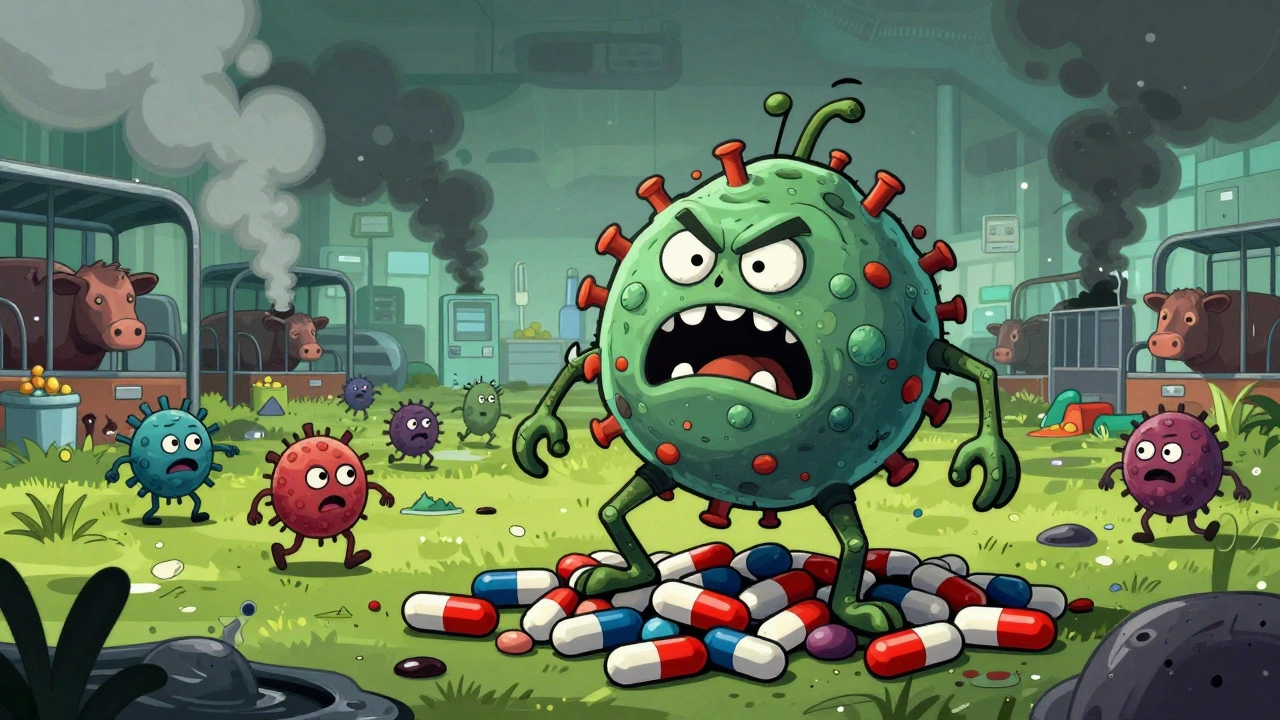
Every time you take an antibiotic when you don’t need it, you’re not just helping yourself-you’re helping bacteria become stronger. That’s the hard truth behind the rise of antibiotic overuse. It’s not just about one bad pill or one unnecessary prescription. It’s a global chain reaction that’s making everyday infections harder, and sometimes impossible, to treat. And one of the scariest outcomes? A deadly gut infection called Clostridioides difficile, or C. difficile, that’s exploding in hospitals and communities alike.
What Happens When Antibiotics Don’t Work Anymore?
Antibiotics were once miracle drugs. A simple sore throat or urinary tract infection could be cleared in days. But over the last 20 years, that’s changed. Bacteria have adapted. They’ve evolved. And now, one in six bacterial infections worldwide are resistant to the first-line antibiotics doctors used to rely on. That’s not a guess-it’s data from the World Health Organization’s 2025 global surveillance report. This isn’t magic. It’s evolution. When antibiotics are used too often, or in the wrong way, the bacteria that survive are the ones that can fight back. They pass on their resistance genes. Soon, entire strains become untouchable. Think of it like a game of survival: every time you fire a bullet at a crowd of bacteria, the ones that dodge live to reproduce. And they’re getting better at dodging. The most dangerous players? Eight key bacteria: Escherichia coli, Klebsiella pneumoniae, Staphylococcus aureus, and others. In some regions, over 40% of E. coli infections don’t respond to common drugs like ampicillin or fluoroquinolones. In parts of South Asia and the Eastern Mediterranean, one in three infections are already resistant. And it’s getting worse-resistance rates jumped 5% to 15% every year between 2018 and 2023. Even worse, last-resort antibiotics like carbapenems are losing their power. These are the drugs doctors turn to when everything else fails. But by 2035, resistance to them could double compared to 2005 levels. That means a simple cut, a urinary infection, or a post-surgery fever could turn deadly because there’s nothing left to give.How Antibiotics Trigger C. difficile Infections
Your gut is home to trillions of bacteria-most of them good. They help digest food, make vitamins, and keep harmful bugs in check. Antibiotics don’t care about that balance. They wipe out everything in their path. That’s where Clostridioides difficile comes in. It’s a sneaky bacterium that lives quietly in many people’s guts without causing harm. But when antibiotics clear out the good bacteria, C. difficile takes over. It multiplies fast, releases toxins, and causes severe diarrhea, fever, and abdominal pain. In serious cases, it leads to colon damage, sepsis, or death. The CDC estimates that in the U.S. alone, C. difficile caused nearly half a million infections in 2017. While newer data isn’t included here, trends show it’s still climbing. And here’s the kicker: antibiotic use is the #1 risk factor. It’s not about being in a hospital-though that increases risk-it’s about having taken antibiotics recently. Even a short course of amoxicillin or ciprofloxacin can trigger it. And it’s not just hospitals. Community cases are rising. People who’ve never been hospitalized are getting C. difficile after taking antibiotics for a sinus infection, a toothache, or even a cough that didn’t need treatment in the first place.Why We Keep Overusing Antibiotics
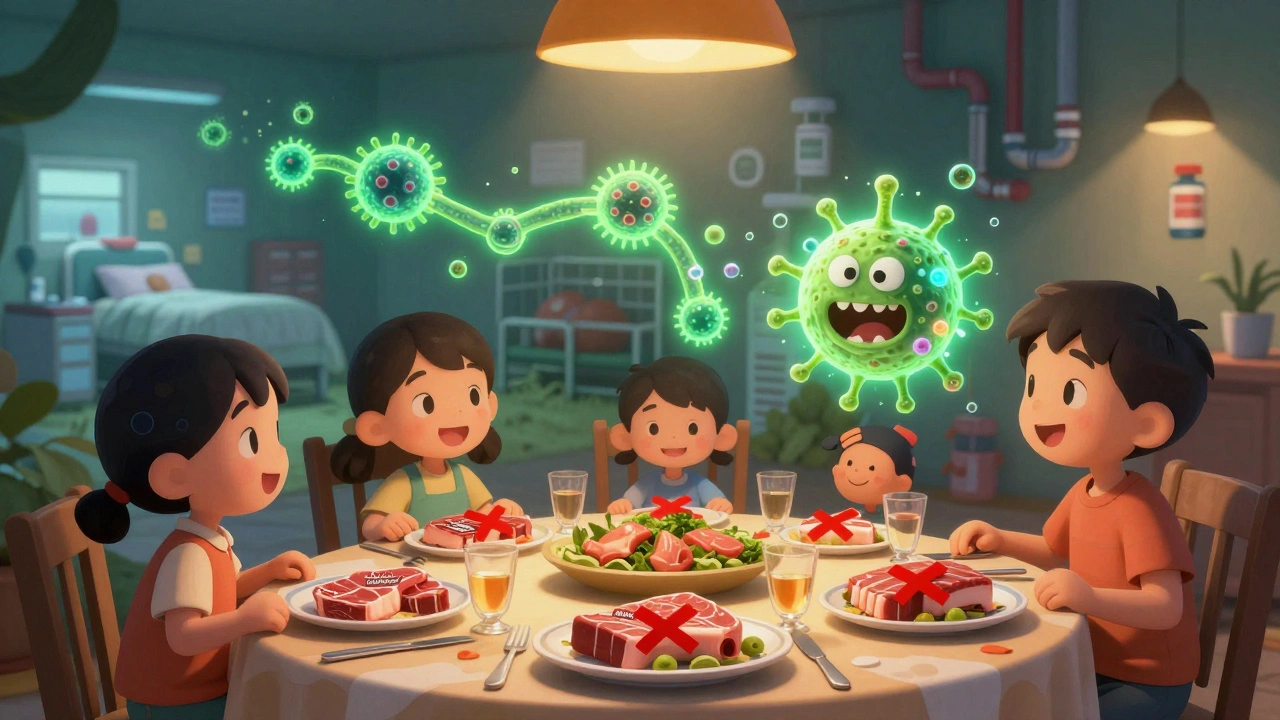
You might wonder: if the risks are so clear, why are doctors still prescribing them so freely? One reason is pressure. Patients ask for antibiotics when they have a cold. They’ve seen them work before. They want something to fix it now. Doctors, under time pressure, sometimes give in-even if they know it’s viral and won’t respond. Another reason is diagnosis. In many places, especially low-resource settings, there’s no quick test to tell if an infection is bacterial or viral. So doctors guess. And when they guess wrong, antibiotics get used unnecessarily. Then there’s agriculture. More than 70% of all antibiotics produced globally are given to livestock-not to treat illness, but to make animals grow faster or prevent disease in crowded farms. Those drugs don’t disappear. They enter the environment through manure, water, and food. Resistant bacteria from farms end up on our plates and in our water supply. And let’s not forget the pandemic. Between 2020 and 2022, antibiotic use spiked in hospitals as doctors tried to prevent secondary infections in COVID patients. That surge undid years of progress. Resistant infections that had been dropping since 2012 began rising again. In the U.S., hospital-acquired resistant infections jumped 20% during that time.
What’s at Stake If We Don’t Change
This isn’t just about stomach bugs or UTIs. It’s about the future of modern medicine. Think about surgery. Cancer chemotherapy. Organ transplants. All of these rely on antibiotics to prevent deadly infections. If antibiotics stop working, these procedures become far riskier-or impossible. Experts warn that by 2050, antimicrobial resistance could kill 10 million people a year-more than cancer. That’s not science fiction. It’s a projection from the World Health Organization and Vanderbilt University. The economic cost? Up to $100 trillion in lost global output. And it’s already happening. In 2019, AMR directly caused 1.27 million deaths worldwide. Another 4.95 million deaths were linked to resistant infections. That’s more than malaria, HIV, or tuberculosis combined. Doctors are already seeing the effects. One infectious disease specialist at Vanderbilt said, “Sometimes we don’t have anything effective to offer.” That’s not a rare story anymore. It’s becoming routine.What Can You Do?
You don’t need to wait for governments or hospitals to fix this. You have power too.- Don’t ask for antibiotics for colds, flu, or most sore throats. These are usually viral. Antibiotics won’t help-and they might hurt.
- If you’re prescribed antibiotics, take them exactly as directed. Don’t skip doses. Don’t save leftovers. Don’t share them.
- Ask your doctor: “Is this really a bacterial infection?” If they say yes, ask: “What’s the narrowest-spectrum antibiotic that will work?”
- Choose meat and dairy from animals raised without routine antibiotics. Look for labels like “raised without antibiotics” or “organic.”
- Wash your hands. Get vaccinated. Preventing infections in the first place reduces the need for antibiotics.


Jade Hovet
OMG this is so real 😭 I took antibiotics for a fake sinus infection last year and got C. diff after. Spent 3 days in the ER. Never again. 🙏
Constantine Vigderman
Bro this is wild-antibiotics are like nuking your gut with a grenade. I used to pop them for every sniffle, now I’m all about probiotics, ginger tea, and just waiting it out. My gut’s never felt better! 🌱💪
Cole Newman
You guys are overreacting. I’ve taken 50+ courses of antibiotics since I was 12 and I’m fine. The real problem is lazy doctors and scared patients. If you can’t handle a little bacteria, maybe you shouldn’t be alive.
Tom Zerkoff
The data presented here is both compelling and alarming. Antibiotic stewardship is not merely a clinical best practice-it is a public health imperative. The economic and mortality burdens associated with antimicrobial resistance are not theoretical; they are already manifesting in clinical settings worldwide. Systemic intervention is required at the policy, educational, and individual levels.
Yatendra S
We are all just temporary hosts for bacteria, right? 🤔 Maybe resistance isn’t the enemy… maybe it’s just evolution’s way of reminding us we’re not in charge. We think we’re the apex species, but the microbes? They’ve been here for 3.5 billion years. We’re just the latest glitch in their code.
kevin moranga
I used to be the guy who’d call his doctor at 2 a.m. because he had a sore throat. Then my cousin got C. diff from a 5-day course of amoxicillin for a viral bronchitis. She was in the hospital for three weeks. I started asking my docs: ‘Is this bacterial?’ Now I don’t even touch antibiotics unless I have a fever over 101 and green snot for 10+ days. And honestly? My immune system’s stronger than ever. You don’t need a pill for every sniffle. Your body’s got this.
Alvin Montanez
People think they’re being responsible by avoiding antibiotics, but the real criminals are the big pharma CEOs and factory farms dumping antibiotics into the environment like it’s toilet water. You want to fix this? Ban agribusiness from using antibiotics as growth promoters. Shut down the factory farms. Stop pretending this is about ‘personal choice’-it’s corporate greed disguised as medical practice. And if you’re still taking antibiotics for a cold, you’re part of the problem.
Lara Tobin
I just lost my mom to a resistant infection after her hip surgery... they gave her antibiotics ‘just in case’ and it backfired. I didn’t know this was happening to so many people. Thank you for writing this. 💔
Jamie Clark
This isn’t a public health crisis-it’s a failure of human arrogance. We thought we could conquer nature with chemicals. We didn’t. We just made it angry. Bacteria don’t need to be smarter than us. They just need to outlast us. And they’re winning. The real question isn’t how to stop resistance-it’s whether we’re worthy of surviving it.
Keasha Trawick
Okay so imagine your gut flora is a rave party. Antibiotics? The bouncer who kicks out EVERYONE-including the chill DJs and the bouncers who keep the peace. Then C. diff shows up in a neon bodysuit with a subwoofer and turns the whole place into a toxic moshpit. 🎧💥 Now you’re stuck screaming in the bathroom for three days. That’s not science. That’s a horror movie written by a microbiologist with a dark sense of humor.
Bruno Janssen
I read this and just sat there. I’ve been on antibiotics since I was a kid. I don’t even know if I’ve ever had a natural immune response. What if I’m already broken?
Scott Butler
America’s got it right. We don’t coddle weak people. If you can’t handle a little bacteria, go live in Sweden and drink kombucha all day. We don’t need to bow to fear-mongering science. Antibiotics saved this country. Don’t take them? Fine. But don’t make the rest of us suffer because you’re scared of germs.
Emma Sbarge
My dad’s a vet. He says the same thing about livestock. They pump antibiotics into cows like they’re energy drinks. And then we eat the meat. And drink the milk. And breathe the air. This isn’t a medical issue. It’s a food system failure. We’re poisoning ourselves slowly. And nobody wants to talk about it because it’s cheaper to keep doing it.
Deborah Andrich
I used to think this was just a hospital problem until my neighbor’s kid got C. diff after a round of amoxicillin for an ear infection. She was 4. I started asking every doctor I see: ‘Is this necessary?’ And you know what? Most of them say yes-but now they look at me like I’m the one who’s weird. We need to normalize asking. It’s not rude. It’s survival.
Jade Hovet
I know right?? I started asking for cultures before they give me antibiotics and my doc rolled his eyes but then he gave me one. Turns out it was viral. I felt like a hero 😎