
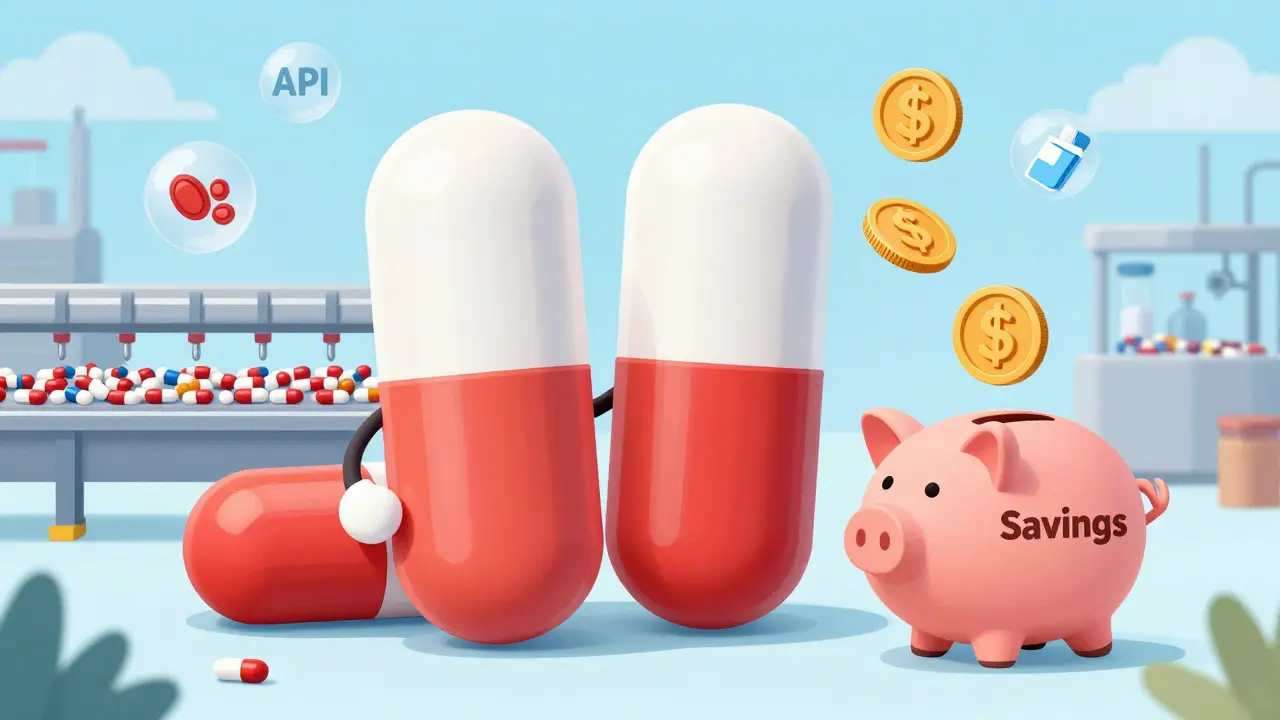
When you pick up a prescription at the pharmacy, you might notice two versions of the same drug: one with a well-known brand name, and another labeled simply with its chemical name. The generic version often costs a fraction of the price. But why? It’s not because it’s made with cheaper ingredients or lower quality. The difference comes down to one thing: manufacturing cost analysis. Generic drugs aren’t cheaper because they’re inferior - they’re cheaper because their entire production model is built for efficiency, scale, and minimal overhead.
How Generic Drugs Skip the Biggest Expenses
Branded drugs take over a decade and more than $2.6 billion to develop. That money goes into years of lab research, clinical trials on thousands of patients, regulatory filings, and marketing campaigns to convince doctors and patients the drug is worth the price. Generic manufacturers don’t do any of that. Instead, they rely on the data already proven by the original drugmaker. The 1984 Hatch-Waxman Act in the U.S. created a shortcut: if a generic drug is bioequivalent - meaning it works the same way in the body - it doesn’t need to repeat expensive clinical trials. That alone cuts development costs from billions to just $2-5 million.This isn’t a loophole. It’s policy designed to create competition. The result? A generic version of a drug can hit the market within 36 months after the brand’s patent expires, and at a fraction of the price.
What’s Actually in the Cost of a Generic Drug?
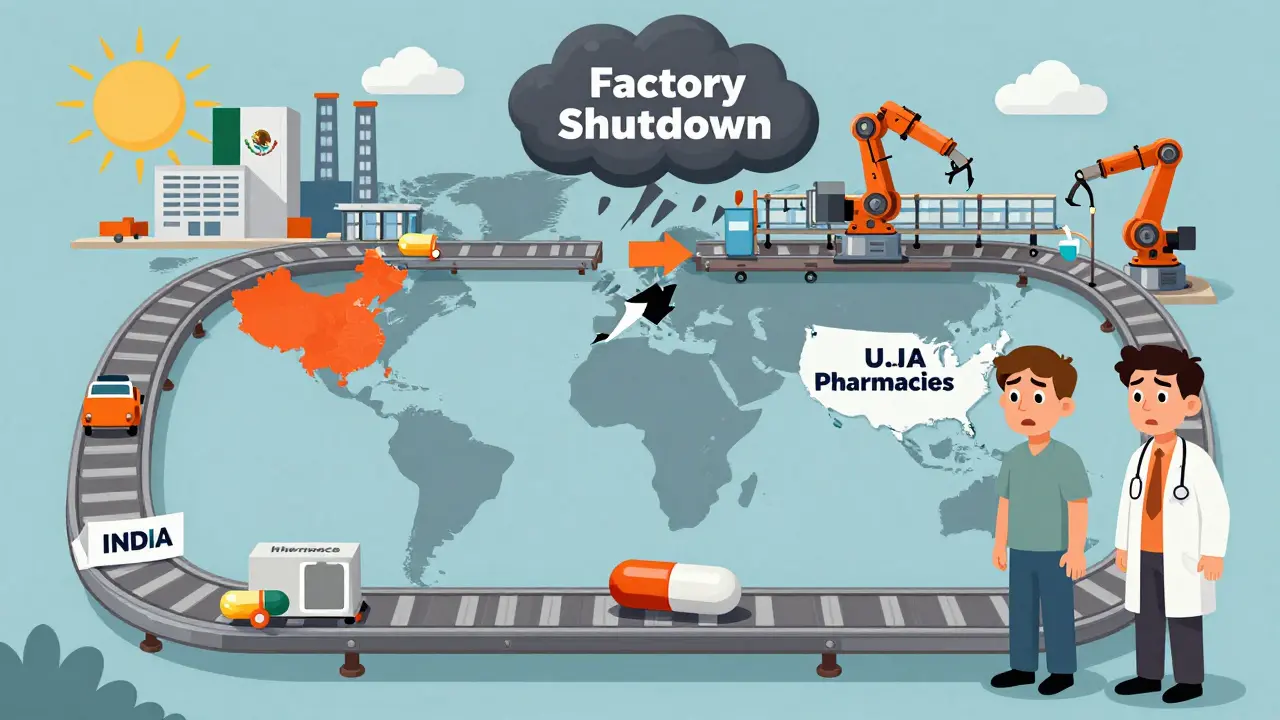
The total cost to make a generic pill breaks down into four clear parts:- Active Pharmaceutical Ingredient (API): This is the actual medicine - the chemical that treats the condition. It makes up the biggest chunk of cost, sometimes over 50% of the total. API prices can swing 20-30% a year based on supply, like when a factory in India or China shuts down for inspections or natural disasters.
- Excipients: These are the non-medicinal ingredients - fillers, binders, coatings - that give the pill its shape, taste, or slow-release properties. They’re cheap, but you need them. A single tablet might contain five or six different excipients.
- Quality Assurance: Every batch must be tested to meet FDA standards. This includes checking purity, potency, and stability. It’s not optional. A single failed test can scrap an entire production run.
- Packaging: Blister packs, bottles, labels, cartons. Even this step adds up when you’re making billions of pills a year.
Here’s the key: unlike branded drugs, generics don’t spend money on advertising, sales reps, or patient support programs. A brand-name company might spend $100 million on marketing a single drug. A generic company spends $1 million - if that.
Scale Is Everything
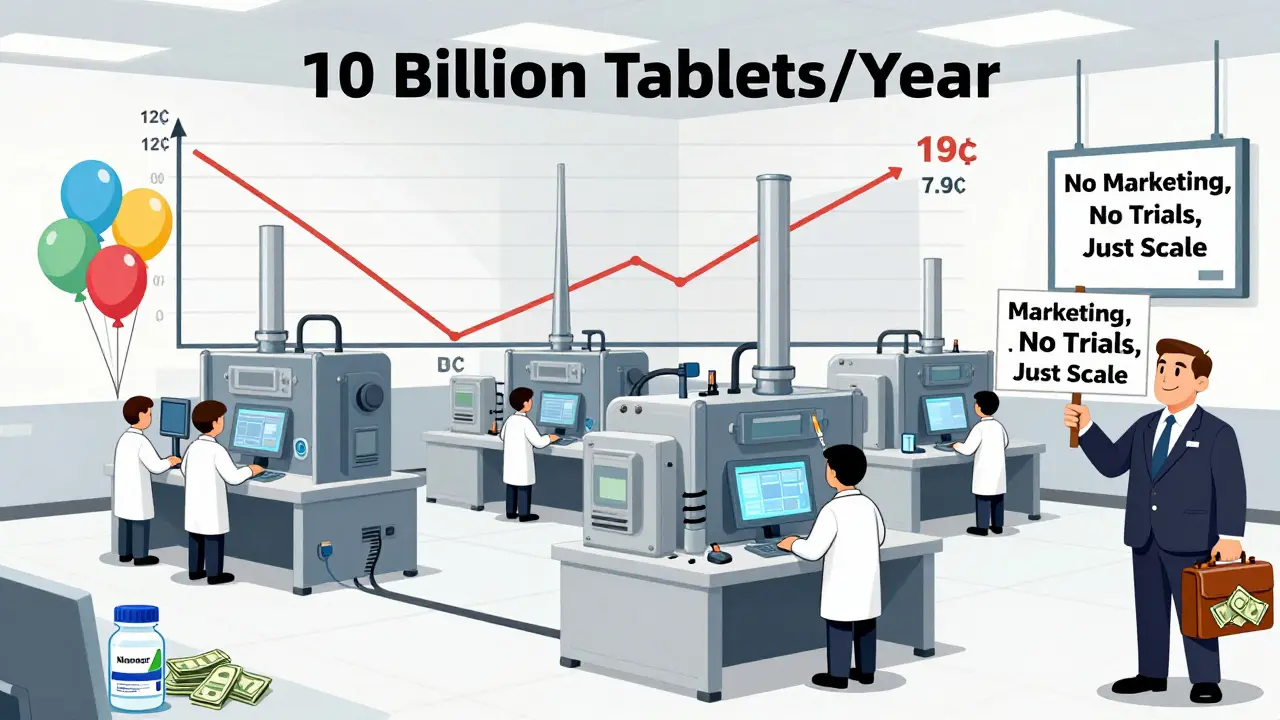
The biggest cost-saver in generic manufacturing? Volume. Every time production doubles, unit costs drop by 18%. That’s not a guess - it’s a measurable trend tracked across 15 major generic manufacturers by the Boston Consulting Group. If you’re making 100 million tablets a year, your cost per pill might be 12 cents. If you ramp up to 200 million, it drops to 9.8 cents. Hit 400 million? It’s 7.9 cents.This effect is even stronger when you focus on one product. If a company makes only one version of a drug - say, 20mg lisinopril - and produces 10 billion tablets a year, the cost per unit can fall by 45% compared to making smaller batches of multiple strengths. That’s why the biggest generic makers, like Teva and Sandoz, focus on high-volume, low-complexity drugs: statins, antibiotics, blood pressure meds.
There’s a limit, though. Once production exceeds 30-40 billion oral solid dosage units, costs start creeping back up. Why? Equipment wear, labor bottlenecks, inventory overhang. The sweet spot is somewhere between 10 and 30 billion units per year per product.
Why Generics Still Cost Less Than Branded Drugs - Even After Competition
You’d think that as more generic companies enter the market, prices would drop to zero. But they don’t. Here’s why:- With just one or two generic competitors, prices are about 54% lower than the brand.
- With six or more generic manufacturers, prices fall over 95% below the original brand price.
Take cetirizine (Zyrtec). When it went generic, the brand cost $3.50 per pill. Today, a 30-pill bottle of generic cetirizine costs $2. That’s a 99% price drop. But the manufacturer still makes a profit - because their cost to produce it is less than 5 cents per pill.
The FDA’s Average Manufacturer Price (AMP) data shows that, on average, generics sell for 40% of the brand price. That means a 60% reduction. But in reality, the cost to produce the generic is often under 10% of the brand’s price. The rest is distribution, pharmacy markup, and insurance processing.
The Hidden Trade-Offs
There’s a dark side to this efficiency. When every penny counts, there’s little room for error - or for resilience.Drug shortages in the U.S. hit 350 in 2022. Many were caused by a single factory failure. Because generics are made by a handful of suppliers - often overseas - a hurricane, a regulatory inspection, or a labor strike can shut down supply for months. The industry has no buffer. Unlike branded drugs, which have multiple production lines and stockpiles, generics operate on just-in-time manufacturing. One broken machine = no supply.
Also, some complex drugs - like inhalers, injectables, or topical creams - are harder to copy. The manufacturing process isn’t just about chemistry. It’s about precision engineering. That’s why there are fewer generic versions of these drugs, and they cost more.
What’s Changing Now?
The rules are shifting. The FDA’s 2023 Generic Drug User Fee Amendments (GDUFA III) are pushing to cut approval times from 40 months to 24. That means more generics will enter the market faster. The Inflation Reduction Act of 2022 lets Medicare negotiate drug prices - and that includes generics. Experts predict a 10-15% further price drop in the next two years.Automation is also changing the game. Continuous manufacturing - where pills are made in one unbroken line instead of batch-by-batch - could cut production costs by 20-25% by 2027. Companies are investing millions to make this happen.
But geopolitical risks loom. Over 80% of active ingredients still come from China and India. If trade tensions rise, or if countries restrict exports, API prices could spike 5-8% overnight. That’s why some manufacturers are building new facilities in Eastern Europe and Mexico.
Generics Are the Silent Heroes of Healthcare
In the U.S., 90% of prescriptions are filled with generics. But they account for only 15.8% of total drug spending. That’s $443 billion saved out of $2.8 trillion in annual drug costs. From 2023 to 2027, generics are projected to save the U.S. healthcare system $1.7 trillion.They’re not glamorous. No one throws a parade for a generic metformin pill. But every time someone chooses the generic, they’re choosing affordability. They’re choosing access. They’re choosing a system that works because it’s built on transparency, scale, and ruthless efficiency.
Manufacturing cost analysis doesn’t just explain why generics are cheaper. It shows how a system designed for competition can deliver life-saving medicine to millions - at a price that doesn’t break the bank.
Why do generic drugs cost so much less than brand-name drugs?
Generic drugs cost less because they don’t repeat the expensive research, clinical trials, and marketing that brand-name drugs require. They only need to prove they work the same way as the original. This cuts development costs from over $2 billion to just $2-5 million. Plus, generic manufacturers focus on high-volume production, which lowers the cost per unit dramatically.
Are generic drugs as safe and effective as brand-name drugs?
Yes. The FDA requires generics to be bioequivalent - meaning they deliver the same amount of active ingredient into the bloodstream at the same rate as the brand. They must meet the same strict standards for purity, strength, and quality. Millions of people take generics every day with the same results as the brand.
Why do some generic drugs still have high prices?
Some generics stay expensive because there’s little competition - often only one or two manufacturers make the drug. Without competition, prices don’t drop. This is common for older drugs, complex formulations like inhalers, or drugs with manufacturing barriers. Once more companies enter the market, prices usually fall sharply.
Do generic manufacturers cut corners on quality?
No. All generic manufacturers must follow the same FDA regulations as brand-name companies. Every batch is tested for potency, purity, and stability. Factories are inspected regularly. The difference isn’t in quality - it’s in cost structure. Generics avoid spending on marketing, patents, and lengthy clinical trials.
Why are there drug shortages with generics?
Many generics are made in just one or two factories, often overseas. If a factory shuts down due to inspections, natural disasters, or supply chain issues, there’s no backup. Unlike brand drugs with multiple production lines, generics operate with little margin for error. This makes them vulnerable to disruptions.
Will generic drug prices keep falling?
Yes - but slowly. As more companies enter the market, prices drop. Automation, continuous manufacturing, and policy changes like Medicare price negotiation will push prices down further. However, rising costs for raw materials (especially active ingredients from Asia) and geopolitical risks may cause short-term spikes.



Jack Havard
Let’s be real - if generics are so cheap and safe, why do hospitals still stock brand-name drugs for critical care? Something’s not adding up. The FDA’s ‘bioequivalent’ standard is a joke. I’ve seen patients react differently to generics. It’s not placebo - it’s manufacturing variance they sweep under the rug.
And don’t get me started on the Indian and Chinese API factories. One inspection shutdown and half the country’s blood pressure meds vanish. This isn’t efficiency - it’s a single point of failure waiting to collapse.
They call it ‘ruthless efficiency.’ I call it a ticking time bomb.
Luke Trouten
The elegance of the generic drug model lies in its humility. It doesn’t seek to invent - it seeks to serve. By eliminating the profit-driven excesses of patent monopolies, it redirects resources toward accessibility rather than advertising.
This isn’t just economics - it’s ethics. We’ve built a system where the value of a life-saving pill is measured not by its origin, but by its impact. The fact that 90% of prescriptions are filled with generics speaks louder than any marketing campaign ever could.
Perhaps the real innovation isn’t in the chemistry - it’s in the decision to prioritize human need over corporate gain.
Gabriella Adams
For anyone who’s ever had to choose between rent and medication - this is why generics matter. I work in community health. Every day, I see people who can’t afford the brand, but can afford the generic. It’s not a theoretical debate - it’s survival.
The 10-15% price drop from Medicare negotiation? That’s not a policy tweak - it’s a lifeline. And automation? That’s the future. Continuous manufacturing means fewer shortages, better consistency, and more stable supply chains.
Yes, there are risks - overseas dependency, single-source factories. But the solution isn’t to scrap generics. It’s to diversify supply, invest in domestic API production, and enforce stricter quality controls - not because we distrust generics, but because we value them too much to let them fail.
Brad Ralph
So we spent $2.6 billion to prove a pill works… then let someone else make it for 5 cents?
Man. Capitalism is weird.
Suzette Smith
Wait - you’re telling me the reason my blood pressure med costs $2 instead of $150 is because someone else did the hard work first? And now we’re just copying it? That’s… kind of beautiful? Like, who gets to be the hero here? The guy who invented it? Or the guy who made it affordable?
I’m conflicted. But mostly impressed.
Autumn Frankart
Let’s not pretend this is about healthcare. This is about control. The FDA, the WHO, the big pharma lobby - they all want you to believe generics are safe. But how many times have you heard about a batch being recalled? How many times did the media even report it?
They’re outsourcing production to countries with lax regulations. The active ingredients? Probably made in a warehouse with no air filtration. The pills? Packaged in a room where workers don’t even wear gloves.
You think you’re saving money? You’re gambling with your health. And they’re laughing all the way to the bank.
Skilken Awe
API cost volatility? Excipients? QA protocols? You’re treating this like a supply chain seminar. Let’s cut through the jargon: generics are cheap because they’re produced in factories with no unionized labor, no environmental oversight, and no accountability. The FDA ‘inspections’? They’re scheduled months in advance. The manufacturers know exactly when to clean up.
It’s not ‘efficiency.’ It’s exploitation dressed up as innovation. And the fact that you’re praising this as a ‘silent hero’ tells me you’ve never had to swallow a generic that didn’t work - because your insurance forced you to.
Ernie Simsek
Bro. I took generic lisinopril for 3 years. Then switched back to brand because my anxiety spiked. No joke. My doctor said ‘it’s the same’ - but my body said otherwise. So now I pay $120/month because my mental health > corporate savings.
Also, why is the FDA pushing continuous manufacturing? Because they know the current system is a dumpster fire. One factory outage = nationwide shortage. We’re one cyberattack away from a national crisis.
Geniuses. 🤡