
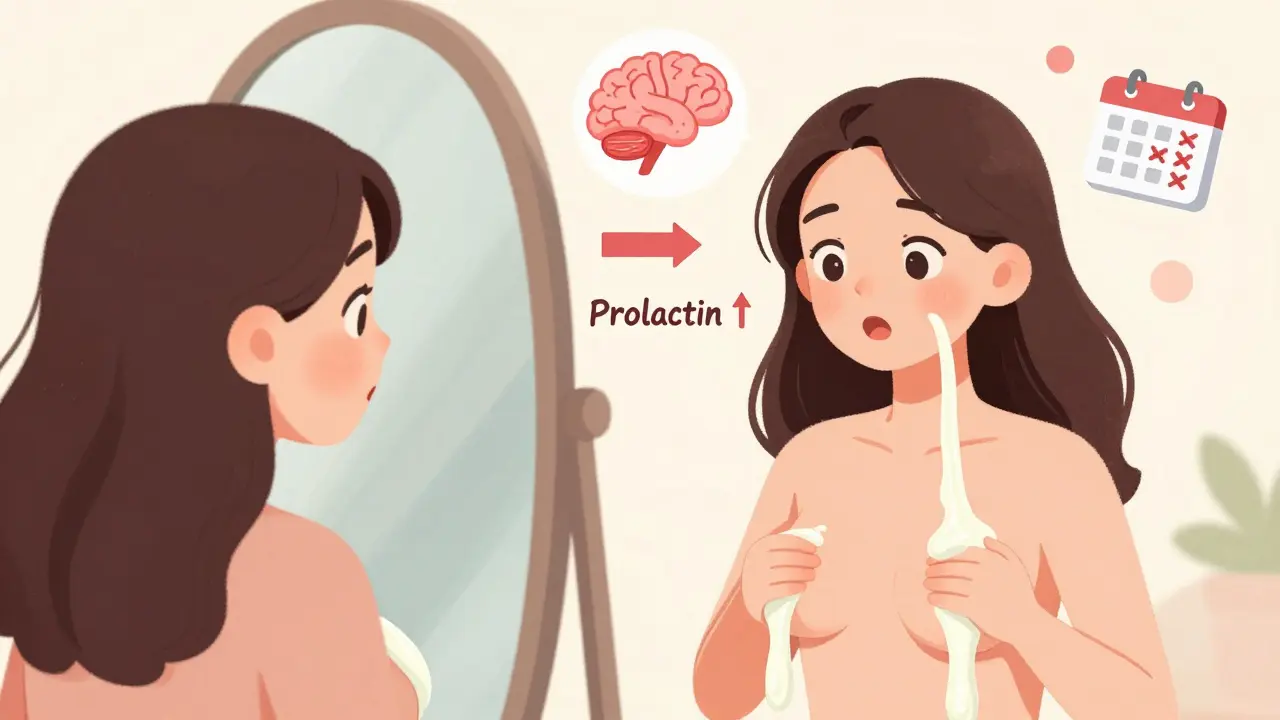
When a woman notices milky discharge from her nipples - but she’s not pregnant or breastfeeding - it’s natural to panic. Is it cancer? Is something seriously wrong? The truth is, this symptom, called galactorrhea, is rarely a sign of cancer. More often, it’s a clue pointing to a simple hormonal imbalance: too much prolactin. And while it sounds rare, about 1 in 5 women experience it at some point in their lives. What most people don’t realize is that galactorrhea doesn’t just affect the breasts. It can stop periods, block fertility, and even mess with sex drive. The good news? In most cases, it’s completely treatable.
What Exactly Is Galactorrhea?
Galactorrhea isn’t a disease. It’s a symptom. It means your body is making milk when it shouldn’t be. The discharge is usually thick, white, and comes from both breasts - though sometimes just one side is affected. Unlike bloody or clear fluid that might signal a tumor, galactorrhea doesn’t hurt. You won’t feel tenderness or lumps. It often leaks on its own, especially when the breasts are touched or squeezed. Some women notice it only when they wake up. Others see it drip during a shower or when changing clothes. The hormone behind this is prolactin. Made in the pituitary gland - a pea-sized organ at the base of your brain - prolactin’s main job is to trigger milk production after childbirth. But when it’s too high, even outside pregnancy, your body gets confused. Normal prolactin levels in non-pregnant women range from 2.8 to 29.2 ng/mL. Once it climbs above 25 ng/mL, you’re in the hyperprolactinemia zone. That’s when galactorrhea typically shows up.Why Does Prolactin Go Too High?
There are over a dozen reasons prolactin spikes. The most common? A tiny, harmless tumor on the pituitary gland called a prolactinoma. These are non-cancerous and affect about 1 in 10,000 people. Microprolactinomas (under 10 mm) are the most frequent - and they respond beautifully to medication. Larger tumors can press on nerves and cause headaches or vision problems, but they’re rare. Other causes are just as common - and easier to fix. Certain medications can push prolactin up. Antidepressants like SSRIs (sertraline, fluoxetine), antipsychotics (risperidone), and even some blood pressure pills (verapamil) can do it. Switching to bupropion, for example, often clears up the discharge within weeks. Thyroid problems are another big player. If your thyroid is underactive (hypothyroidism), your body makes more TRH - a hormone that accidentally stimulates prolactin release. Simple blood tests for TSH can catch this. Kidney failure can also cause buildup of prolactin since your kidneys help clear it from your blood. Stress and even how your blood is drawn can skew results. If you’re anxious during a blood test, or if the nurse has to poke you multiple times, prolactin can jump 10-20 ng/mL. That’s why doctors always repeat the test. And here’s something surprising: about 35% of galactorrhea cases have no clear cause at all - they’re called idiopathic. In these cases, the body just starts making too much prolactin for no obvious reason.How Galactorrhea Leads to Infertility
High prolactin doesn’t just make milk - it shuts down your reproductive system. Prolactin suppresses GnRH, the hormone that tells your brain to release FSH and LH. Without those, your ovaries don’t ovulate. No ovulation means no period. And no period means you can’t get pregnant. Studies show that 80-90% of women with hyperprolactinemia and missed periods will start ovulating again once prolactin levels drop. That’s why treating galactorrhea isn’t just about stopping the discharge - it’s about restoring fertility. One woman on Reddit shared: “My period vanished for 18 months. After three months on cabergoline, it came back. Four months later, I got pregnant naturally.” That’s not rare. It’s standard. Men can be affected too. High prolactin lowers testosterone, leading to low libido, erectile dysfunction, and reduced sperm count. It’s less common, but just as treatable.How Doctors Diagnose It
The first step is simple: a blood test. Your doctor will check your prolactin level, thyroid function (TSH), and kidney function. If prolactin is above 25 ng/mL, they’ll repeat it. If it’s over 100 ng/mL, they’ll order an MRI to look for a pituitary tumor. That’s because tumors above that level are more likely to be large or pressing on nearby structures. They’ll also ask about your meds. Did you start a new antidepressant? Are you taking birth control? Any supplements? Herbal teas like fenugreek or fennel can stimulate milk production. Even nipple stimulation - from sex or tight bras - can trigger discharge in sensitive people. If the discharge looks bloody, clear, or one-sided, they’ll send you for a mammogram or ultrasound. Serosanguinous discharge (pink or bloody) is a red flag - it’s linked to breast cancer in 60% of cases, even though it only makes up 5% of galactorrhea cases.
Treatment: Dopamine Agonists Are the Gold Standard
The first-line treatment for prolactin disorders is dopamine agonists. These drugs mimic dopamine - the brain’s natural prolactin suppressor. Two drugs dominate: cabergoline and bromocriptine. Cabergoline (Dostinex) is the go-to. It’s taken just twice a week - 0.25 to 1 mg. Clinical trials show 83% of patients normalize prolactin within three months. Side effects? Mild nausea in 10-15% of users. Most people tolerate it well. And because it’s long-acting, you don’t have to remember to take it daily. Bromocriptine works too - but you have to take it every day, 1.25 to 2.5 mg. Nausea hits 25-30% of users. Many report vomiting, dizziness, or low blood pressure. One patient wrote: “I had to take it at bedtime just to survive the first month.” Cost matters too. Cabergoline runs $300-$400 a month. Bromocriptine is $50-$100. But insurance usually covers both. And since cabergoline is more effective and easier to take, most endocrinologists start with it. For prolactinomas under 10 mm, 90% shrink or disappear within six months. Even larger tumors often shrink enough to avoid surgery. That’s why drugs come first - surgery is only for cases that don’t respond or cause vision loss.New Developments on the Horizon
In January 2025, the FDA approved a new extended-release form of cabergoline called Cabergoline ER. It’s taken once a week. Phase 3 trials showed 89% efficacy at six months - slightly better than the standard version. This could be a game-changer for people struggling with adherence. Novartis is testing a brand-new drug: a selective prolactin receptor antagonist. Instead of suppressing prolactin production, it blocks prolactin from binding to breast tissue. If approved by 2027, it could offer relief without affecting dopamine levels - meaning fewer side effects like dizziness or nausea. Clinics are also getting smarter. Mayo Clinic launched integrated endocrine-breast clinics in 2024. Instead of seeing five different specialists over eight weeks, patients get a full workup in one visit. Diagnostic time dropped from 8.2 weeks to 3.5 weeks.What If Nothing Works?
About 15-20% of women have mildly elevated prolactin but no symptoms. They have normal periods, no discharge, and no fertility issues. Treating them is unnecessary. As one expert warns: “Don’t treat the number. Treat the person.” If medication fails or you can’t tolerate it, surgery is an option - but only for large tumors causing vision or neurological problems. Radiation is rarely used today. And for idiopathic cases? About 30% of women see the discharge resolve on its own within a year. Sometimes, all you need is time.
Real Stories, Real Results
One 32-year-old teacher noticed milk leaking from both breasts after starting sertraline for anxiety. She was terrified she had cancer. Blood tests showed prolactin at 48 ng/mL. She switched to bupropion. Within three weeks, the discharge stopped. Her period returned two months later. She didn’t need pills. Another woman, 29, had no periods for two years. Her prolactin was 120 ng/mL. MRI showed a 6 mm prolactinoma. She started cabergoline 0.5 mg twice a week. At three months, her levels were normal. At five months, she ovulated. At seven months, she was pregnant. These aren’t outliers. They’re the norm.When to See a Doctor
You don’t need to wait until you’re desperate. See a doctor if:- You have milky discharge and aren’t pregnant or nursing
- Your periods have stopped or become irregular
- You’re trying to get pregnant and can’t
- You have headaches, vision changes, or low libido
What to Expect Long-Term
Most people stay on medication for 1-2 years. After that, doctors slowly lower the dose to see if the body can stay balanced on its own. Some need lifelong treatment, especially if they had a large tumor. But many - especially those with medication-induced or idiopathic cases - can stop completely. Fertility returns quickly. Periods usually come back in 1-3 months after prolactin normalizes. Pregnancy rates after treatment match those of women without the condition. The biggest risk? Not treating it. Left alone, prolactinomas can grow. Infertility can become permanent. And the emotional toll of unexplained discharge - the shame, the fear - can be heavier than the physical symptoms.Final Thoughts
Galactorrhea isn’t scary. It’s a signal. Your body is telling you something’s off with your hormones. And the fix? Usually simple. Blood tests. A pill. A switch in meds. Time. You don’t need surgery. You don’t need to live with it. And you don’t need to feel alone. Over 1.5 million people in the U.S. deal with this every year. Most of them go on to live normal, fertile, healthy lives. The key is acting early. Don’t ignore the discharge. Don’t assume it’s nothing. See your doctor. Get tested. Treat the cause - not just the symptom.Can galactorrhea cause breast cancer?
No, galactorrhea itself does not cause breast cancer. However, milky discharge is different from bloody, clear, or one-sided discharge, which can be a sign of cancer. If your discharge is not milky or only comes from one breast, your doctor will likely order a mammogram or ultrasound to rule out tumors. About 60% of cancer-related discharges are bloody or serosanguinous - not milky.
Can I get pregnant with high prolactin?
It’s unlikely without treatment. High prolactin stops ovulation, which means you can’t get pregnant. But once prolactin levels are lowered with medication - usually within 1-3 months - ovulation returns in 80-90% of women. Many conceive naturally within 4-6 months of starting treatment.
Is cabergoline safe for long-term use?
Yes, at standard doses (under 2 mg/day), cabergoline is very safe for long-term use. The risk of heart valve problems only appears at doses over 2 mg/day for more than a year - far higher than what’s used for prolactin disorders. Most patients take 0.5-1 mg twice a week. Side effects like nausea are mild and usually fade after a few weeks.
How long does it take for prolactin levels to drop?
Prolactin levels usually start falling within days of starting cabergoline or bromocriptine. Most people see normal levels within 3 months. Discharge often stops in 2-6 weeks. For pituitary tumors, shrinkage takes longer - typically 4-6 months.
Can stress cause galactorrhea?
Stress doesn’t directly cause galactorrhea, but it can temporarily raise prolactin levels by 10-20 ng/mL during a blood draw. That’s why doctors repeat the test. Chronic stress may indirectly affect hormones, but it’s rarely the sole cause of persistent discharge. If your levels stay high, there’s likely another underlying reason.
Will my periods come back after treatment?
Yes, in most cases. Once prolactin drops to normal, your body restarts ovulation. Periods usually return within 1-3 months. If they don’t, your doctor may check for other causes like PCOS or thyroid issues. But for hyperprolactinemia, period restoration is the rule, not the exception.







Christina Widodo
I had no idea galactorrhea was so common. I thought it was some rare cancer sign. My sister had it after starting Zoloft and switched to Wellbutrin-discharge stopped in 3 weeks. No pills, no drama. Just a med swap.
Alice Elanora Shepherd
It's crucial to remember that prolactin levels fluctuate-especially with stress or improper blood-draw technique. I've seen patients with levels around 35 ng/mL who were panic-stricken, only to find normal levels on repeat testing. Always confirm before jumping to MRI or medication. Treat the person, not the number.
Cassie Widders
My cousin had this. Didn't even know what it was. Thought she was dying. Took her six months to get a doctor who actually listened. Finally got cabergoline. Periods came back. Got pregnant. Life changed.
Darryl Perry
Cabergoline is expensive. Insurance doesn't always cover it. Bromocriptine is cheaper but brutal. Why isn't there a generic extended release yet? Pharma is milking this.
Katherine Carlock
I’m so glad this post exists. I’ve seen so many women told it’s 'just stress' or 'you’re imagining it.' It’s not. It’s real. And it’s treatable. Stop dismissing it. Get tested. You deserve to feel normal again.
Rinky Tandon
Why do Western doctors always reach for drugs first? Why not try yoga? Ayurveda? Fasting? In India we’ve been balancing hormones for centuries without pills. Cabergoline? That’s just suppressing symptoms. You’re ignoring root causes!
Ben Kono
My ex took bromocriptine and would vomit every morning. She quit after two weeks. Then she got pregnant anyway. Turns out her prolactin was normal. All that stress for nothing.
Konika Choudhury
This is why India needs better healthcare. In the US they test prolactin and fix it in weeks. In my village my aunt bled for years and no one knew why. Now she's 50 and still has no periods. This is a first world problem.
Windie Wilson
So let me get this straight. You’re telling me a woman can leak milk from her boobs, miss her period, and then take a pill twice a week and boom-baby on the way? Sounds like a miracle. Or a Netflix rom-com. Either way, I’m taking notes.
Daniel Pate
The real issue isn't the drug-it's the diagnostic delay. Why does it take 8 months on average for women to get diagnosed? Why aren't gynecologists trained to screen for this? It's not rare. It's overlooked.
Amanda Eichstaedt
I’m a nurse in Texas. I’ve seen this too many times. A woman comes in terrified, clutching her shirt like it’s stained with blood. We run the labs, find prolactin at 60. She’s in tears. We start cabergoline. Three months later she’s holding her newborn. That’s why I love endocrinology. It’s not magic-it’s science.
Jose Mecanico
I had idiopathic galactorrhea. No tumor. No meds. Just weird hormone glitch. Took 14 months to resolve on its own. I didn’t even tell anyone. Just wore dark shirts. But I’m glad someone wrote this-helps others feel less alone.
Audu ikhlas
Why do Americans always need a pill? In Nigeria we use ginger tea and prayer. My cousin stopped leaking milk after 3 weeks of fasting and reading the Quran. No doctor. No drugs. Just faith and discipline.
Sonal Guha
The post is accurate but oversimplified. Prolactin isn't the only factor. Estrogen dominance, cortisol dysregulation, and leptin resistance all interact. You're reducing a complex endocrine network to a single hormone. That's lazy medicine.
Prachi Chauhan
I used to think my body was broken. I was 28, no kids, milk coming out, no period. Felt like a monster. Then I found this. I took cabergoline. One day, I woke up and it was gone. Two months later, I got my period. Six months later, I was pregnant. It’s not magic. It’s biology. And it’s fixable. You’re not broken. You’re just out of balance.