
Drug Interaction Checker
This tool checks for the dangerous interaction between isotretinoin and tetracycline-class antibiotics that can lead to permanent vision loss due to pseudotumor cerebri.
Select the medications you're currently taking to see if they create a dangerous combination.
Please select your medications to check for dangerous interactions.
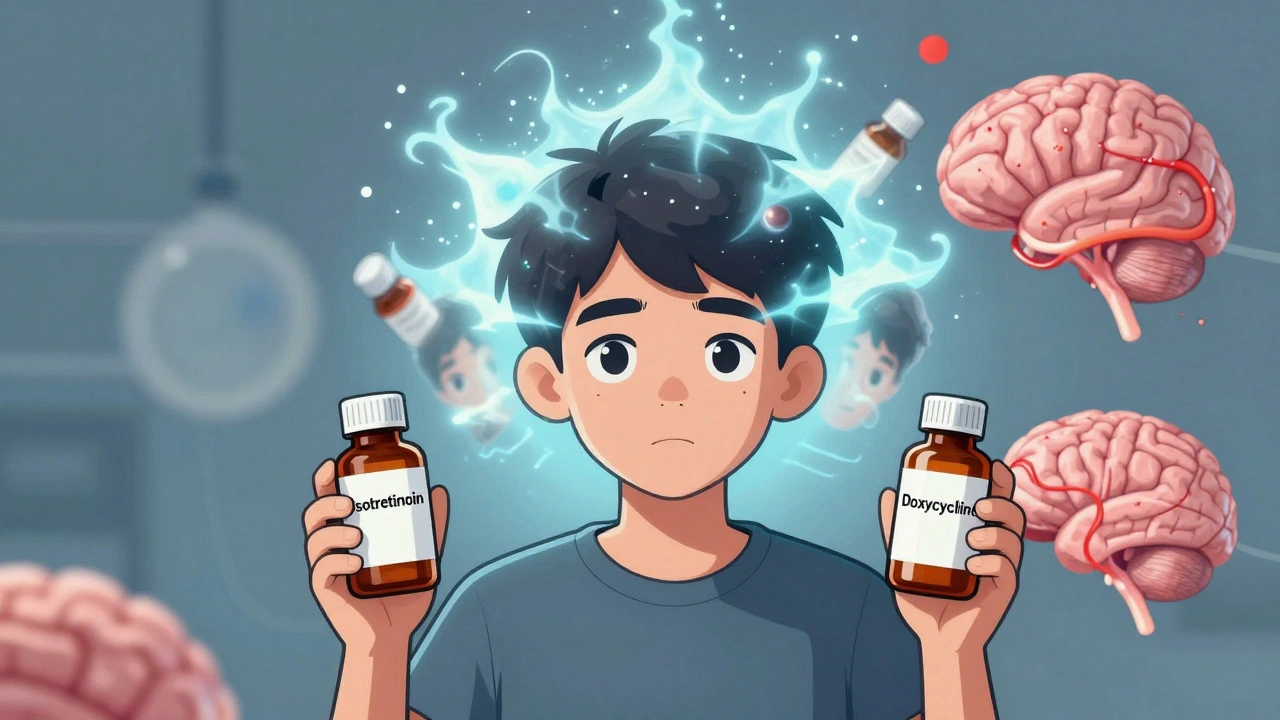
Two common acne treatments - tetracyclines like doxycycline and isotretinoin (brand names like Claravis or Amnesteem) - are safe on their own. But together? They can trigger a rare but devastating condition called pseudotumor cerebri, which mimics a brain tumor and can steal your vision before you even realize something’s wrong.
What Is Pseudotumor Cerebri?
Pseudotumor cerebri, also known as idiopathic intracranial hypertension, means your brain is under too much pressure - but there’s no tumor. No cancer. No infection. Just fluid building up inside your skull, squeezing your optic nerves and causing intense headaches, ringing in your ears, blurred vision, and sometimes permanent blindness.
This isn’t a theoretical risk. It’s happened to real people. A 16-year-old girl in 2018 lost part of her vision after taking doxycycline and isotretinoin together for just 18 days. Another patient on Reddit described seeing flashes of light and double vision after 10 days of the combo. Both needed emergency spinal taps to drain fluid and save their sight.
Why This Combination Is So Dangerous
Neither drug alone is a big threat. Isotretinoin alone carries a risk of pseudotumor cerebri in about 1 out of every 10,000 users. Tetracyclines? About 1 in 1,000. But when you put them together, the risk doesn’t just add up - it multiplies.
Doctors don’t fully understand why, but research points to both drugs messing with how your brain handles fluid. Isotretinoin changes how your body processes vitamin A, which affects fluid pressure. Tetracyclines, especially doxycycline and minocycline, slip easily into the brain and may trigger inflammation in the cells that control cerebrospinal fluid. A 2023 study found the combo spikes a protein called aquaporin-4 in brain cells - the same protein involved in fluid buildup. That’s likely why the risk is worse than either drug alone.
Who’s at Highest Risk?
Teenagers. Young women. People with obesity. These groups already have a higher baseline risk for pseudotumor cerebri. But when you add isotretinoin and a tetracycline on top? The numbers get scary.
A 2019 study looked at over 1,200 acne patients on isotretinoin. Nearly 4% were also prescribed a tetracycline within 30 days. The highest rate? Teens aged 12 to 17 - almost 5% got both. That’s not a fluke. It’s a pattern. And it’s happening because many doctors still don’t realize how quickly this interaction can turn deadly.
What Tetracyclines Are Dangerous?
It’s not just one drug. All tetracycline-class antibiotics carry this risk:
- Tetracycline
- Doxycycline
- Minocycline
- Sarecycline
Some doctors think doxycycline is “safer” because it’s often used for acne. It’s not. All of them cross the blood-brain barrier. All of them can trigger this reaction. There’s no safe choice in this class when isotretinoin is involved.
What About Other Acne Treatments?
Isotretinoin is often paired with topical treatments like retinoids or benzoyl peroxide. Those are fine. They don’t raise brain pressure. Even oral antibiotics like azithromycin or erythromycin don’t carry this risk.
There’s a better alternative: dapsone gel. It’s an anti-inflammatory that works for acne without touching your brain’s fluid balance. A 2021 study confirmed it doesn’t increase intracranial pressure. And prescriptions for dapsone have jumped 34% since 2018 as dermatologists shift away from antibiotics.
How Doctors Are Trying to Stop This
The FDA warned about this interaction in 1998. The American Academy of Dermatology said “avoid at all costs” in 2022. Yet, it still happens.
Why? Because prescriptions are still being written. Some doctors assume a few days of overlap won’t hurt. But experts say: there’s no safe window. The moment you take both, the risk starts.
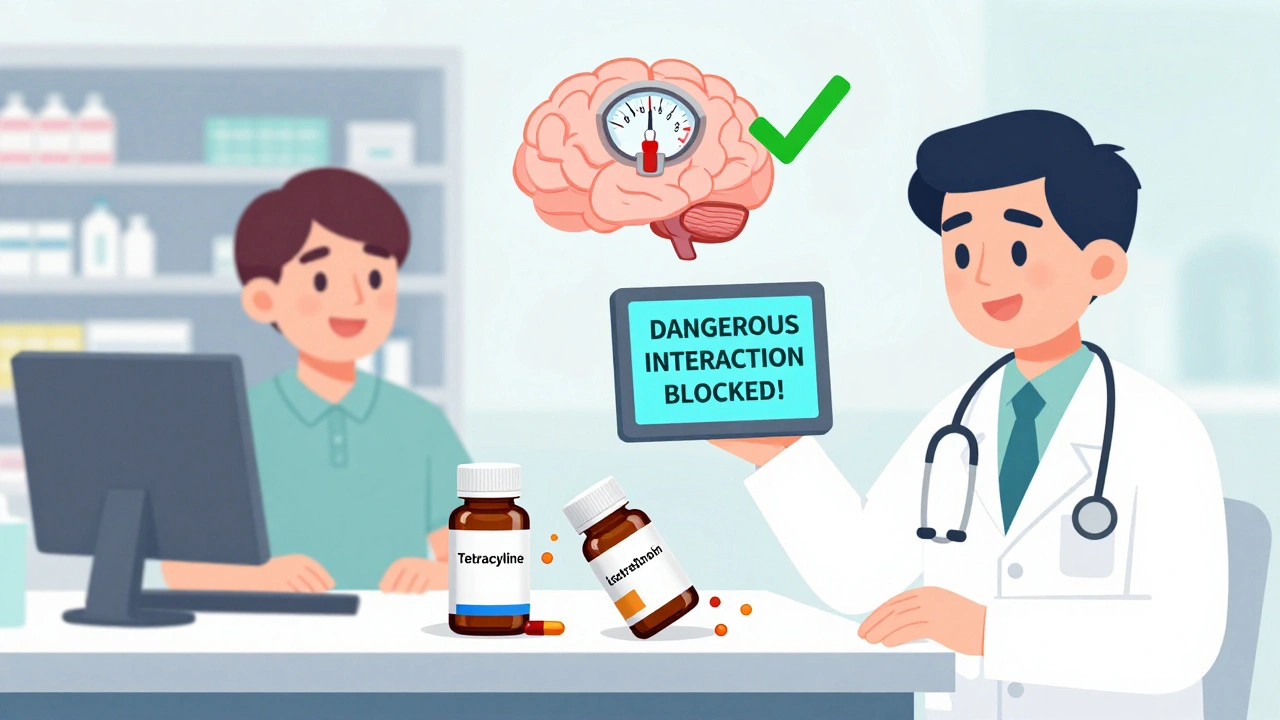
Now, many clinics use electronic alerts. Systems like Epic and Cerner can block a pharmacist from filling both drugs at once. In places with these alerts, co-prescribing dropped from 3.7% to just 0.4%. One dermatologist’s practice had zero cases after installing the alert - compared to two cases in the five years before.

What Should You Do If You’re on One of These Drugs?
If you’re taking isotretinoin, don’t start a tetracycline. Ever.
If you’re on a tetracycline and your doctor wants to switch you to isotretinoin, wait at least a week after your last dose. Some clinics recommend two weeks. It’s not about the drug being “cleared” - it’s about giving your brain time to reset its fluid balance.
If you’re already on both - stop the tetracycline immediately. Call your doctor. Don’t wait for symptoms. But if you get:
- Severe, constant headaches (especially worse in the morning or when lying down)
- Blurred or double vision
- Ringing in your ears that pulses with your heartbeat
- Nausea or vomiting with no other cause
Go to the ER. Get a brain MRI and a lumbar puncture. Early action can save your vision.
This Isn’t Just a Dermatology Issue
This is a systemic failure. Antibiotics are overused for acne. Isotretinoin is underused because people fear side effects. But the real danger isn’t dry skin or mood changes - it’s this hidden, silent killer hiding in plain sight.
The market is shifting. Tetracycline prescriptions for acne have dropped 27% since 2010. Isotretinoin use is up 18% annually. More dermatologists are choosing monotherapy. More pharmacies are blocking the combo. But it’s not enough.
Patients still get prescribed both. Parents still don’t know. Teens still assume “both are for acne, so it’s fine.”
Final Word: Don’t Risk It
You wouldn’t mix bleach and ammonia. You wouldn’t drive with a flat tire. And you shouldn’t mix isotretinoin and tetracyclines.
This isn’t a “maybe.” It’s a documented, preventable disaster. Thousands of acne patients are treated safely every day. But every time someone gets both drugs, they’re playing Russian roulette with their eyesight.
There’s no benefit. There’s no safe dose. There’s no exception.
Just say no. And make sure your doctor knows why.
Can I take doxycycline and isotretinoin together if I stop one after a few days?
No. There is no safe period of overlap. The risk of pseudotumor cerebri begins immediately when both drugs are in your system. Even a few days of concurrent use has led to permanent vision loss. Experts recommend waiting at least one week - and preferably two - after stopping a tetracycline before starting isotretinoin.
Is minocycline safer than doxycycline when combined with isotretinoin?
No. All tetracycline-class antibiotics - including minocycline, doxycycline, tetracycline, and sarecycline - carry the same risk. Minocycline crosses the blood-brain barrier even more easily than doxycycline, and both are linked to cases of pseudotumor cerebri. There is no safe option in this drug class when used with isotretinoin.
What are the early warning signs of pseudotumor cerebri?
The earliest signs include severe headaches - often worse in the morning or when lying down - ringing in the ears that matches your heartbeat (pulsatile tinnitus), and brief episodes of blurred or double vision. Other symptoms include nausea, vomiting, and seeing light flashes. These symptoms can develop within days of starting both drugs. If you experience any of these, seek emergency care immediately.
Are there safer antibiotics for acne if I can’t take isotretinoin?
Yes. Azithromycin and erythromycin are macrolide antibiotics that do not carry the same risk of pseudotumor cerebri. For inflammatory acne, topical dapsone gel is also an effective non-antibiotic alternative. Both options avoid the dangerous interaction with isotretinoin and are recommended by dermatology guidelines as safer choices.
Can this interaction happen with over-the-counter tetracycline products?
Tetracycline-class antibiotics are prescription-only in the U.S. and most countries. There are no FDA-approved over-the-counter tetracyclines. However, some online sellers or foreign sources may illegally sell them. Never take antibiotics without a prescription, especially if you’re using isotretinoin. The risk remains the same regardless of where the drug comes from.
How do I know if my doctor is aware of this risk?
Ask directly: “Is it safe to take this antibiotic while on isotretinoin?” If they hesitate, say, “I read that combining these can cause permanent vision loss - is that true?” Board-certified dermatologists are trained on this interaction. If your provider dismisses your concern or says it’s “rare,” seek a second opinion. This is not a controversial topic in dermatology - it’s a hard rule.







Iris Carmen
bro i took doxycycline for 3 days and then started accutane a week later and i’m fine lol maybe it’s just hype
Suzanne Johnston
This is one of those silent public health failures where the system assumes patients are informed, but no one actually tells them. We treat acne like a cosmetic issue, not a medical one - and then wonder why people are blind. The real tragedy isn’t the drugs. It’s that we’ve normalized risk because it’s inconvenient to change prescribing habits.
Imagine if this was a new cancer drug combo. There’d be TV ads, congressional hearings, mandatory counseling. But because it’s acne? We shrug and say ‘it’s rare.’ Rare doesn’t mean harmless. It means nobody’s paying attention.
Graham Abbas
I remember reading about a girl who lost her vision after this combo - she was 15, just wanted to stop being bullied for her skin. Her mom didn’t know the drugs could do this. The doctor didn’t warn her. Now she can’t drive. Can’t read. Can’t see her own face in the mirror. And the worst part? It was preventable. Not just ‘maybe’ preventable. 100% preventable.
Doctors aren’t evil. They’re overwhelmed. But when you’re writing a script for a kid who’s crying in your office because they’re ‘ugly,’ you don’t just hand out pills. You pause. You ask. You think. And if you don’t know? You look it up. Before you click ‘send.’
Chris Marel
This is so important. I’m from Nigeria, and here, antibiotics are sold like candy - no prescription needed. I’ve seen teens on Accutane buying doxycycline from street vendors because ‘it clears acne faster.’ No one tells them. No one warns them. This isn’t just an American problem. It’s global. Someone needs to make a simple poster in clinics: ‘DO NOT MIX THESE.’ In 5 languages. In pictures. Because words don’t always reach.
ian septian
Stop both. Call your derm. Don’t wait.
George Taylor
...and yet, the pharmaceutical companies still market these drugs as ‘safe,’ ‘effective,’ ‘first-line’... while burying the real risks in 12-point footnotes no one reads. And the FDA? They issued a warning in 1998... and then did NOTHING. No black box. No mandatory counseling. No pharmacy alerts until 2020. That’s not negligence. That’s profit-driven complacency.
They don’t care about your vision. They care about your prescription refill rate. And if you go blind? Well, there’s a lawsuit. And a settlement. And a new ad campaign for ‘safe’ alternatives. It’s a business model.
Tiffany Sowby
oh my god i was on both for 2 weeks and i had the worst headaches i’ve ever had… i thought i was just stressed. now i’m scared to even look at my skin in the mirror. what if i’m already blind inside?
Stacy Tolbert
My cousin lost her sight from this. She was 19. She loved drawing. Now she can’t see the colors. The doctors said it was ‘idiopathic’ - like it just happened. But it didn’t. It was the combo. And her dermatologist didn’t even know. I’m screaming into the void now. Please. Just ask your doctor. Don’t assume.
Andrea Petrov
Let’s be real - this isn’t about medical ethics. It’s about control. Big Pharma wants you on long-term antibiotics because they’re profitable. Isotretinoin? It’s a one-time cure. They hate it. So they let doctors keep prescribing the combo - because if you’re on doxycycline for 6 months, you’re not getting Accutane. And if you’re not on Accutane, they keep selling you more antibiotics. This is systemic poisoning disguised as treatment. And the ‘warning’? A footnote. Because if they made it bold, people would stop buying.
Who profits when you go blind? Not the dermatologist. Not the pharmacist. The stockholders. And they’re still laughing.
Steve Sullivan
just got my first Accutane script today and my doc already blocked the tetracycline combo in the system 🙌 thank god for tech. also, if you're on doxy and your skin flares up, don't panic - try dapsone gel. it's not sexy, but it doesn't make you go blind. i'm so glad this info is out there. 🙏👁️
Carina M
It is both lamentable and profoundly disconcerting that such a preventable iatrogenic catastrophe continues to occur within the contemporary medical ecosystem. The concomitant administration of tetracycline-class antibiotics with isotretinoin constitutes a flagrant deviation from established clinical guidelines, and its persistence reflects a systemic dereliction of duty on the part of prescribers, institutions, and regulatory bodies alike. One must question the integrity of a profession that permits such negligence under the guise of therapeutic expediency.
Steve Sullivan
carina, you’re right - but your tone makes people tune out. i get it. this is scary. but screaming in latin won’t save a teen in rural texas who thinks ‘antibiotics are just pills.’ we need plain talk. posters. memes. tiktoks. not a PhD thesis.