
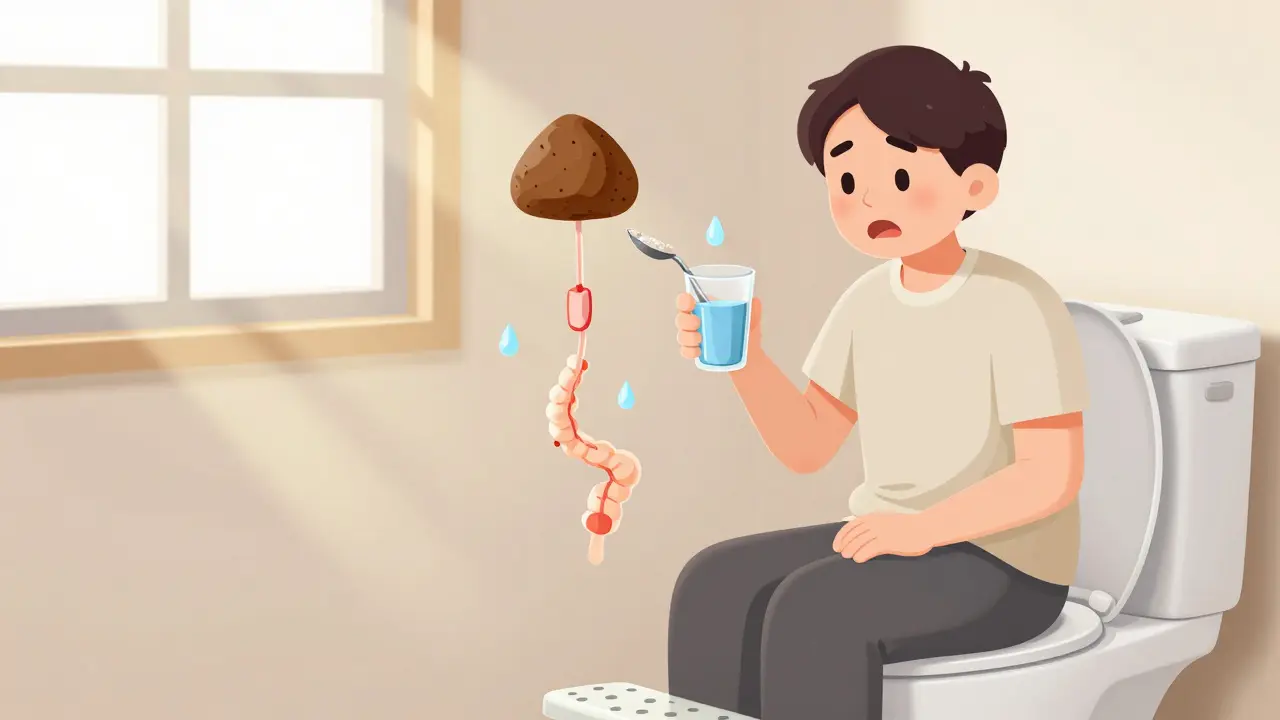
Constipation isn’t just an inconvenience-it’s a common, often misunderstood condition that affects one in three people who visit a doctor for digestive issues. If you’re struggling to go more than three times a week, dealing with hard stools, or feeling like you haven’t fully emptied your bowels, you’re not alone. But what’s really going on? And more importantly, how do you fix it without relying on pills forever?
What’s Actually Happening in Your Body?
Constipation happens when stool moves too slowly through your colon. As it sits there, your body pulls out more and more water, turning soft waste into dry, stubborn lumps. Normal transit time is 24 to 72 hours. When it takes longer than that-especially over 72 hours-you’re dealing with slow transit constipation. But it’s not always about speed. Some people have normal transit times but still feel blocked because their pelvic floor muscles don’t relax properly during a bowel movement. This is called a defecatory disorder, and it’s behind 20 to 50% of chronic cases.It’s easy to blame diet, but the causes run deeper. Medications play a huge role. Opioids cause constipation in up to 95% of users. Calcium channel blockers like verapamil and tricyclic antidepressants are common culprits too. Medical conditions like diabetes (affecting nearly 60% of patients), hypothyroidism, Parkinson’s disease, and spinal cord injuries are strongly linked. Even something as simple as not drinking enough water-less than 1.5 liters a day-can trigger it.
Why Laxatives Often Don’t Solve the Problem
Most people reach for laxatives first. But not all are created equal-and many make things worse over time.Bulk-forming laxatives like psyllium (Metamucil) or methylcellulose (Citrucel) work by soaking up water and swelling into a gel that pushes stool along. They’re great for normal transit constipation, but only if you drink enough water. Without it, they can actually cause blockages. Studies show 50 to 60% of users benefit, but 30 to 40% get bloated if they increase fiber too fast.
Osmotic laxatives like polyethylene glycol (PEG 3350) pull water into the colon, softening stool. This is the first-line recommendation from doctors because it’s effective in 65 to 75% of cases with minimal side effects. A single daily dose of 17 grams works for most people. Lactulose and magnesium hydroxide are alternatives, but they can cause cramping or diarrhea.
Stimulant laxatives like senna or bisacodyl force the colon to contract. They work fast-often within 6 to 12 hours-but shouldn’t be used for more than 2 to 3 weeks. Long-term use can damage the colon’s nerves, leading to a condition called cathartic colon, where the colon loses its ability to move stool on its own. The American Gastroenterological Association warns against using these for more than three months.
Stool softeners like docusate sodium? They’re largely ineffective. Studies show they’re only 10 to 15% better than a placebo. Don’t waste your money on them alone.
For stubborn cases, newer prescription drugs like linaclotide (Linzess), lubiprostone (Amitiza), and plecanatide (Trulance) help by increasing fluid secretion in the intestines. They’re not cheap-some cost over $500 a month-but they work for 40 to 60% of patients who haven’t responded to anything else.
The Real Fix: Lifestyle Changes That Actually Work
Medication can help, but lasting relief comes from changing how you live.Start with fiber. The average American eats 15 grams of fiber a day. The target is 25 to 30 grams. Don’t jump straight to 30 grams-do it slowly. Add 5 grams every 3 to 4 days. Too fast, and you’ll bloat. Focus on soluble fiber: oats, beans, apples, flaxseeds, and chia. These absorb water and soften stool better than insoluble fiber like bran.
Drink more water. For every 5 grams of fiber you add, drink an extra 250 to 500 milliliters of water. If you’re taking 25 grams of psyllium, you need at least 2.5 liters of water daily. Without it, fiber just hardens and makes constipation worse.
Train your body to go. Sit on the toilet for 10 to 15 minutes after breakfast. That’s when your gastrocolic reflex is strongest-your stomach signals your colon to move. Don’t rush. Don’t strain. Just sit. Use a footstool to elevate your feet. This puts your hips at a 35-degree angle, mimicking the squat position. Studies show this reduces straining by 60%.
Movement matters. Even a 20-minute walk after meals helps stimulate bowel contractions. Sitting all day slows everything down. If you have a desk job, set a timer to stand up and walk every hour.

When You Need More Than Diet and Water
If lifestyle changes don’t help after 4 to 6 weeks, it’s time to dig deeper.Biofeedback therapy is a game-changer for people with pelvic floor dysfunction. It uses sensors to show you how your muscles are working during a bowel movement. With 6 to 8 weekly sessions, 70 to 80% of patients learn to relax the right muscles and push effectively. It’s not magic-it’s retraining. But it takes time and commitment.
Testing is key. If you’ve tried everything and still struggle, ask for a colonic transit study or anorectal manometry. These tests show whether your colon is moving slowly or if your pelvic floor is the problem. Most primary care doctors won’t order them, but a gastroenterologist should.
Watch for alarm symptoms. If you’ve lost weight without trying, see blood in your stool, or your bowel habits changed suddenly and lasted more than 6 weeks, get checked. These could signal something serious like colon cancer or a bowel obstruction.
What Doesn’t Work (And Why)
There’s a lot of noise out there. Here’s what science says doesn’t help:- Drinking coffee every morning won’t cure chronic constipation-even though it may give you a temporary boost.
- Prunes are helpful, but you’d need to eat 6 to 8 a day to match the effect of a single dose of PEG 3350.
- Enemas and suppositories are fine for occasional relief but not for daily use. They can irritate the rectum and make you dependent.
- Probiotics? Some strains might help, but the evidence is weak. Don’t expect miracles.
And while many people worry about “laxative dependency,” the real issue isn’t the medication-it’s not treating the root cause. If you’re relying on stimulants for months, you’re masking a deeper problem.
Long-Term Success Stories
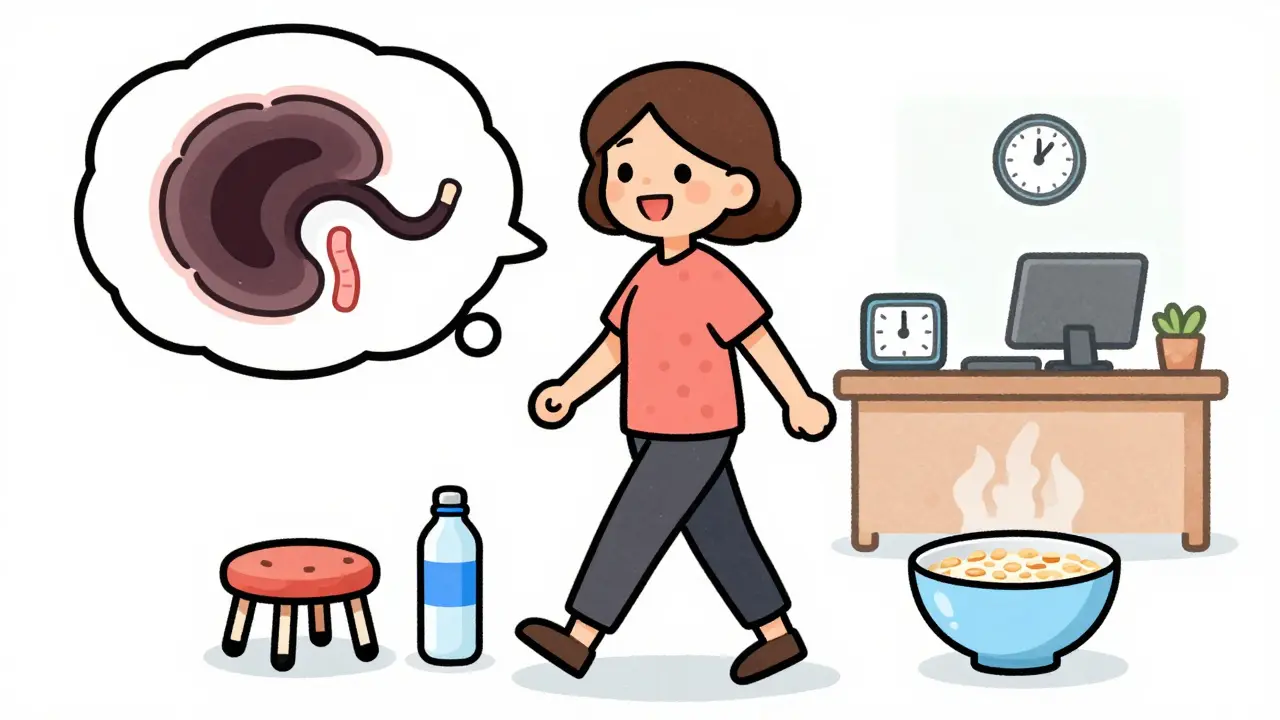
One 52-year-old woman had been constipated for 15 years. She tried senna, magnesium, fiber pills, even enemas. Nothing stuck. Then she started: 25 grams of psyllium husk every morning with 2 liters of water, a 10-minute sit on the toilet after breakfast with her feet on a stool, and a daily walk. Within 8 weeks, she was going regularly without any laxatives. She still drinks coffee, but now it’s just a bonus-not a crutch.Another man with Parkinson’s used to go once every 5 days. His doctor added linaclotide and recommended daily squatting. Within a month, he was going every 2 to 3 days. His quality of life improved dramatically.
These aren’t outliers. They’re examples of what happens when you treat constipation as a system problem-not just a symptom.
What to Do Next
Start here:- Track your bowel movements for a week. How often? How hard? Do you feel incomplete?
- Drink at least 1.5 liters of water daily. Add 500 mL for every 5 grams of fiber you take.
- Add 5 grams of soluble fiber (like psyllium or oats) to your diet. Do this every 3 to 4 days until you hit 25 grams.
- Sit on the toilet for 10 minutes after breakfast. Use a footstool.
- If no improvement in 4 weeks, talk to your doctor about PEG 3350 or a referral to a specialist.
Constipation isn’t something you just live with. It’s a signal-your body is telling you something’s off. Fix the habits, and the pills become optional.
How do I know if my constipation is serious?
See a doctor if you have unintentional weight loss, rectal bleeding, persistent changes in bowel habits lasting more than 6 weeks, or a family history of colorectal cancer. These are red flags that need evaluation, not just a laxative.
Can constipation cause other health problems?
Yes. Chronic straining can lead to hemorrhoids, anal fissures, or rectal prolapse. In rare cases, severe constipation can cause fecal impaction, where stool hardens and blocks the colon entirely. It can also worsen symptoms of pelvic floor disorders and increase discomfort in people with neurological conditions like Parkinson’s.
Is it safe to take laxatives every day?
Osmotic laxatives like PEG 3350 are safe for daily, long-term use and are often recommended for chronic constipation. Stimulant laxatives like senna should be limited to short-term use (under 3 weeks) because they can damage colon nerves over time. Always pair any laxative with enough water to avoid complications.
Why does constipation get worse with age?
As we age, our muscles-including those in the colon and pelvic floor-lose strength and tone. Slower metabolism, reduced physical activity, and more medications (like painkillers or blood pressure drugs) all contribute. Prevalence jumps from 15% in people aged 20-30 to over 34% in those 60-70.
Can stress cause constipation?
Absolutely. Stress affects the gut-brain axis, which controls digestion. Many people with irritable bowel syndrome with constipation (IBS-C) report flare-ups during stressful periods. Visceral hypersensitivity-where the gut becomes overly sensitive to normal movements-is present in over half of these patients and makes constipation feel worse than it is.
What’s the best fiber supplement for constipation?
Psyllium husk (Metamucil) is the most studied and effective. It’s soluble, gentle, and expands to form a gel that softens stool. Methylcellulose (Citrucel) is another good option, especially if you’re sensitive to psyllium. Avoid wheat bran-it can irritate the gut and doesn’t soften stool as well.
Most people think constipation is just a matter of “eating more fiber.” But it’s more complex than that. It’s about hydration, timing, posture, muscle coordination, and sometimes, medical conditions you didn’t even know were connected. The good news? You don’t need to live with it. With the right approach, relief is possible-and lasting.







Henry Marcus
So let me get this straight-you're telling me the government, Big Pharma, and the fiber-industrial complex are all hiding the TRUTH? Constipation? It's not about fiber or water-it's about the electromagnetic frequencies from 5G towers disrupting your colon's natural resonance! I've been using a copper bracelet and chanting mantras while squatting over a toilet made of quartz crystals-and guess what? I haven't had a bowel movement in 14 days, but my aura is *flawless*. They don't want you to know this.
Chris porto
I think the real issue here isn't the colon. It's the disconnect between how we live and how our bodies evolved. We're meant to move, squat, eat whole foods, and rest. Now we sit, sip processed drinks, and swallow pills to fix what our lifestyle broke. Maybe the answer isn't more science-but less interference. Let the body do what it was designed to do.
William Liu
This is actually some of the clearest, most helpful info I've read on constipation. No fluff. Just facts. Thank you.
Meenakshi Jaiswal
I've helped dozens of clients with chronic constipation, and the #1 mistake? They start with 30g of fiber overnight. Boom-bloating city. Start slow. Psyllium with 2L water, daily squatting posture, and a 10-minute post-breakfast sit. It’s not sexy, but it works. And yes-PEG 3350 is safe long-term. Don't fear it. Use it wisely.
holly Sinclair
I keep thinking about how we’ve medicalized something that’s fundamentally a behavioral and environmental issue. We’ve turned a natural bodily function into a pathology requiring pharmaceutical intervention, when in reality, it’s often just our modern lives-sedentary, dehydrated, overprocessed, emotionally stressed-that have dysregulated our physiology. The colon doesn’t care about your LinkedIn profile or your morning coffee ritual. It just wants movement, water, silence, and rhythm. And yet, we treat it like a broken machine instead of a living system that’s crying out for alignment.
Monte Pareek
Look. I don’t care if you're from India or Iowa. If you’re still using docusate like it’s magic dust, you’re wasting time. Psyllium + water + squatting + walking is the holy trinity. No debate. No exceptions. If you’re 50 and still on senna? You’re not constipated-you’re in denial. Go see a gastroenterologist. Get the manometry. Fix the root. Stop chasing quick fixes. Your colon will thank you in 10 years when you’re still walking without a colostomy bag.
Lynsey Tyson
I used to think constipation was just 'being a little backed up.' Then I started sitting after breakfast with my feet up and drinking water like it was my job. It’s not glamorous. But I haven’t needed laxatives in 8 months. I still eat pizza. I still drink soda. But I also move. And I listen. It’s not about perfection. It’s about consistency.
Allison Pannabekcer
I love how this post doesn’t just list solutions-it explains why they work. Like the squatting thing. I never realized my toilet was literally working against me. I bought a footstool last week. Changed everything. Also, the part about stress and the gut-brain axis? So true. I had a rough month at work and my bowels went silent. Started meditating for 5 minutes before bed and walking after dinner. Within days, things returned. It’s all connected.
Dikshita Mehta
For anyone wondering about fiber supplements, psyllium is the gold standard. But if you're sensitive, try glucomannan-it’s even gentler and expands more. Also, don't forget magnesium glycinate for nighttime use. It helps relax the colon without cramping. And yes, stress absolutely worsens it. I’ve seen patients improve just by cutting out caffeine after 2 PM and doing diaphragmatic breathing for 10 minutes before bed. Small shifts, big results.