
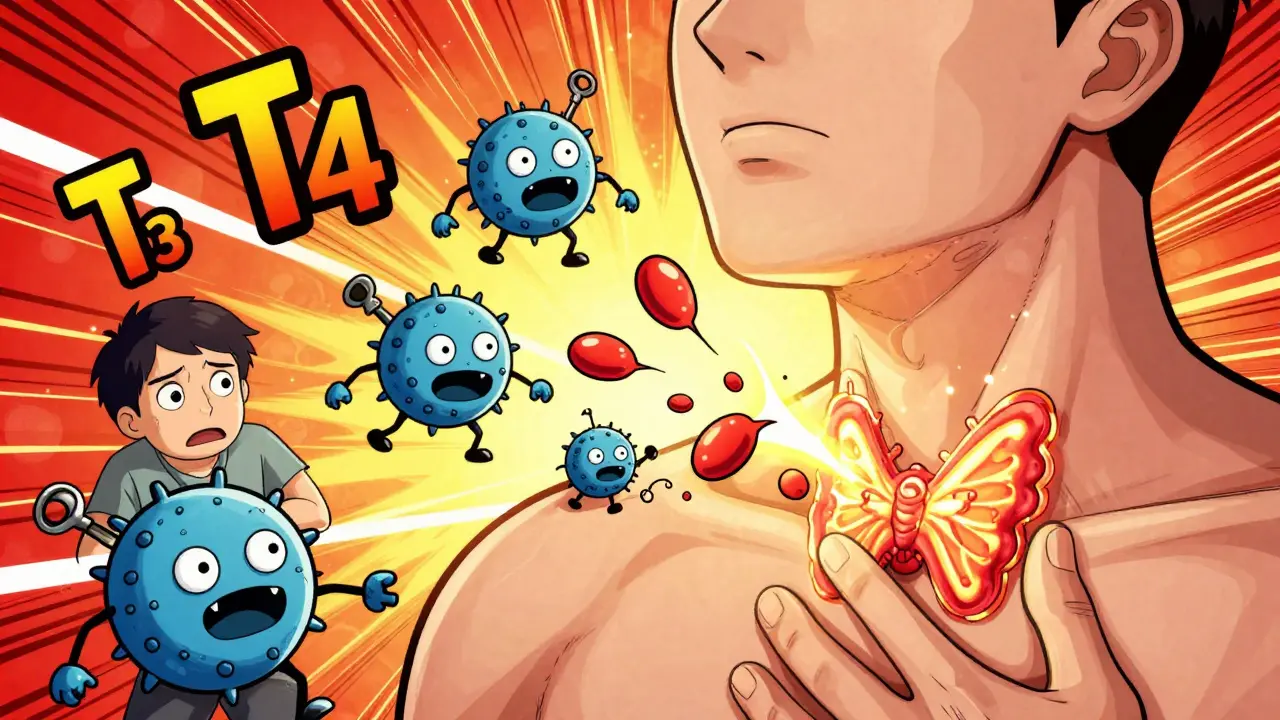
Graves’ disease isn’t just an overactive thyroid. It’s your immune system turning against you. Instead of protecting your body, it sends out faulty signals that tell your thyroid to produce way too much hormone. This isn’t a minor glitch-it’s a full-blown autoimmune attack that can wreck your heart, your sleep, your weight, and even your eyes. About 80% of all hyperthyroidism cases in the U.S. are caused by Graves’ disease, and it hits women seven times more often than men, mostly between ages 30 and 50.
What Happens When Your Immune System Attacks Your Thyroid?
Your thyroid is a small butterfly-shaped gland at the base of your neck. It controls your metabolism-how fast your body burns energy, how your heart beats, even how you feel emotionally. In Graves’ disease, your immune system makes something called thyroid-stimulating immunoglobulins (TSI), or TRAb antibodies. These fake signals lock onto your thyroid like keys in a lock, forcing it to churn out excessive amounts of T3 and T4 hormones. The result? Your whole body speeds up.
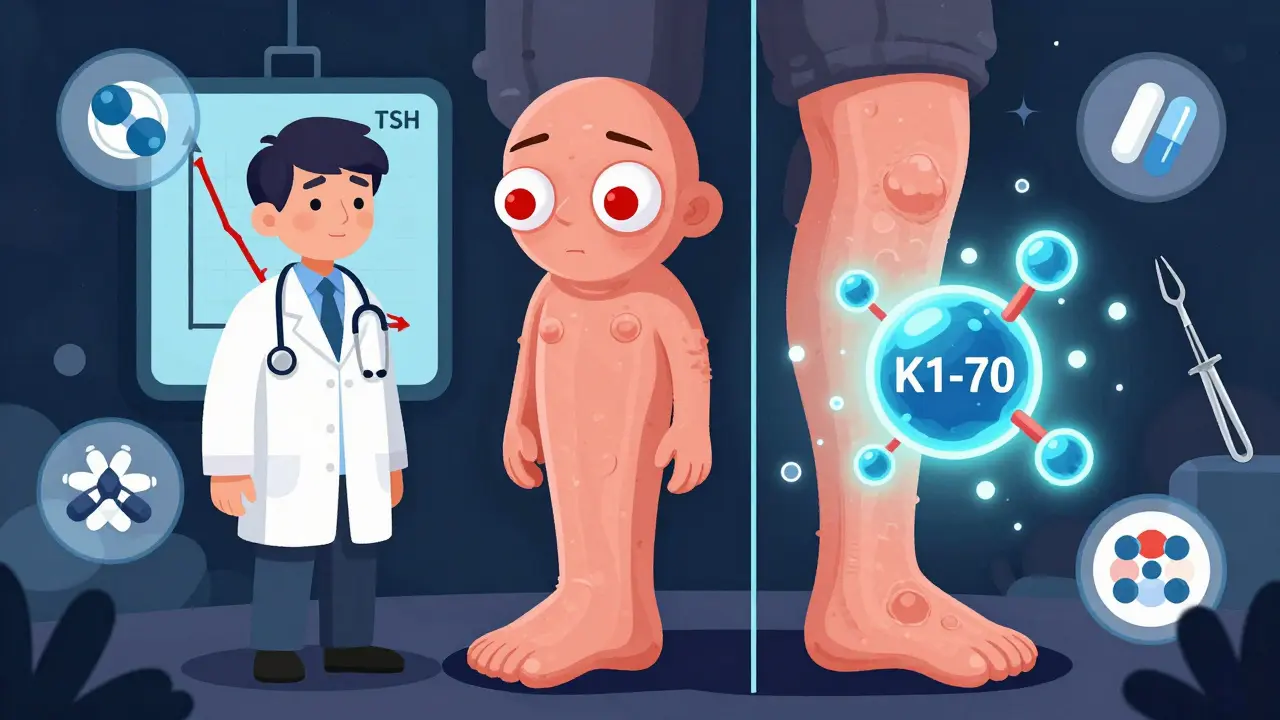
Standard lab values tell the story: TSH drops below 0.4 mIU/L (normally 0.5-5.0), while free T4 climbs above 1.8 ng/dL and free T3 pushes past 4.2 pg/mL. But blood tests alone don’t show the full picture. About half of people with Graves’ develop eye problems-bulging eyes, redness, double vision, even pressure behind the eyeballs. This is Graves’ ophthalmopathy. In 1 to 4% of cases, the skin on the shins or tops of feet thickens into a rare, lumpy rash called pretibial myxedema. These aren’t side effects-they’re part of the disease itself.
Why PTU? The Trade-Offs in Antithyroid Medications
There are two main antithyroid drugs: methimazole and propylthiouracil (PTU). Both stop your thyroid from making too much hormone. But they’re not interchangeable. Methimazole is usually the first choice for adults because you only need to take it once a day, and it has a lower risk of serious side effects. PTU, on the other hand, is slower to work, requires three doses a day, and carries a black box warning from the FDA for severe liver damage.
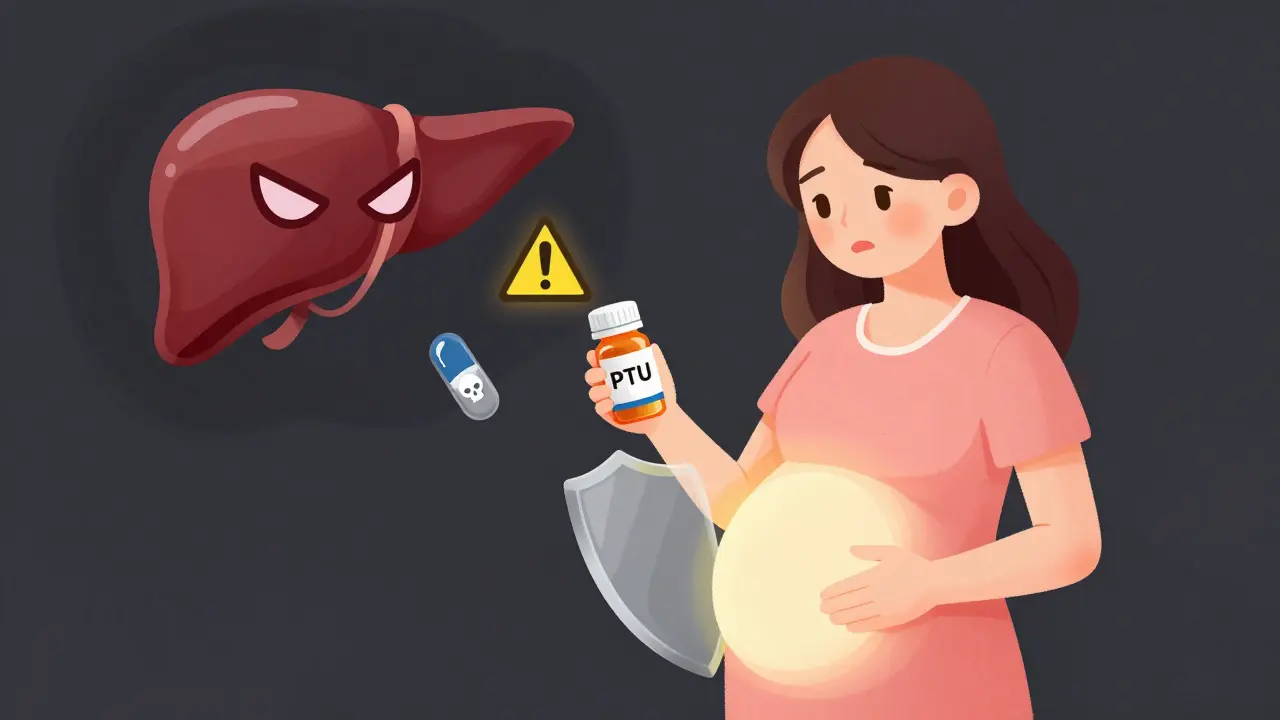
So why use PTU at all? Because in the first trimester of pregnancy, methimazole can cause rare but serious birth defects. PTU is considered safer during early pregnancy, even though it’s not risk-free. About 0.2% to 0.5% of people on PTU develop liver injury-sometimes life-threatening. That’s why anyone on PTU needs monthly liver function tests. One patient on a Graves’ forum shared: “PTU saved my pregnancy, but my ALT spiked to 120 at week 24. I had to cut my dose in half and was terrified every time I went for bloodwork.”
Other side effects of PTU include taste changes (reported by 32% of users), joint pain (18%), and rare but dangerous drops in white blood cells (agranulocytosis), which can cause sudden fever or sore throat. If that happens, stop the drug immediately and go to the ER. The same goes for yellowing skin or dark urine-signs of liver trouble.
How Long Does Treatment Last? And Will It Come Back?
Treatment with antithyroid drugs usually lasts 12 to 18 months. During that time, your doctor will check your TSH every 4 to 6 weeks until your levels stabilize, then every 2 to 3 months. Most people start feeling better within 6 to 12 weeks. By three months, about 75% are back to normal thyroid function.
But here’s the catch: remission isn’t permanent. After stopping medication, 30% to 50% stay in remission. The other half? Their thyroid wakes up again. Relapse rates hit 40% to 60% within a year of stopping. That’s why doctors test TRAb levels at diagnosis and again after treatment. If your TRAb is above 10 IU/L, you have an 80% chance of the disease returning. That’s a strong signal to consider other options.
What Are the Other Treatment Choices?
If drugs don’t work-or if you don’t want to be on them forever-there are two definitive options: radioactive iodine and surgery.
Radioactive iodine (I-131) is the most common long-term fix in the U.S. You swallow a pill, the radiation destroys overactive thyroid cells, and your hormone levels drop. Within a year, 50% to 80% of people become permanently hypothyroid and need lifelong thyroid hormone replacement. It’s cheap ($300-$1,500), effective (80-90% success), and non-invasive. But it’s not ideal for pregnant women or those with severe eye disease-it can make eye symptoms worse.
Thyroidectomy-surgical removal of the thyroid-is the fastest solution. It’s 95% effective. But it’s surgery. Risks include damage to the vocal cords (1% chance) or parathyroid glands (1-2%), which control calcium. You’ll need hormone replacement for life, just like with radioactive iodine. Costs range from $5,000 to $15,000 depending on your location and insurance.
For eye disease that doesn’t respond to meds, newer treatments like teprotumumab (brand name Tepezza) can reduce bulging eyes by 70% in clinical trials. But it costs about $150,000 for a full course and isn’t for everyone. Most patients still rely on steroids, eye lubricants, and sometimes orbital radiation.
The Hidden Costs: Mental Health, Diagnosis Delays, and Quality of Life
Graves’ disease doesn’t just mess with your body-it wrecks your mind. In a survey of over 1,200 patients, 78% said anxiety and insomnia were their worst symptoms. Many were misdiagnosed for months-some thought they had panic disorder, others blamed menopause. One Reddit user wrote: “I went to six doctors over 10 months. They all said I was just stressed. I lost 18 pounds and couldn’t sleep. When I finally got tested, my T3 was through the roof.”
Weight loss is common-15 to 20 pounds on average before diagnosis. Heart palpitations, shaking hands, and heat intolerance are classic signs. But because these symptoms overlap with stress or depression, many people suffer for over a year before getting the right diagnosis.
Even after thyroid levels normalize, 40% still have eye symptoms. And 25% need specialist care-ophthalmologists, sometimes even radiation oncologists-for ongoing eye damage. The emotional toll is real. Support groups like the Graves’ Disease and Thyroid Foundation connect over 15,000 people a year. Talking to others who’ve been there helps more than you’d think.
Who Should Avoid PTU? Who Needs It?
PTU isn’t for everyone. If you’re not pregnant, not in thyroid storm, and not allergic to methimazole, it’s usually not the best first choice. The risk of liver damage is small but serious. If you’re over 50, have a history of liver disease, or drink alcohol regularly, your doctor may avoid it entirely.
But for pregnant women in the first trimester, PTU is still the standard. It crosses the placenta less than methimazole, lowering the risk of fetal abnormalities. After the first 12 weeks, most switch back to methimazole because the baby’s organs are formed, and PTU’s liver risks outweigh its benefits.
Thyroid storm-a rare but deadly complication-is another reason PTU is used. It works faster than methimazole and blocks hormone release from the gland, not just production. In emergencies, it’s a lifesaver.
What’s Next for Graves’ Disease Treatment?
The future is looking more personalized. Researchers are now testing drugs that block the TSH receptor directly-like K1-70-which could normalize thyroid function without causing hypothyroidism. Clinical trials show 85% success. There’s also early work with rituximab, a drug used in lymphoma, which targets the immune cells causing the attack. In refractory cases, it’s achieving 60% remission.
Home monitoring is also changing the game. The FDA approved ThyroidTrack, a home device that measures TSH with 95% accuracy compared to lab tests. It’s still limited to research, but soon, patients may track their levels without driving to a clinic.
Genetic testing is becoming more common too. If you have the HLA-DR3 gene, your risk of Graves’ is tripled. Knowing that could help predict who’s likely to relapse-or who might respond better to certain drugs.
For now, PTU remains a critical tool-not because it’s perfect, but because it fills a unique role. It’s not the first-line drug for most. But for pregnant women, for thyroid storm, for those who can’t tolerate methimazole-it’s the bridge that saves lives.
When to Call Your Doctor Immediately
- Fever above 100.4°F or sore throat (signs of low white blood cells)
- Yellow skin or eyes, dark urine, severe nausea (liver damage)
- Heart rate over 100 bpm at rest, chest pain, or trouble breathing
- Sudden vision loss or severe eye pain
- Unexplained weight gain, extreme fatigue, or feeling cold (signs of under-treatment or over-treatment)
If you’re on PTU, keep a symptom journal. Note your energy levels, heart rate, sleep quality, and any new aches or changes in vision. Bring it to every appointment. The more you track, the better your doctor can adjust your care.
Is PTU safe during pregnancy?
PTU is considered the preferred antithyroid drug during the first trimester of pregnancy because it carries a lower risk of birth defects compared to methimazole. After the first 12 weeks, most doctors switch patients back to methimazole due to PTU’s risk of severe liver injury. Always work closely with your endocrinologist and obstetrician when managing Graves’ disease during pregnancy.
Can Graves’ disease be cured?
Graves’ disease can go into remission, especially after 12-18 months of antithyroid medication. About 30-50% of people stay in remission after stopping treatment. But it’s not a true cure-relapse is common, especially if TRAb levels remain high. For many, definitive treatments like radioactive iodine or surgery are needed to achieve long-term stability, though these lead to lifelong thyroid hormone replacement.
What are the signs of thyroid storm?
Thyroid storm is a life-threatening emergency. Signs include fever above 102°F, rapid heartbeat (over 140 bpm), confusion, vomiting, diarrhea, severe agitation, and sometimes coma. It’s rare but has a 20-30% death rate if not treated immediately. If you have Graves’ disease and develop these symptoms, go to the ER right away.
Why does Graves’ disease affect the eyes?
The same antibodies that attack the thyroid also target tissues behind the eyes, causing inflammation and swelling. This pushes the eyeballs forward (proptosis), leads to redness, double vision, and pressure. Smoking greatly increases the risk and severity. Eye symptoms can persist even after thyroid levels are controlled, requiring separate treatment from an ophthalmologist.
Does stress cause Graves’ disease?
Stress doesn’t cause Graves’ disease, but it can trigger it in people who are genetically predisposed. Major life events-like pregnancy, loss, or illness-can activate the immune system in ways that start the autoimmune response. If you have a family history of thyroid or autoimmune disorders, stress may be the spark, not the fuel.
Graves’ disease is complex, but it’s manageable. With the right treatment, monitoring, and support, most people live full, active lives. The key is catching it early, staying informed, and never ignoring symptoms-even if they seem like just “stress.” Your thyroid is more than a gland. It’s the engine of your body. When it’s out of control, everything suffers. But with the right care, you can get it back on track.



Christopher King
This is all just a cover-up. The pharmaceutical industry doesn't want you to know that Graves' is caused by fluoride in the water and 5G radiation syncing with your thyroid's electromagnetic field. PTU? That's just a placebo designed to keep you dependent. The real cure is infrared saunas and drinking distilled water with Himalayan salt. They banned this in 1973. Ask your doctor why they never mention it.
Bailey Adkison
You say PTU has a black box warning but you don't mention that methimazole is classified as a teratogen in the FDA's Pregnancy Category D while PTU is Category D only in the third trimester. Your paragraph is misleading because you omit the temporal nuance. Also 'through the roof' is unscientific. Use 'elevated beyond reference range.'
Harbans Singh
I'm from India and we see a lot of this in rural areas where people don't get tested till they're in thyroid storm. I had a cousin who lost her voice after surgery because the surgeon wasn't trained well. Maybe we need more community health workers trained to spot the early signs - shaking hands, weight loss, bulging eyes. It's not just a US problem.
Justin James
You think this is bad wait till you find out that the entire endocrinology field is controlled by the same three pharmaceutical companies that make both methimazole and PTU and they're the ones funding all the research and all the guidelines and if you dig deep enough you'll find that the FDA's black box warning on PTU was pushed through by lobbyists who had stock in the company that makes methimazole and they wanted to kill PTU because it's cheaper and they couldn't patent the formula anymore and now they're pushing this expensive Tepezza drug that costs 150k and it's literally just a monoclonal antibody that could be made generic if they weren't so scared of losing their monopoly and the reason they don't test for HLA-DR3 more often is because insurance won't cover it unless you're already in crisis and they profit more from lifelong hormone replacement than from curing you and they want you to believe this is normal and you're just lucky if you get through it without losing your eyes or your liver or your job or your sanity and they're laughing all the way to the bank while you're Googling 'why do I feel like I'm melting from the inside' at 3am again
Zabihullah Saleh
There's something deeply human about how our bodies betray us. We're made of stardust, they say, but sometimes the stars align wrong. Graves’ isn't just a disease - it's a mirror. It shows you how fragile your control really is. You think you're managing stress, but your immune system doesn't care about your calendar. It just reacts. And in that chaos, there's a strange kind of beauty - the body refusing to be ignored, screaming until you listen.
Rick Kimberly
The clinical data presented is largely accurate; however, the assertion that 78% of patients report anxiety and insomnia as their worst symptoms lacks a cited source. Furthermore, the term 'wrecks your mind' is colloquial and non-technical. A more appropriate phrasing would be 'significantly impacts psychological well-being.' Additionally, the efficacy of Tepezza is based on Phase III trials with limited long-term follow-up. Caution is warranted.
Katherine Blumhardt
I was on PTU for 8 months and my taste buds just died like literally everything tasted like metal and my husband said I was yelling at him for no reason but it was the meds and then my liver spiked and I cried for three days and now I'm hypothyroid and I hate my life but at least I'm not bulging out of my sockets anymore
sagar patel
In India we use PTU only when methimazole fails because of cost and availability. The liver risk is real but so is the risk of untreated hyperthyroidism. Many patients delay treatment because they think it's just stress. By the time they come, their TSH is 0.01 and their heart is racing at 130. No one tells them it's not normal to lose 20 pounds in two months while eating like a horse.
Michael Dillon
So let me get this straight - you're telling me the solution to an autoimmune disease is to poison your liver with a drug that's banned in Europe? And you call that medicine? I'd rather just drink kombucha and meditate. Also, why is everyone so obsessed with drugs? Maybe if you stopped eating processed carbs your thyroid wouldn't be screaming for help.
Gary Hartung
The casual tone of this article is... profoundly unbecoming. One does not discuss life-altering autoimmune pathology with phrases like 'your thyroid wakes up again.' This is not a children's bedtime story. Furthermore, the casual invocation of Reddit anecdotes as clinical evidence is a dereliction of scholarly duty. One might as well cite TikTok influencers as peer-reviewed sources.
Ben Harris
I had Graves’ and I didn’t take any meds because I found out it was caused by my ex cheating on me and my soul was broken and my thyroid just gave up. I cried for 6 months and then one day I just stopped shaking. No drugs. No labs. Just healing. They don’t tell you this part. The body remembers trauma. And sometimes, the thyroid is just the messenger.
Mussin Machhour
This is actually super helpful. I just got diagnosed and I was scared to death. I didn’t know PTU was even an option for pregnancy - my endo just said ‘take methimazole’ and I was panicking. Thanks for laying it out real. I’m gonna print this and bring it to my next appointment.
Carlos Narvaez
PTU is a last-resort drug. Not a first-line option. Don't be fooled by the pregnancy exception - it's still dangerous. Methimazole is better. Period.
Winni Victor
So let me get this straight - you're recommending a drug that can kill your liver to save your eyes? That's like using a flamethrower to light a candle. And then you wonder why people are scared of doctors? I'm just here for the drama. Also, why is everyone so obsessed with TSH? I don't care about your numbers. I care that I can't sleep because my heart feels like it's trying to escape my chest.
Terry Free
You call PTU a bridge? More like a rickety plank over a pit of liver failure. Meanwhile, methimazole is the actual highway. You're giving people false hope with this ‘it’s safer in pregnancy’ nonsense. The FDA didn't slap a black box on PTU for fun. It's because people died. And now you're just glorifying it because it’s the ‘nicer’ option? That’s not medicine. That's moralizing with a stethoscope.