
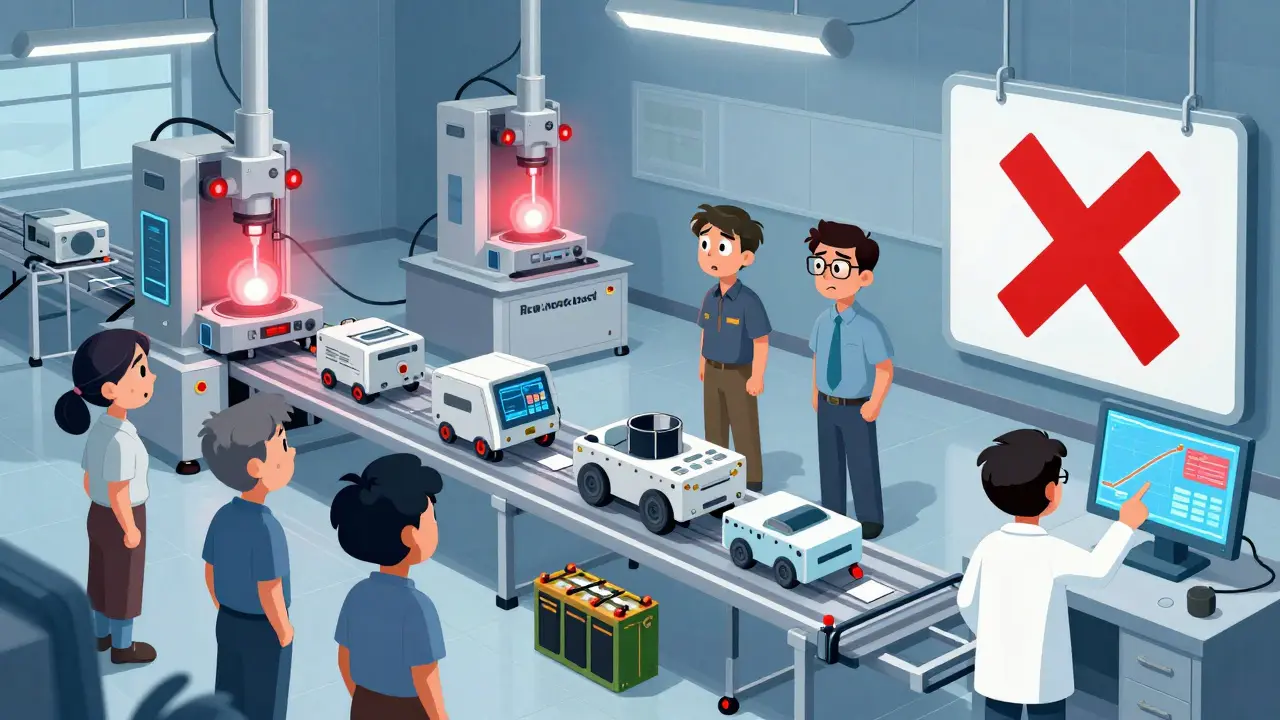
When you buy a medical device, an electric car, or even a smartphone, you expect it to work perfectly the first time. But behind that expectation lies a growing crisis in manufacturing-one that’s not about broken parts, but about broken systems. In 2025, quality assurance is no longer just a step in production. It’s the difference between staying in business and falling behind. And for many manufacturers, the fear isn’t that something will go wrong-it’s that they don’t know how to stop it from going wrong in the first place.
Quality Isn’t a Cost Center Anymore
For decades, quality control was treated like a necessary evil. A team of inspectors stood at the end of the line, checking for defects. If something failed, they pulled it aside. Rework. Scrap. Delays. But now, companies are realizing that fixing mistakes after they happen is far more expensive than preventing them in the first place. According to the ZEISS U.S. Manufacturing Insights Report 2025, 38% of manufacturers list the cost of rework and iterations as their top quality challenge. That’s not just wasted material-it’s lost time, missed deadlines, and eroded customer trust.
What’s changed? Product complexity. Modern devices-like electric vehicle batteries, implantable medical sensors, or smart factory robots-require precision down to the micrometer. One tiny flaw in a battery separator can cause a fire. One misaligned sensor in a ventilator can kill. These aren’t products you can recall and fix later. They’re life-or-death. And that’s why quality has moved from the back end to the front line. It’s now a strategic lever for innovation, not just a compliance checkbox.
The Skills Gap Is Real
Here’s the hard truth: you can buy the fanciest AI-powered inspection system in the world, but if your team doesn’t know how to use it, it’s just expensive furniture. 47% of manufacturers say the biggest barrier to quality improvement is a lack of skilled personnel. And it’s not just about finding workers-it’s about finding the right kind of workers.
Today’s quality engineers don’t just need to read blueprints. They need to understand data streams, interpret AI outputs, and collaborate with IT teams. The median salary for a quality professional with AI/ML skills hit $98,500 in Q2 2025-22% higher than traditional roles. But there aren’t enough people with that mix of skills. On Reddit’s r/Manufacturing forum, 87% of respondents said inconsistent data integration between departments is their biggest frustration. Why? Because quality teams are still using spreadsheets while production runs on cloud-based systems. The disconnect isn’t just technical-it’s cultural.
One automotive supplier told Manufacturing Dive they spent $2.3 million on automated inspection tech… and saw error rates go up 40% in the first year. Why? No one was trained to interpret the new alerts. The machines flagged issues, but the staff didn’t know what they meant. So they ignored them. Until a batch of faulty sensors slipped through-and caused a recall.
Technology Alone Won’t Fix It
There’s a dangerous myth out there: if we just buy more robots, we’ll solve our quality problems. It’s not true. In fact, manufacturers who implement new tools without integrating them into their existing workflows are worse off than those who stick with manual processes.
Reader Precision’s July 2025 case studies show that automation, robotics, and AI are often rolled out in silos. One department gets a 3D scanner. Another gets real-time monitoring software. A third uses a cloud-based QMS. But none of them talk to each other. The result? Data silos. Conflicting reports. And confusion on the floor.
The winners? Companies that treat quality as a connected system. Deloitte’s 2026 outlook found that manufacturers with integrated quality systems saw 22% lower rework costs and 18% faster time-to-market. How? They linked their metrology tools to their ERP systems. They gave production teams live access to quality metrics. They trained everyone-not just inspectors-to act on data in real time.
One medical device maker reduced annual rework costs by $1.2 million by using precise metrology to optimize material usage. They didn’t just measure parts-they predicted where defects would occur before the machine even started. That’s the future: not inspection, but prevention.
The Rise of Predictive Quality
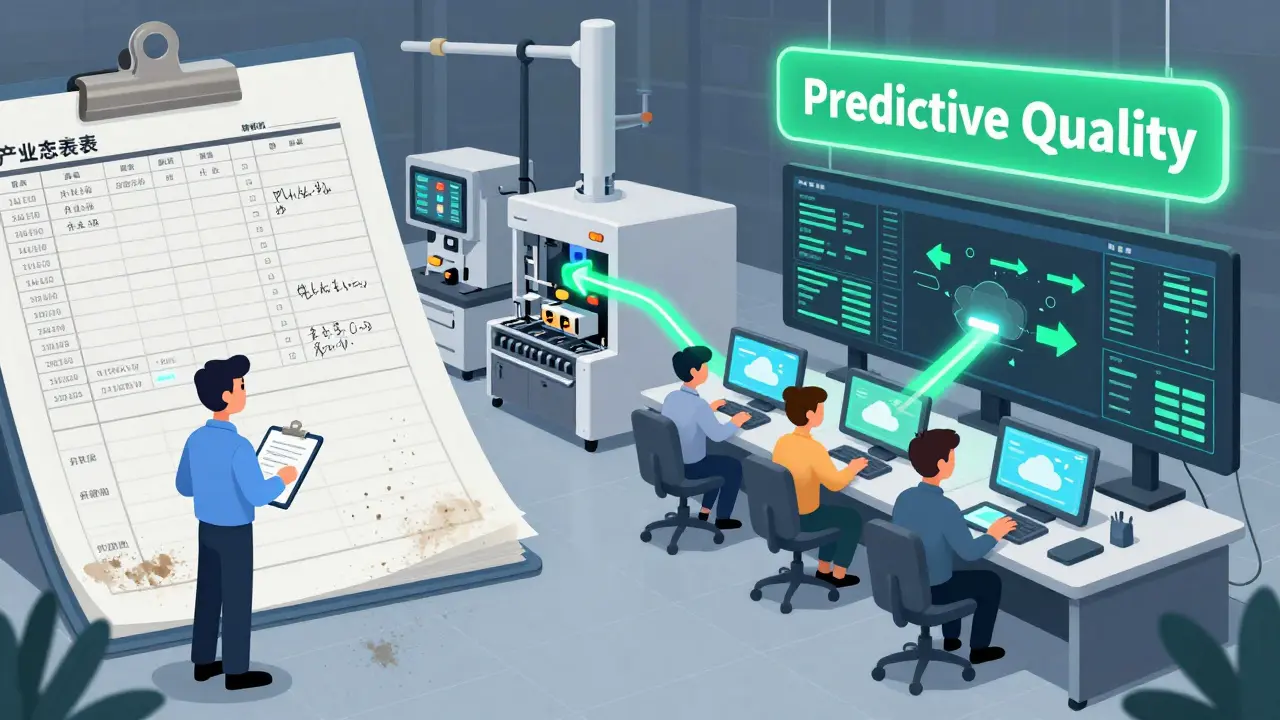
The most powerful shift in 2025 isn’t about faster inspections-it’s about stopping defects before they happen. Predictive quality analytics uses machine learning to analyze patterns in real-time production data and flag potential failures before they occur. Early adopters are seeing 27% fewer quality deviations reaching customers.
Think of it like a weather forecast for your factory. Instead of waiting for rain (a defect), you shut down a risky machine before it starts producing faulty parts. One aerospace supplier cut customer-reported defects by 41% by using predictive models trained on 18 months of production data. They didn’t need more inspectors. They needed better data.
But here’s the catch: predictive analytics only works if you have clean, connected data. That’s why 68% of new enterprise deployments in 2025 are cloud-based Quality Management Systems (QMS). They break down silos. They let quality engineers in Wisconsin see what’s happening on the line in Mexico. They make compliance easier by auto-generating audit trails.

Who’s Falling Behind?
The gap between manufacturers is widening fast. In aerospace and medical device sectors, where safety is non-negotiable, adoption of advanced quality tech is at 78% and 72% respectively. But in general manufacturing? Only 48%. Why? Because those companies still see quality as a cost, not an investment.
Forrester Research warned in August 2025 that manufacturers who delay investing in predictive analytics will see 23% higher defect rates by 2027. That’s not a guess-it’s a projection based on real data trends. Meanwhile, companies that treat supplier relationships like extensions of their own operation-sharing forecasts, aligning on quality standards, and co-investing in training-are achieving 31% greater supply chain resilience.
And it’s not just about technology. Regulatory pressure is rising. In 2025, 63% of manufacturers reported increased compliance documentation requirements. Sustainability mandates now tie energy use and material waste to quality scores. Lean isn’t a buzzword anymore-it’s a survival tactic.
What Needs to Change
If you’re a manufacturer reading this, here’s what you need to do:
- Stop treating quality as a department. It’s a company-wide discipline. Everyone from the CEO to the machine operator needs to own it.
- Invest in integration, not just tools. A $500,000 3D scanner won’t help if it can’t talk to your ERP system. Look for platforms that connect data across the entire product lifecycle.
- Train your people before you buy new tech. The best system fails without skilled users. Allocate budget for cross-training-quality engineers learning data science, production staff learning how to read dashboards.
- Start small, but start now. Pick one high-cost, high-risk product line. Implement predictive analytics there. Measure the results. Then scale.
There’s no magic bullet. But there is a clear path: connect your systems, empower your people, and treat quality as the engine of innovation-not the brake.
Why is rework so expensive in modern manufacturing?
Rework isn’t just about fixing a defective part. It triggers a chain reaction: machines sit idle, supply chains delay, customer orders fall behind, and materials are wasted. In 2025, 38% of manufacturers say rework costs are their top quality challenge. For complex products like EV batteries or medical implants, a single flawed component can mean scrapping an entire assembly-costing thousands in materials and lost production time. Worse, repeated failures damage brand trust, which is harder to recover than any dollar amount.
Can AI really reduce manufacturing defects?
Yes-but only if it’s properly integrated. AI-enhanced inspection software doesn’t just find defects; it learns from patterns over time. One automotive supplier saw defect detection improve by 37% and false positives drop by 29% after implementing AI tools. The system flagged subtle anomalies human inspectors missed, like micro-cracks in welds or slight misalignments in sensor housings. The key? AI works best when trained on thousands of real-world examples and connected to live production data, not as a standalone tool.
What’s the biggest mistake manufacturers make with quality tech?
Buying technology without training people. A company spent $2.3 million on automated inspection systems but didn’t train staff to interpret the alerts. Result? Operators ignored the system, defects increased by 40%, and the investment became a liability. Technology alone doesn’t improve quality-people using it correctly do. The most successful implementations involve cross-functional teams: quality engineers, IT, and frontline workers all involved from day one.
Why are cloud-based QMS systems becoming so popular?
Because they break down data silos. Legacy systems kept quality records in isolated spreadsheets or on-premise servers. Cloud-based QMS connects quality data from factories, suppliers, and labs in real time. In 2025, 68% of new enterprise deployments used cloud QMS, up from 52% in 2023. This allows manufacturers to track compliance across global sites, automate audit trails, and respond faster to issues-critical for industries under strict regulatory pressure like medical devices and aerospace.
How does quality affect a company’s profitability?
It’s direct and measurable. Manufacturers treating quality as a strategic priority achieve 28% higher profit margins by 2030, according to Deloitte. Why? Fewer defects mean less scrap, fewer recalls, faster production cycles, and stronger customer loyalty. One medical device maker saved $1.2 million annually just by optimizing material use through precise metrology. Meanwhile, companies stuck in manual, reactive quality processes pay 43% more in labor costs for inspections and face 19% higher operational costs overall.









Kandace Bennett
OMG this is SO TRUE!!! 🤯 I work in medtech and let me tell you-our last batch of glucose monitors had a 0.003mm misalignment in the sensor housing. ONE. MICRO. MILLIMETER. And guess what? 14 patients got false readings. 😭 We lost $2.1M in recalls and trust. Quality isn’t a department-it’s our DNA now. If you’re still using spreadsheets in 2025, you’re basically running a haunted house. 🏚️
Sabrina Sanches
Finally someone gets it
Shruti Chaturvedi
Love how this post breaks it down
But I think we’re missing the real issue
It’s not just tech or training
It’s culture
Every factory I’ve worked in has this silent rule: don’t stop the line
Even if something’s wrong
Because production targets matter more than safety
Until someone gets hurt
Then we panic
Then we spend millions fixing what we could’ve prevented for $50k
Change starts with leadership saying: safety over speed
Katherine Rodriguez
Why are we even talking about this like it’s new
Every manufacturer in China and Germany has been doing this for years
We’re 10 years behind
And we wonder why our EVs keep catching fire
Stop pretending we’re innovators
We’re just late adopters with a PR team
Devin Ersoy
Oh honey
You think AI is the answer? Please
I’ve seen more ‘smart’ inspection bots than I’ve had hot dinners
They’re just glorified cameras with a fancy dashboard
The real magic? The guy who notices the faint hum in the motor before the sensor even flags it
That’s intuition
That’s craft
That’s not in any ROI spreadsheet
Stop worshipping algorithms like they’re gods
The factory floor still runs on sweat, grit, and a well-trained eye
And no, you can’t train that with a webinar
Scott Smith
Great breakdown
One thing I’d add
Too many companies treat quality tech as a one-time purchase
It’s not
It’s a living system
Like your car
You don’t buy a Tesla and never change the tires
You update software
You recalibrate sensors
You train new hires
Quality systems need the same care
Otherwise they become expensive paperweights
Emma Deasy
Let me be perfectly clear: the erosion of manufacturing integrity in the United States is not merely a technical failure-it is a moral catastrophe.
Every time a company chooses cost-cutting over precision, it is not merely a business decision-it is a betrayal of public trust.
When a child’s ventilator fails because a technician was never trained to interpret an AI alert-this is not negligence.
This is malice.
And yet, we celebrate CEOs who cut R&D budgets while hiking dividends.
Where is the outrage?
Where is the congressional hearing?
Where is the shame?
We are not just manufacturing products.
We are manufacturing legacy.
And right now, our legacy is rust.
Rosemary Chude-Sokei
I appreciate how thorough this is
But I think we’re missing one huge piece
Supplier quality
It’s not enough to have perfect internal systems
If your third-party vendor in Vietnam is still using manual calipers from 2012
It doesn’t matter how fancy your cloud QMS is
That one component will fail
And take your whole batch with it
Maybe we need mandatory supplier quality certifications
Like ISO but with teeth
Noluthando Devour Mamabolo
From a SA manufacturing perspective
Cloud QMS is non-negotiable
Our regulatory compliance audit trail is now automated
Real-time data sync across Durban, Cape Town, and Johannesburg
Zero manual entry
Zero discrepancies
And yes
We’re seeing a 33% reduction in rework
But here’s the kicker
Our engineers now spend 60% less time on paperwork
And 40% more time on actual problem-solving
That’s the real ROI
Not cost savings
But cognitive bandwidth regained
Leah Dobbin
How amusing
You speak of predictive analytics as if it’s some revolutionary breakthrough
As if no one else has thought of this
It’s merely the logical extension of statistical process control
Which was developed in the 1920s
But now
Because we have fancy dashboards
We pretend we’ve discovered fire
How quaint
How… American
Ali Hughey
EVERYTHING you’re saying is a distraction
Do you know who really controls quality?
It’s not the engineers
It’s not the AI
It’s the shadowy consortium behind the cloud QMS providers
They’re collecting your production data
Building profiles
And selling them to the government
And the military
And maybe even aliens
That’s why they want you to go cloud
Because they want to own your factory
Don’t be fooled
It’s not about quality
It’s about control
And they’re using ‘safety’ as the Trojan horse
Alex MC
Good post
Just wanted to say
I’ve been in this field for 18 years
And I’ve seen every trend come and go
Lean
Six Sigma
IoT
AI
Most of it’s noise
But this one? The integrated systems thing?
It’s real
My team at the plant cut rework by 41% last year
Not because we bought the fanciest robot
But because we finally let the line workers see the quality data
They fixed things before they broke
Simple
And yes
It works
rakesh sabharwal
Typical Western bias
You think quality is about sensors and cloud platforms
But in India
We’ve been doing predictive quality for decades
With our eyes
With our hands
With our intuition
No AI needed
No cloud required
Just skilled workers
And respect
Maybe instead of buying $500k scanners
You should pay your workers more
And listen to them
That’s real quality
Not algorithms