Vitamin A & Retinoid Risk Evaluator
Select a source or medication below to understand its risk level and safety guidelines during pregnancy.
Imagine a substance that is absolutely essential for your baby's heart and brain to develop, but in just a slightly higher dose, it becomes one of the most dangerous triggers for birth defects. That is the paradox of Vitamin A is a group of fat-soluble compounds including retinol and beta-carotene that regulate embryonic growth and cellular differentiation. While you need it to stay healthy, too much of the "preformed" version-whether from a prescription pill or a high-dose supplement-can rewrite a fetus's genetic blueprint in devastating ways.
If you are planning a pregnancy or currently taking skin medications, the distinction between "safe" and "dangerous" Vitamin A isn't always clear on the label. We need to talk about why some forms of this vitamin are harmless while others are classified as Category X risks, and how to navigate the complex world of retinoids without compromising fetal health.
Key Takeaways for Safety
- Not all Vitamin A is equal: Beta-carotene is generally safe, but preformed Vitamin A (retinol/retinyl esters) can be toxic at high doses.
- The danger window: The first trimester (specifically weeks 3-5) is the highest risk period for malformations.
- High-risk meds: Isotretinoin (Accutane) has a massive teratogenic potential, increasing malformation risks by up to 25-fold.
- The 10,000 IU rule: Most health organizations recommend staying below 10,000 IU of preformed Vitamin A daily during pregnancy.
The Spectrum of Retinoids: From Carrots to Accutane
To understand the risk, we have to look at the chemistry. Retinoids are chemical compounds that are vitamers of vitamin A, acting as ligands for nuclear receptors to regulate gene expression. They aren't all the same, and their impact on a developing embryo varies wildly based on their structure.
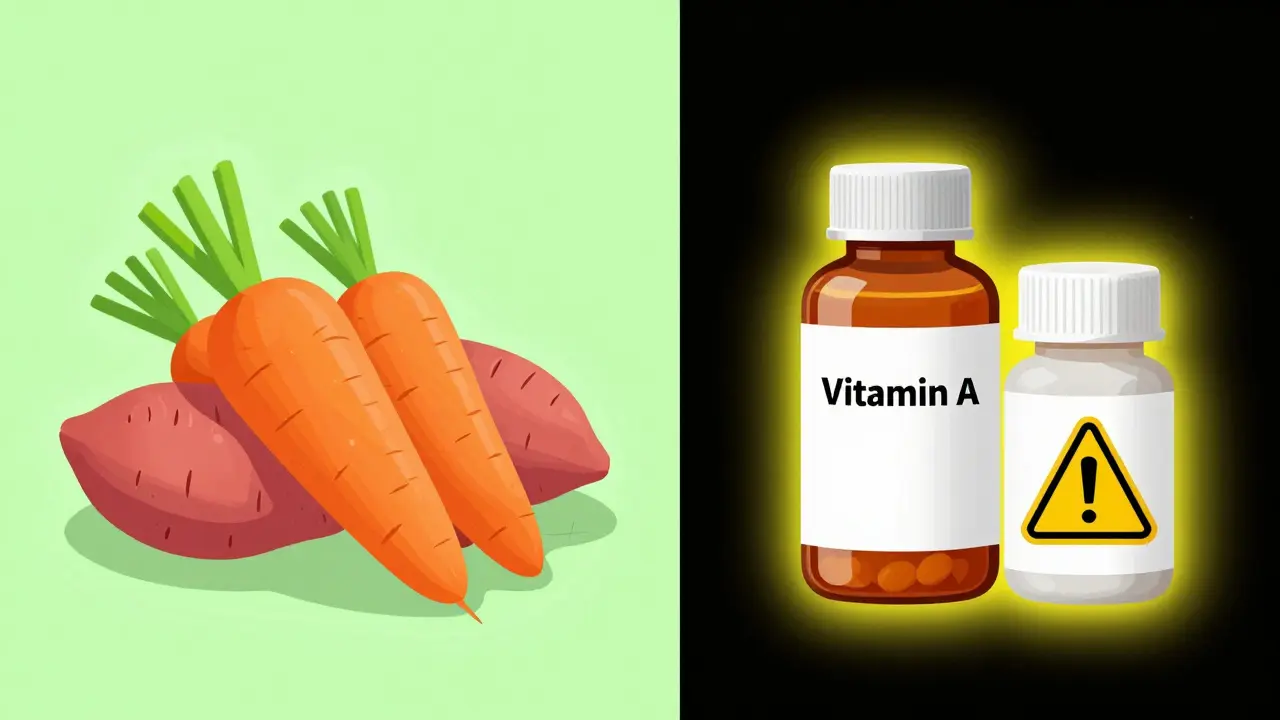
First, there are the provitamin A carotenoids, like beta-carotene found in carrots. Your body is smart; it only converts beta-carotene into active Vitamin A as needed. Because of this natural brake system, these are essentially non-teratogenic. You could take high doses of beta-carotene and the risk of birth defects remains negligible.
Then you have preformed Vitamin A (retinol and retinyl esters). These are found in cod liver oil and beef liver. Unlike carotenoids, these are stored in the liver and can build up. When doses exceed 10,000 IU daily, they start to interfere with how an embryo patterns its organs. For example, a single 3-ounce serving of beef liver can pack about 27,000 IU, which is way over the safety limit for a pregnant woman.
Finally, we have synthetic retinoids. These are the heavy hitters. Isotretinoin (often known by the brand Accutane) is a powerful medication for severe acne. Because it is designed to be potent, it bypasses the body's normal regulatory checks, making it a potent teratogen even at very low doses.
| Form | Typical Source | Risk Level | Toxicity Threshold / Note |
|---|---|---|---|
| Beta-carotene | Carrots, Sweet Potatoes | Very Low | No established teratogenic limit |
| Preformed Vitamin A | Liver, Fish Oil, Supplements | Moderate to High | Risky above 10,000 IU/day |
| Tretinoin (Topical) | Prescription Creams | Low | Minimal systemic absorption |
| Isotretinoin (Oral) | Accutane | Extreme | Category X; high risk at 0.5-1.0 mg/kg/day |
Why Does This Happen? The Science of Teratogenicity
So, why does a vitamin actually cause a birth defect? It comes down to a process called organogenesis. During the first few weeks of pregnancy, the embryo relies on specific proteins and genes to tell it where the head goes, where the arms grow, and how the heart folds. Hox genes (specifically Hoxb-1) are the "architects" of this process.
When there is an excess of retinoids in the system, they act like a loud noise that drowns out the architect's instructions. This specifically damages neural crest cells-a group of migratory cells that eventually form the face, skull, and parts of the heart. When these cells are disrupted, the result is often what doctors call "retinoid embryopathy." This can manifest as cleft palates, small or absent lower jaws (brachygnathia), and severe heart defects.
This isn't just a theoretical risk. Research pioneered by Sidney Q. Cohlan back in the 1950s showed that high doses of Vitamin A in rats led to offspring with brain protrusions and eye defects. In humans, the data is even more sobering: exposure to oral isotretinoin during the first trimester can result in major malformations in 20-35% of pregnancies.
The "Washout" Period: When is it Safe to Conceive?
One of the biggest points of confusion for patients is how long these drugs stay in the body. If you stop taking a retinoid today, can you get pregnant tomorrow? The answer depends entirely on which drug you were taking.
Isotretinoin has a relatively short half-life (around 18-24 hours). Because it clears the system quickly, most doctors require a one-month waiting period after the last dose before attempting to conceive. However, other medications like Etretinate (Tigason) are a different story. This drug is stored in the fatty tissues of the body for a long time. Its half-life is roughly 120 days, meaning it can linger for months or even years. For these specific medications, a much longer washout period-sometimes up to two years-is required to ensure the baby isn't exposed.
This is why programs like iPLEDGE are so strict. By requiring two forms of contraception and monthly pregnancy tests, the medical community has managed to drop the pregnancy rate among isotretinoin users from 3.7% in 2002 down to 0.7% in 2022. It's a rigorous system, but given the stakes, it's necessary.
Spotting Hidden Risks in Supplements and Food
Many people think they are safe because they aren't taking prescription acne medication. But the risk often hides in plain sight: the prenatal vitamin. Roughly 45% of prenatal vitamins contain preformed Vitamin A in the form of retinyl palmitate. While the average dose is usually safe (around 2,565 IU), some high-potency multivitamins can push users over the 10,000 IU limit.
Then there's the "health food" trap. Cod liver oil is often praised for Omega-3s, but it's also packed with preformed Vitamin A. If you're taking a prenatal vitamin and then adding a daily dose of liver oil, you might be inadvertently crossing into the toxicity zone. The safest move? Look for supplements that list Vitamin A as "beta-carotene." This allows your body to regulate the absorption, removing the risk of accidental toxicity.
Topical vs. Oral Retinoids: Does the Cream Matter?
A common question is whether using a retinoid cream (like Tretinoin or Retinol) is as dangerous as the pill. The short answer is: not nearly as much, but still be cautious. Oral retinoids are absorbed directly into the bloodstream, hitting the embryo with full force. Topical versions have very minimal systemic absorption. Research has shown that plasma concentrations of tretinoin remain below detectable levels after standard skin application.
Despite this, most dermatologists and the American College of Obstetricians and Gynecologists (ACOG) still advise against using them during pregnancy. Why? Because the data on topical safety is simply not as comprehensive as the data on oral danger. When the risk is a permanent birth defect, most providers prefer the "better safe than sorry" approach.
Is it safe to take a standard multivitamin during pregnancy?
Yes, most standard prenatal vitamins are safe. However, you should check the label for the amount of preformed Vitamin A (retinol). Ensure the total daily intake from all sources stays below 10,000 IU to avoid teratogenic risks.
Can I use Retinol skin creams if I'm trying to conceive?
While systemic absorption of topical retinols is very low, most doctors recommend stopping them once you start trying to conceive. This removes any uncertainty and ensures the safest possible environment for the embryo during the critical first trimester.
What is the difference between Vitamin A and Beta-carotene in terms of safety?
Preformed Vitamin A (retinol) is biologically active and can become toxic if intake is too high. Beta-carotene is a "provitamin" that your body converts to Vitamin A only as needed, making it virtually impossible to reach toxic or teratogenic levels through diet or supplementation.
How long should I wait after Accutane before getting pregnant?
For isotretinoin (Accutane), the standard medical guidance is to wait at least one month after the last dose. For other retinoids like etretinate, the wait time can be significantly longer (up to several years) due to how they are stored in body fat.
What are the most common birth defects associated with retinoid toxicity?
The most common issues are "retinoid embryopathy," which includes craniofacial malformations (like cleft palate or small jaw), cardiac defects (heart valve issues), and central nervous system anomalies (such as microcephaly or brain protrusions).
Next Steps for Patients and Partners
If you've recently discovered you're pregnant and have been using retinoids, don't panic, but act quickly. Stop the medication immediately and call your doctor. Because the highest risk occurs in the first 3 to 5 weeks of embryonic development, early intervention and screening are key.
For those currently on oral retinoids, stay diligent with your contraception. Whether it's the iPLEDGE program in the US or similar systems globally, these protocols exist because the window for error is incredibly small. If you're unsure about your supplements, switch to a beta-carotene-based Vitamin A source and double-check your prenatal labels for the "IU" count of retinol.