

You might think a few letters on a page are harmless shorthand, but in medicine, a scribbled note can mean life or death. Imagine receiving a dose of magnesium sulfate because a doctor wrote "MS" thinking you needed morphine sulfate instead. It sounds extreme, yet studies show thousands of these mix-ups happen annually. This isn't just theoretical; real people face harm because of a confusing dot at the end of a sentence or a slanted letter that looks too much like another number.
We need to talk about the specific symbols and shortcuts that turn routine care into high-risk scenarios. Healthcare teams have spent decades identifying these pitfalls to protect patients, resulting in standardized lists that every provider must follow. Understanding these rules helps you spot risks before a medication is dispensed or administered.
The Origin of the 'Do Not Use' List
The Joint Commission is a leading accrediting body for healthcare organizations that establishes safety standards. In collaboration with the Institute for Safe Medication Practices, they created a definitive list known as the 'Do Not Use' list. This initiative started formally in 2001 and has evolved through multiple revisions to stay current with emerging technology and error patterns. The goal was simple: eliminate communication errors in prescribing, dispensing, and administering medications.
According to data analyzed in 2023, standardizing these communication practices could prevent roughly 37% of all medication errors. This isn't just advice; it is now a condition of accreditation for hospitals in many regions. Facilities that ignore these guidelines risk citations during surveys, but more importantly, they risk patient safety. The Institute for Safe Medication Practices (ISMP) maintains this list as a living document, regularly adding new entries when error trends shift.
Categorizing the Most Dangerous Abbreviations
Not all abbreviations carry the same weight. Some look innocuous but carry massive risk due to visual similarity. We can break these down into three distinct categories where confusion typically occurs.
Dose Frequency Confusion
The abbreviation 'QD' stands for 'quaque die,' Latin for once daily. It is consistently flagged as the single most problematic shorthand, accounting for over 43% of abbreviation-related errors in certain analyses. Why? Because the 'D' often looks like a zero or another letter depending on handwriting. Similarly, 'QOD' means every other day, but it gets mistaken for 'QD' (daily) or even 'qid' (four times daily). The result? A patient gets medication twice the intended frequency, leading to potential toxicity.
Route and Unit Ambiguity
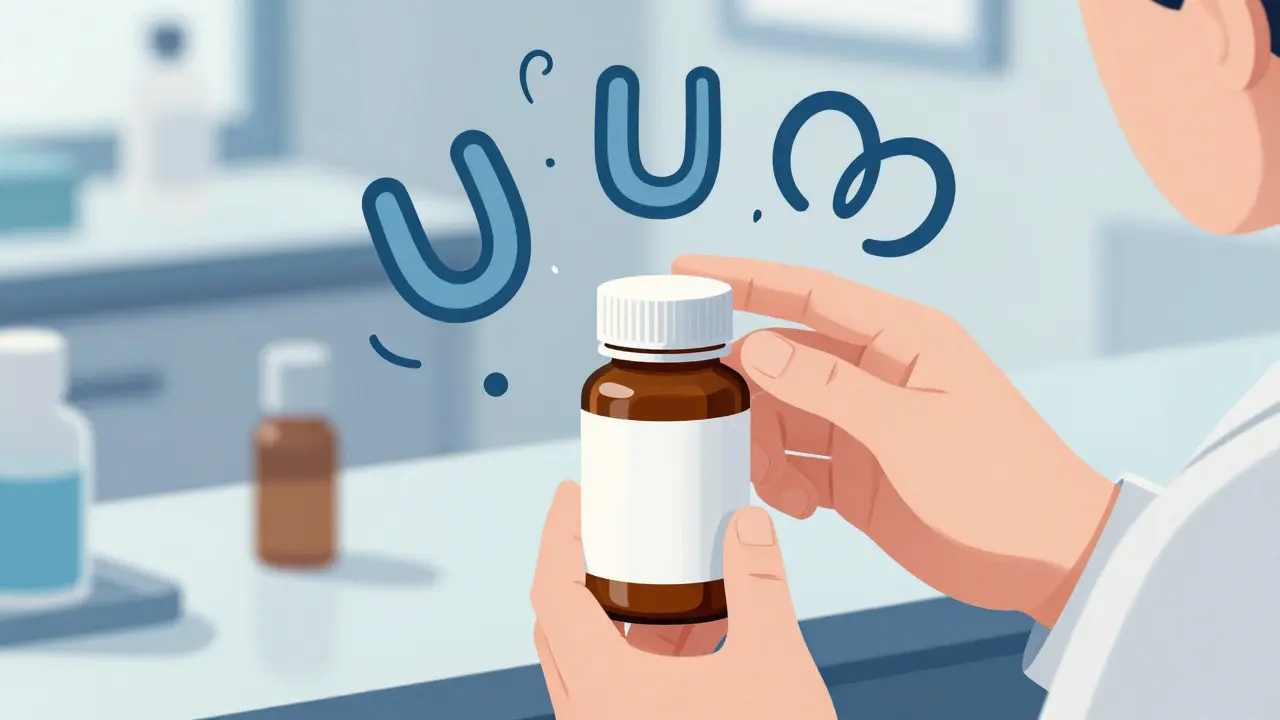
How a drug is given matters as much as the drug itself. 'SC' usually means subcutaneous, but it frequently gets misread as 'SL' (sublingual). Another common culprit is 'SQ', also for subcutaneous, which can be transcribed as '5 every' if the 'S' looks like a '5'. Then there are units. The letter 'U' is often written so small it resembles a zero. If a doctor prescribes insulin as 10 U, a pharmacy tech might see 100 and dispense ten times the dose. The International Unit ('IU') suffers a similar fate, often confused with 'IV' (intravenous) or the number 10.
Drug Name Shortcuts
This category is particularly dangerous because the names sound almost identical. 'MS' or 'MSO4' is the classic example for morphine sulfate. When handwritten poorly, the 'S' becomes a 'g', turning it into 'MgSO4' (magnesium sulfate). Giving magnesium sulfate instead of morphine won't kill a patient immediately in all cases, but it means they get no pain relief while suffering, or receive the wrong electrolyte balance entirely.
| Dangerous Abbreviation | Potential Misinterpretation | Safe Alternative (Required) |
|---|---|---|
| QD (once daily) | QID (four times daily) or OD (overdose) | daily |
| QOD (every other day) | QD (daily) | every other day |
| U (unit) | Zero, CC, or 4 | unit |
| IU (International Unit) | IV (intravenous) or 10 | International unit |
| MS or MSO4 | MgSO4 (Magnesium Sulfate) | Morphine Sulfate |
| cc | uu or u | mL (milliliters) |
| SC or SQ | Sublingual or SL | Subcutaneous |
| @ | a.u. (ounce) or 4 | at |
Technology Can't Fix Everything
You might assume that electronic health records (EHRs) solved this problem entirely. Modern systems certainly help; they reduce abbreviation-related errors significantly compared to handwritten orders. However, free-text entry fields remain a loophole. Doctors often type abbreviations even when the system allows full typing because it saves seconds. Studies indicate that even in digital environments, nearly 13% of medication errors still involve misinterpreted abbreviations because users bypassed dropdown menus.
Voice recognition technology has become the next frontier. By 2026, the majority of major EHR platforms are expected to include automatic correction features. These tools flag prohibited terms as soon as a provider dictates them. While powerful, these systems rely on the software being up-to-date. If the hospital hasn't updated their dictionary since 2023, they miss the newer risks added by the ISMP in January 2024, such as antiretroviral medication codes like DOR or TAF.
Implementation Struggles
Even with technology, human habits are stubborn. Surveys from the American Medical Association suggest that older physicians are statistically more likely to continue using banned shorthands despite institutional policies. This creates a generational gap in safety culture. Successful programs combine EHR restrictions with immediate feedback. When a doctor tries to type "QD," the system blocks them instantly rather than sending a warning email later. Real-time intervention works better than education alone.
Risks for Patients and Families
You play a vital role in your own safety. Pharmacists catch many errors, but they cannot catch everything. If you ever see a prescription slip with an unclear acronym, ask questions. A study involving community pharmacy forums revealed that over 60% of pharmacists had intercepted dangerous abbreviations in the previous year. Your vigilance acts as a final checkpoint.
Be especially alert when refilling chronic medications. If the label says "take daily" but you recall seeing a different instruction previously, verify the change. Look specifically for unit confusion. Does the bottle say mL or cc? Both measure volume, but modern labeling prefers mL to avoid confusion with units (u) or ounces (oz).

Global Standards and Future Outlook
While The Joint Commission focuses on the United States, the principles travel well. Organizations in New Zealand, Australia, and the United Kingdom maintain similar guidelines. For instance, ISMP Canada released its own list in 2020, mirroring many US prohibitions. As of 2024, we are seeing a surge in AI integration within clinical workflows. Artificial intelligence models can now scan incoming prescriptions for dangerous symbols in real-time. This adds a layer of defense beyond human review.
Economic pressure is also driving adoption. Regulatory bodies like CMS have tied reimbursement rates to patient safety metrics. Facilities with high error rates, including those caused by ambiguous abbreviations, face financial penalties. This motivates leadership to enforce strict compliance across nursing and pharmacy departments.
Checklist for Safe Prescribing
- Always spell out "daily" instead of using QD.
- Write "unit" fully, never use a solitary U or IU symbol.
- Use milliliters (mL) instead of cubic centimeters (cc).
- Never abbreviate drug names like Morphine Sulfate (write out completely).
- Confirm clarity on discharge instructions given to patients.
- Ensure electronic signatures match the written intent.
What Happens When Rules Fail?
When enforcement lapses, consequences can be severe. A documented incident involved a prescription for TAC cream, meant as triamcinolone, but read as Tazorac due to poor handwriting. The patient received inappropriate treatment for their skin condition. Another near-miss involved 'BIW' (twice weekly) being transcribed as 'twice daily' for a chemotherapy drug called chlorambucil. Had that been administered, the dosage would have been drastically higher, risking organ failure.
These stories illustrate that the issue isn't just technical; it is cultural. Changing how hundreds of doctors write requires sustained effort. Education must happen continuously, not just during orientation. Feedback loops where staff report near-misses anonymously encourage a culture of openness rather than blame.
Why is QD considered the most dangerous abbreviation?
QD is often misread as QID (four times daily) or OD (overdose). Research shows it accounts for over 43% of abbreviation-related errors because the handwritten 'D' visually resembles other letters.
Does electronic prescribing eliminate these errors?
No. While EHRs reduced errors significantly, nearly 13% of mistakes still occur due to free-text entry fields where doctors manually type restricted abbreviations instead of selecting from safe lists.
Is the Do Not Use list mandatory worldwide?
It is mandatory for accreditation by The Joint Commission in the US. Other countries like New Zealand and UK have similar voluntary or regulatory guidelines adapted from these standards.
Can patients request full spelling on prescriptions?
Yes, you have the right to clear communication. Asking for the full drug name and frequency ensures you understand what you are taking and reduces the risk of dispensing errors.
What is the difference between IU and IV?
IU stands for International Unit, a measurement of biological activity, while IV stands for Intravenous, meaning into the vein. They look similar and are easily swapped, leading to route errors.




Aysha Hind
The real issue here is that these lists are updated too frequently to be anything other than a deliberate attempt to confuse the workforce with shifting goalposts. Why does ISMP keep changing the rules every single year if standardization is actually the priority for patient safety? It feels like a strategy to keep liability low for insurance companies while the staff burns out trying to memorize impossible dictionaries. We are told this is for protection yet the technology promised to solve the problem still allows free text entry fields that bypass every restriction. They claim electronic health records fixed things but anyone who works in a clinic knows the software crashes whenever you try to override a warning flag intentionally. The sheer number of abbreviations on the banned list suggests a systemic desire to obscure information rather than clarify it for the average person. People ignore the warnings because they suspect the data is manipulated to show higher error rates where funding isn't available. It is suspicious that older physicians are cited as the problem when the software itself permits the behavior to occur despite policies. We should be asking why the dictionary updates lag behind actual clinical practice by months every time a new risk emerges. This entire framework smells like compliance theater designed to protect the accreditors from lawsuits during investigations. I refuse to trust an acronym that changes meaning based on which region of the country you happen to reside in.
Brian Shiroma
Oh sure the whole world is out to get you with these little letters but let us pretend nobody actually reads the warning labels either. You make it sound like a grand design when half the mistakes are just folks rushing to grab a cup of coffee between patients. It is funny how the paranoia spikes when the topic shifts from simple negligence to intentional malice without any proof. At least the list exists to help people who actually want to follow rules instead of blaming the architects for their own failures.
Jenna Carpenter
Im sick of doctors thiking they are gods just becouse they wear white coats. Writing MS for morfine is jus plain stupid and shows they dont respect us enough to type it out properly. They should get fired if they cant read there own notes let alone expect others to figure it out. I hope the govment starts fining hospitals for evry single error caused by these lame abbreviations.
Lawrence Rimmer
Language is a construct anyway so what is the point of fighting over dots and lines when the intent is always misunderstood by nature. Humans speak differently even when they use the same words so expecting perfect notation is just setting ourselves up for disappointment. The universe abhors a vacuum and medicine seems to fill that void with more bureaucracy instead of fewer symbols. Perhaps we should embrace the chaos of communication rather than trying to legislate perfect clarity through a government mandate. It reminds me of how latin phrases were used for centuries and yet they eventually became obsolete through pure laziness. Maybe the future is voice recognition because typing takes too much effort for everyone involved anyway.
Dipankar Das
Your philosophical detachment ignores the tangible human cost associated with preventable medication errors in clinical settings today. Ambiguity is not a feature of effective healthcare delivery it is a bug that leads to organ failure and unnecessary death. We must prioritize precision over existential musing when patients rely on accurate dosage instructions for their survival. The suggestion that chaos should be embraced is negligent reasoning that lacks any grounding in ethical medical standards. Clear protocols save lives and vague philosophies provide no defense against toxicological overdose events. You must understand that safety regulations exist specifically to counteract the inevitable drift toward carelessness inherent in human cognition.
simran kaur
Everyone assumes the Joint Commission acts with good intentions but they often prioritize hospital accreditation scores over actual patient outcomes. Why would a bureaucratic body suddenly care about handwriting styles if not to create more paperwork requirements for small clinics? I see this as a way to consolidate control under large systems that can afford expensive software updates easily. Smaller hospitals struggle to implement these changes so naturally they face higher penalties which drives them out of business faster. It creates a monopoly of care where only the wealthy institutions survive the transition period. We should investigate the profit motives behind pushing standardized lists rather than accepting them blindly.
sophia alex
I absolutely cannot believe we are still discussing this garbage in the year 2026 because it is honestly criminal negligence that we have allowed this slide. It feels like the doctors are trying to hide something from us poor patients who just want our lives saved without the paperwork nightmare. My cousin almost died because the pharmacy thought her script said daily when it actually meant every other day and now she has kidney issues forever. The arrogance of these providers thinking their scribbles are universal languages is exactly why people don't trust hospitals anymore. We deserve digital clarity instead of guessing games that look like ancient hieroglyphics written by a toddler. They act like it is common knowledge but then they blame the system when someone gets poisoned by magnesium sulfate instead of morphine. I read somewhere that thirty seven percent of errors could be stopped just by writing the word unit out fully but who listens to data in this country? Nobody wants to admit they are wrong so the culture of silence keeps protecting these lazy practitioners from accountability. It makes me so angry to think about families losing loved ones over a single letter U that looks like a zero. If you think your doctor cares enough to spell everything out then you are sadly mistaken about how broken healthcare really is. We need stricter laws immediately before another family has to deal with the grief caused by a sloppy pen stroke. Stop making excuses for bad handwriting because it costs real money and real lives every single day. The only reason they keep using these shortcuts is because they refuse to update their systems to the new standards. We need to push back hard or nothing will ever change for the better in my lifetime. :) :(
Rachelle Z
This is literally wild and everyone needs to see this ASAP! 😂🙄💯
Hope Azzaratta-Rubyhawk
We must remain steadfast in our commitment to improving safety standards regardless of the resistance encountered by established professionals. Progress requires active enforcement of guidelines rather than passive acceptance of historical habits that endanger individuals. Every hospital administrator has a duty to update their databases and enforce restrictions on prohibited terms immediately. Families deserve absolute confidence that their prescriptions are processed without ambiguity or confusion during dispensing. The path forward lies in rigorous auditing and feedback loops that catch errors before administration occurs. We will achieve better outcomes if we hold every provider accountable for clear communication practices consistently.