
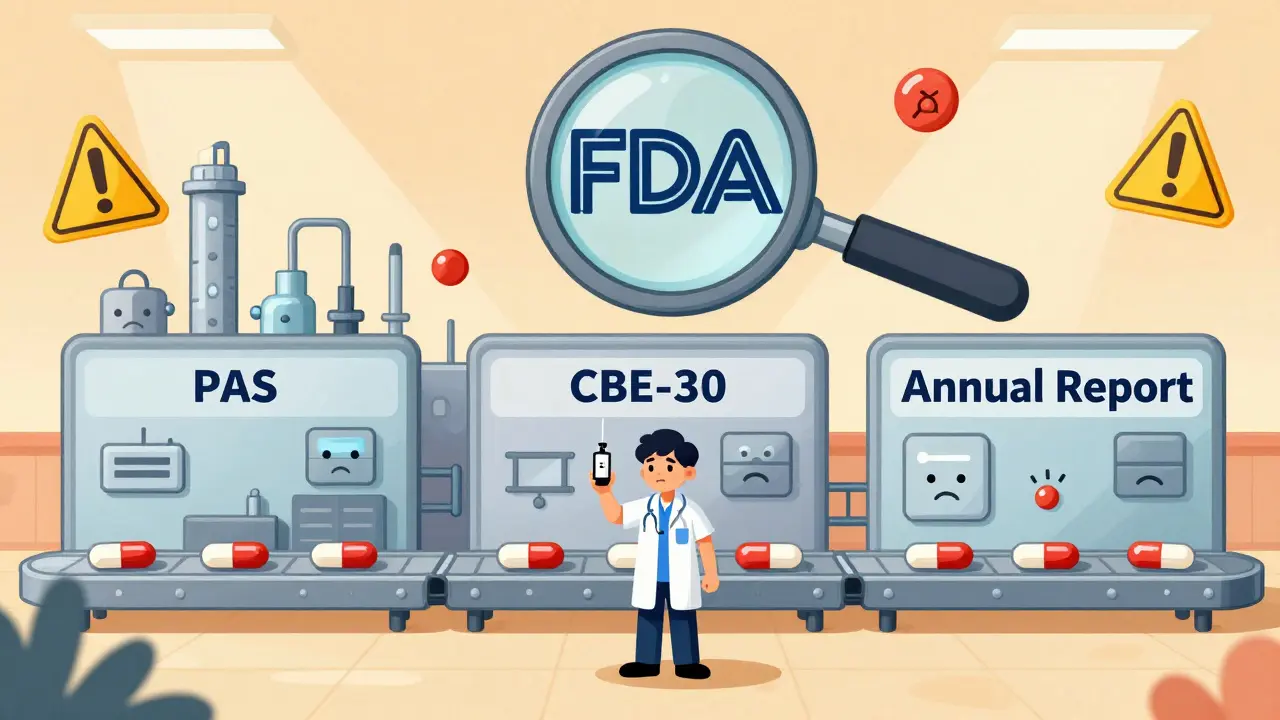
When a pharmaceutical company tweaks a single step in its drug manufacturing process - even something as small as swapping out a pump or moving a mixing tank - it’s not just an internal operational decision. It’s a regulatory event. Under U.S. law, manufacturing changes must be classified, documented, and approved before the product hits the market. Failure to follow the rules can lead to warning letters, product recalls, or even a shutdown of production lines. This isn’t about bureaucracy. It’s about ensuring every pill, injection, or inhaler you take is safe, effective, and exactly what the label says it is.
Why Manufacturing Changes Matter
Every drug approved by the FDA has a specific recipe and process behind it. That includes the active ingredient, the equipment used, the facility where it’s made, and how quality is tested. If you change any of those, you risk altering the drug’s identity, strength, purity, or potency. Even a minor change - like switching to a different supplier for a raw material - can affect how the drug dissolves in your body. That’s why regulators require strict controls. The goal isn’t to slow things down. It’s to prevent harm.The Three Tiers of Change: FDA’s System Explained
The U.S. Food and Drug Administration (FDA) uses a three-tier system to manage manufacturing changes under 21 CFR 314.70. Each category has different rules for when and how you notify the agency.- Prior Approval Supplement (PAS) - This is for major changes with a high risk of affecting product quality. Examples: changing the chemical synthesis route for the active ingredient, moving production to a new facility, or replacing critical equipment that alters process parameters. You cannot distribute the product until the FDA approves your submission. This can take 6 to 12 months.
- Changes Being Effected in 30 Days (CBE-30) - Used for moderate changes. You submit the notification 30 days before making the change. Examples: replacing a tablet press with an identical model from the same manufacturer, or updating software controlling a filling machine. You can proceed after 30 days unless the FDA objects. If the change affects identity, strength, or purity, you may need a CBE-0, which allows immediate implementation but requires immediate notification.
- Annual Report - For minor changes with low risk. Examples: changing the location of a non-critical step within the same facility, or updating packaging design that doesn’t affect the product. These are documented and reported once a year, typically within 60 days of the application’s anniversary date.
The key to getting this right? Risk assessment. The FDA expects you to ask: Could this change impact the drug’s safety or effectiveness? If yes, it’s likely not a minor change.
How Other Regulators Compare
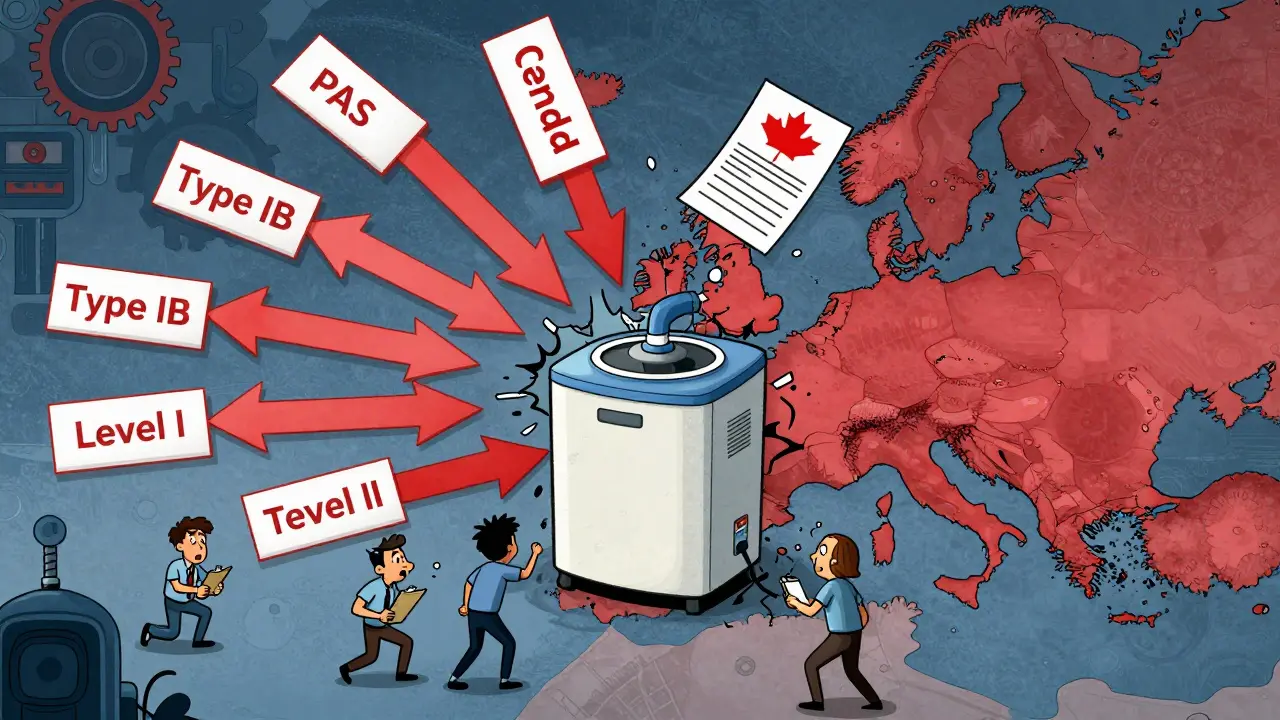
The U.S. isn’t alone. Other major markets have their own systems - and they don’t always line up.- European Medicines Agency (EMA) uses Type IA (minor, notify within 12 months), Type IB (moderate, must be approved before implementation), and Type II (major, full review). Unlike the FDA’s CBE-30, EMA doesn’t let you implement before approval for Type IB changes. There’s no "do and tell" option for moderate changes.
- Health Canada mirrors the FDA’s three-tier model: Level I (prior approval), Level II (notify and wait), and Level III (annual report). But their definitions of "equivalent" equipment are stricter.
- WHO Prequalification requires a Comparability Protocol - a detailed plan showing how you’ll prove the change didn’t hurt quality. This includes stability data, bioequivalence studies, and risk analysis.
For companies selling globally, this means managing multiple systems. A change approved as CBE-30 in the U.S. might need full approval in Europe. That’s why many big pharma firms build global change control systems that track requirements across regions.

What Counts as "Equivalent" Equipment?
One of the most common gray areas is equipment replacement. If you swap a mixer for a new one, is it the same? The FDA says: only if it has the same principle of operation, same critical dimensions, and same material of construction. A stainless steel tank with a different impeller design? That’s likely a PAS. A newer model from the same vendor with identical specs? Probably CBE-30.But here’s the catch: companies often assume "newer = better" and assume it’s equivalent. That’s dangerous. Even a small change in agitation speed or heat transfer rate can affect particle size, dissolution rate, or contamination risk. One 2023 FDA warning letter cited a company that replaced a lyophilizer (freeze-dryer) without a PAS - and the new unit had a different drying profile that altered the drug’s stability. The product had to be pulled from shelves.
Real-World Challenges and Pitfalls
In practice, getting this right is hard. A senior regulatory affairs specialist on Reddit described spending 37 hours just deciding whether a tablet press replacement was CBE-30 or PAS. Why? Because the API’s particle size distribution was borderline, and the validation data wasn’t clear enough.Common mistakes include:
- Classifying a major change as minor to save time
- Assuming "same vendor = same equipment" without checking specs
- Not documenting the risk assessment properly
- Forgetting to update batch records or validation protocols after the change
According to FDA data, 22% of all warning letters in 2022 were tied to manufacturing change violations. Of those, 37% involved equipment changes. That’s not a small number. It’s a red flag.
How Companies Handle This in Real Life
Large companies like Pfizer use internal risk-scoring tools - sometimes 15-point checklists - to classify changes. They factor in: impact on critical quality attributes, process validation status, historical performance, and supplier reliability. Smaller firms often struggle. One mid-sized generic manufacturer told a 2023 industry survey they had to hire two new regulatory staff just to keep up with change control demands.Best practices include:
- Using Failure Modes and Effects Analysis (FMEA) to evaluate risk before any change
- Collecting comparative data from at least three batches before and after the change
- Keeping detailed facility diagrams, equipment specs, and process validation reports
- Training QA, manufacturing, and regulatory teams together - not in silos
The Parenteral Drug Association’s Technical Report No. 60 recommends FMEA as the gold standard for equipment changes. It’s not just paperwork - it’s a way to think through what could go wrong.
What’s Changing in 2025?
Regulators are adapting. The FDA’s 2023 draft guidance pushes for using ICH Q9 quality risk management principles to make decisions more consistent. The EMA introduced faster review paths for certain Type IB changes in early 2023. And more companies are using real-time monitoring data - like sensors tracking temperature, pressure, or moisture - to prove changes don’t affect quality. Six major firms ran pilot programs in 2022-2023 showing this can reduce the need for lengthy stability studies.But the biggest shift is in advanced therapies. Drugs made with cell and gene technologies are so sensitive that nearly 78% of their manufacturing changes now require PAS submissions. The current system wasn’t designed for this. Regulators know it. Industry knows it. Change is coming - but not fast enough.
What You Need to Do Today
If you work in pharma manufacturing or quality control, here’s your action list:- Review every change you’ve made in the last 12 months. Was it classified correctly?
- Ensure your team has access to the latest FDA guidance documents - especially the 2021 biologics update and 2022 equipment change clarifications.
- Run a risk assessment using FMEA before any equipment swap, process tweak, or supplier change.
- Document everything - not just the decision, but the data behind it.
- When in doubt, ask the FDA. Early consultation can save months of delays.
There’s no shortcut. Every change, no matter how small, carries risk. The system exists not to frustrate you - but to protect patients. Get it right, and you’re doing more than complying. You’re ensuring trust in medicine.
What happens if I make a manufacturing change without notifying the FDA?
If you implement a change without proper notification or approval, the FDA can issue a warning letter, demand a product recall, or order you to stop shipping the product. In severe cases, the facility may be barred from producing regulated products. Enforcement actions increased in 2023, with four warning letters issued specifically for misclassified equipment changes.
Can I use a new supplier for raw materials without a PAS?
It depends. If the new material has the same chemical structure, purity, and performance as the original, and you have data showing no impact on critical quality attributes, it may qualify as a CBE-30 or annual report. But if the new supplier changes particle size, moisture content, or impurity profile, it’s likely a PAS. Always run comparability studies.
Do I need to re-validate the entire process after a minor change?
Not necessarily. For minor changes, you may only need to validate the affected part of the process. But you must still collect data from at least three consecutive batches to prove quality hasn’t changed. Skipping validation - even for small changes - is a common reason for FDA citations.
How long does a Prior Approval Supplement (PAS) take to get approved?
FDA review for a PAS typically takes 6 to 12 months. Complex changes - like new biologics manufacturing or major facility relocations - can take longer. The clock starts when the FDA accepts your submission. Delays often happen if the application is incomplete or lacks sufficient comparability data.
What’s the difference between CBE-30 and CBE-0?
CBE-30 lets you implement the change after 30 days unless the FDA objects. CBE-0 is for changes that directly affect product identity, strength, purity, or potency - you implement immediately but must notify the FDA right away. CBE-0 is rare and only used when waiting 30 days would cause a public health risk, like a critical drug shortage.
Are there tools to help classify manufacturing changes?
Yes. Many companies use internal risk assessment tools based on ICH Q9 or FMEA. The FDA’s 2021 biologics guidance includes a table listing common changes and their recommended categories. Regulatory software platforms like Veeva Vault or MasterControl also have built-in classification workflows. But no tool replaces human judgment - especially for complex or novel changes.
How often do regulatory agencies inspect change control systems?
FDA inspections of manufacturing sites occur every 2-3 years on average, but they can happen sooner if there’s a complaint or recall. Change control is always a top inspection item. In 2022, 41% of Form 483 observations (inspection findings) related to change management failures.







Glenda Marínez Granados
So let me get this straight... we spend millions to make sure a pill dissolves just right, but if a pump gets swapped, we need a 12-month wait? 🤦♀️ We’re treating medicine like it’s made by elves in a cave, not humans with spreadsheets.
Also, why does every change feel like a courtroom drama? I just want my headache medicine to work, not read a 50-page risk assessment.
Also also - who’s paying for all this? The patient? The insurance company? Or the FDA’s coffee budget? 😅
Yuri Hyuga
This is one of those rare topics where regulation isn’t just bureaucracy - it’s a lifeline. Every time you swallow a pill, you’re trusting that someone, somewhere, did the math, ran the tests, and didn’t cut corners.
Yes, the system is slow. Yes, it’s complex. But imagine if every change was a gamble. That’s not innovation - that’s negligence.
To the teams grinding through FMEA forms and batch validations: thank you. You’re the quiet guardians of public health. Keep going. 🙏
MARILYN ONEILL
OMG I can’t believe people still think this is ‘necessary’. Like, who even cares if the mixer has a different impeller? It’s just a pill. People are dying from opioids, not from a 0.5% variance in dissolution rate.
Also, why do we let the FDA run everything? Europe’s worse. Canada’s worse. WHO? LOL. We need a new system. Like, blockchain for pills. Or AI. Or something.
STOP OVERREGULATING. JUST LET PEOPLE MAKE DRUGS.
Coral Bosley
I used to work in QC. One day, they swapped a filter. Just. A. Filter.
Three months later, a batch came back with 3% more impurity. No one noticed until a patient’s kidney failed.
They blamed the vendor. Then they blamed QA. Then they blamed the software.
No one blamed the guy who said, ‘It’s the same model.’
I quit. Not because I was scared. Because I was sick of pretending that ‘same’ means ‘safe’.
Steve Hesketh
I see so many of my brothers and sisters in pharma overseas struggling with this - especially in places where resources are thin.
But hear me: this isn’t about red tape. It’s about respect. Respect for the person who takes your medicine. Respect for their child. Respect for their grandmother.
Yes, it’s hard. Yes, it’s slow. But when you’re holding that vial, you’re holding someone’s hope.
Don’t rush it. Don’t cut corners. Don’t make it about speed. Make it about safety. You’re not just making pills - you’re making peace of mind.
Kevin Narvaes
why do we even have rules like this? like, who even decided that a pump = life or death?
its just a machine. you replace it. you test it. you move on.
the real problem? people overthink everything.
if it works, its fine. if it dont, we fix it.
why do we need 15 pages of paperwork for a new tank?
someone got rich off this system. and its not you.
Dee Monroe
I’ve spent the last decade in regulatory affairs, and I’ll tell you this: the system isn’t broken - it’s just under-resourced.
Every change, no matter how small, is a ripple. And ripples can become waves. I’ve seen a change in labeling font lead to a misdosage because a nurse misread it.
It’s not about control. It’s about control of chaos.
We’re not just managing equipment - we’re managing human vulnerability.
And yes, the paperwork is endless. But when you hold a patient’s chart and realize you prevented a tragedy because you caught a misclassified change…
you don’t mind the 3 a.m. audits anymore.
Alex Carletti Gouvea
America’s the only country that lets companies make changes and then tell the government later. That’s not freedom - that’s arrogance.
Europe says ‘wait’. Canada says ‘prove it’. We say ‘do it and hope’.
And then we wonder why people don’t trust our drugs.
Stop pretending our system is better. It’s just faster. And faster doesn’t mean safer. It just means more lawsuits later.
Philip Williams
This is an excellent breakdown. One thing I’d add: the real bottleneck isn’t the FDA - it’s the internal validation teams.
Most companies don’t have enough qualified personnel to run comparability studies in parallel.
That’s why PAS submissions pile up. Not because regulators are slow - because the industry is understaffed in QC and analytical development.
Invest in people, not just software. The tools help, but the judgment? That’s human.
Kelly McRainey Moore
Honestly? I skimmed half of this. But I get the gist: don’t mess with the pill machine.
My grandma takes 7 meds a day. If one of them turns into a brick because someone swapped a pump… I’d be mad.
So yeah. Keep the rules. I’m not mad. Just… tired of reading.
lokesh prasanth
CBE-30 is a joke. If you can’t prove equivalence in 30 days, you shouldn’t be making the change.
Industry is lazy. Regulators are asleep.
Fix the data. Not the form.
Samuel Mendoza
The FDA doesn’t care about patients. They care about liability.
If a change causes harm, they get sued.
If they say ‘yes’ to a PAS and it causes harm, they get sued.
So they say ‘no’ to everything.
It’s not safety. It’s legal insurance.
Jarrod Flesch
I’ve been on the other side - worked in a small biotech in Melbourne. We had one regulatory person. One lab tech.
When we upgraded our HPLC, we spent six weeks comparing old vs new chromatograms. Took 17 batches. We cried when we got the data.
It wasn’t fun. But when the FDA inspector said ‘this is the cleanest change control file I’ve seen’…
we knew it mattered.
Don’t underestimate the power of good data. It’s the only thing that speaks louder than bureaucracy.
Barbara Mahone
The precision of this system is astonishing. Every decimal point, every impurity threshold, every equipment spec - it’s all a reflection of the scientific rigor required to ensure human safety.
It’s not perfect. But it’s the most thoughtful framework we’ve built to protect people from invisible harm.
Those who call it excessive haven’t held a vial of medicine that could save a life - and accidentally poisoned it.
Stephen Rock
PAS is a scam. CBE-30 is a loophole. Annual report is a joke.
Everyone knows it.
They just pretend not to.
Same vendor = same equipment? LOL
Next you’ll tell me a Tesla and a Prius are the same because they both have wheels