Imagine taking a blood pressure medication for ten years without a single problem, and then suddenly waking up with lips and a tongue so swollen you can barely speak. It sounds like a freak accident, but for some people, it's a specific, dangerous reaction to a common class of drugs. This isn't your typical allergic reaction to peanuts or bee stings; it's a biological glitch involving a peptide called bradykinin that can turn a routine prescription into a life-threatening emergency.
If you or a loved one are taking medication for hypertension or heart failure, knowing how to spot this specific type of swelling can literally save a life. Because this reaction doesn't respond to the usual "allergy" meds, the wrong treatment in the ER can waste precious minutes while an airway closes. Understanding the difference between a hive and a deep-tissue swell is the first step in staying safe.
Quick Summary: What You Need to Know
- The Cause: A buildup of bradykinin in the tissues, not a histamine-led allergy.
- The Signs: Sudden swelling of the lips, tongue, face, and throat, usually without itching or hives.
- The Danger: Potential for rapid airway obstruction and respiratory failure.
- The Fix: Immediate and permanent stop of the medication; standard allergy meds (Benadryl, Epinephrine) usually don't work.
- High-Risk Groups: African Americans and women are statistically more likely to experience this reaction.
What Exactly is ACE Inhibitor Angioedema?
To understand this reaction, we first have to look at ACE Inhibitors is a class of medications used primarily to treat high blood pressure, heart failure, and kidney disease by blocking the angiotensin-converting enzyme. While they are lifesavers for millions, they have a specific side effect: Angioedema is a deep swelling of the skin and submucosal tissues.
Normally, your body uses the ACE enzyme to break down Bradykinin, which is a powerful vasodilator peptide that makes blood vessels leak. When you take an ACE inhibitor, you block that enzyme. If your body doesn't have enough "backup" ways to clear out the bradykinin (like through the enzyme aminopeptidase P), the peptide builds up. This causes fluid to leak into your tissues, creating that sudden, frightening swelling.
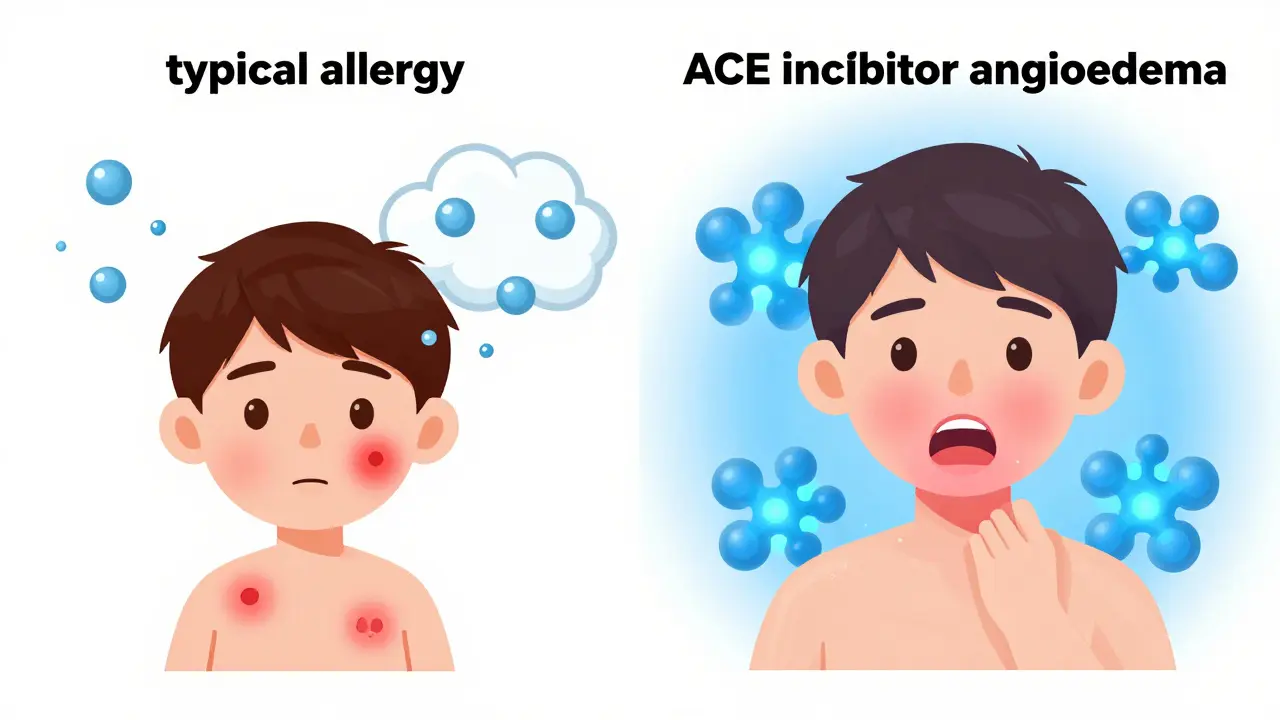
This is fundamentally different from an allergic reaction. In a typical allergy, your body releases histamine, which causes itchy red hives. With ACE inhibitor angioedema, there are usually no hives and no itching. It's a chemical accumulation, not an immune system overreaction.
Spotting the Red Flags: Symptoms and Timing
The most common areas affected are the face, lips, tongue, and throat. It often starts as a mild puffiness but can progress rapidly. You might notice your lips feel "thick" or your tongue feels too large for your mouth. The real danger happens when the swelling hits the larynx (voice box) or the upper airway, making it hard to breathe or swallow.
One of the most confusing parts about this drug reaction is when it happens. You might think, "I've been on this pill for years, so it can't be the medicine." That's a dangerous assumption. While about 50% of cases happen in the first week of treatment, others appear after months or even a decade of stable use. There are documented cases of patients developing this reaction after 10 years of continuous therapy.
Certain people are at a higher risk. Research shows that African Americans are 2 to 4 times more likely to experience this than other groups. Women also experience it more frequently than men, with a ratio of about 2:1. Additionally, if you take an ACE inhibitor alongside a DPP4 inhibitor (common for type 2 diabetes), your risk of swelling jumps 4 to 5 times higher.
| Feature | ACE Inhibitor Angioedema | Typical Allergic Reaction |
|---|---|---|
| Primary Driver | Bradykinin accumulation | Histamine release |
| Skin Appearance | Deep swelling, pale or pink | Hives, red rash (Urticaria) |
| Itching/Tingling | Rarely present | Common and intense |
| Response to Epinephrine | Generally ineffective | Highly effective (Life-saving) |
| Response to Steroids | Little to no effect | Reduces inflammation over time |
The Danger of the "Standard" ER Response
Here is where things get scary. Because the swelling looks like a severe allergy, many emergency room doctors immediately reach for epinephrine (EpiPen), antihistamines (like Benadryl), and corticosteroids. However, since this is a bradykinin problem and not a histamine problem, these drugs usually do absolutely nothing.
When a doctor spends 30 minutes administering meds that don't work, they are losing time that should be spent on airway protection. If the throat is closing, the priority isn't a shot of steroids-it's ensuring the patient can breathe, which might require intubation or a tracheotomy. This mismatch in treatment is why many patients report multiple ER visits before someone realizes the blood pressure medication is the culprit.
Treatment and Immediate Action
If you suspect you are experiencing this reaction, the very first thing you must do is stop taking the medication immediately. This is the only way to stop the accumulation of bradykinin. If you keep taking the pill, the episodes will likely happen more often and become more severe.
For severe cases where the airway is threatened, doctors may use specialized treatments:
- Icatibant (Firazyr): This is a bradykinin B2 receptor antagonist. It basically blocks the peptide from doing its damage and can provide relief within 2 to 4 hours.
- Ecallantide: A kallikrein inhibitor that prevents the formation of bradykinin.
- Fresh Frozen Plasma (FFP): Used off-label in some cases because it contains the active ACE enzyme that can help clear the bradykinin from your system.
Once the acute crisis is over, you can't just switch to another drug in the same class. You must permanently avoid all ACE inhibitors. Many doctors switch patients to ARBs (Angiotensin II Receptor Blockers), which are generally safer. While there is a small chance of cross-reactivity (about 10-15%), the overall risk of angioedema is roughly 10 times lower with ARBs than with ACE inhibitors.

Long-Term Management and Prevention
Recovery isn't always instant. Some people find that mild swelling lingers for months after they stop the drug. This can be frustrating and confusing, but it's a known part of the process as the body resets its chemical balance.
The biggest risk after an episode is recurrence due to a medical mistake. If your chart simply says "allergic to lisinopril," a different doctor might think you can safely take a different ACE inhibitor like ramipril. This is a mistake. You need your records to explicitly state "ACE inhibitor-induced angioedema" as a permanent contraindication.
To protect yourself in an emergency, consider these steps:
- Medical Alert Bracelet: Wear a bracelet that clearly states your reaction to ACE inhibitors. In a crisis where you can't speak, this tells the ER team to skip the Benadryl and focus on the airway.
- Update All Pharmacies: Ensure every pharmacy you use has this listed as a severe adverse reaction.
- Educate Your Family: Make sure your partner or children know that if you swell up, it's not a food allergy and needs specific emergency handling.
Can I take a different ACE inhibitor if one caused swelling?
No. Once you have experienced ACE inhibitor-induced angioedema, you must avoid the entire class of medications. Switching to a different drug within the same class can trigger another, potentially more severe, episode of swelling.
Why doesn't Benadryl work for this kind of swelling?
Benadryl (diphenhydramine) is an antihistamine. It blocks histamine receptors. However, ACE inhibitor angioedema is caused by bradykinin, not histamine. Since the underlying chemical trigger is different, antihistamines have no effect on the swelling.
Are ARBs a safe alternative?
Generally, yes. Angiotensin II Receptor Blockers (ARBs) have a much lower incidence of angioedema-about 10 times lower. However, some cross-reactivity occurs in 10-15% of patients, so you should start them under close medical supervision.
How long does it take for the swelling to go away after stopping the drug?
Acute symptoms typically resolve within 24 to 48 hours after the medication is stopped. However, some patients report mild, intermittent swelling that can persist for several months as the body clears the accumulated peptides.
Is this condition hereditary?
While this specific reaction is drug-induced, some people have a genetic predisposition. For example, variations in the XPNPEP2 gene can make a person significantly more likely to develop angioedema when taking these drugs. It is different from Hereditary Angioedema (HAE), which is a separate genetic disorder involving C1-inhibitor deficiency.
Next Steps and Troubleshooting
If you are currently taking an ACE inhibitor and feel any unusual puffiness in your face or tongue, do not wait for it to "go away." Call your doctor immediately or head to the emergency room. If you are at the ER, be very clear: "I am on an ACE inhibitor and I think I have angioedema." This specific phrasing helps the medical team move past the "allergy" mindset and prioritize your airway.
For those who have already survived an episode, schedule a review of your medication list with your pharmacist. Ensure that your records are updated to prevent any future prescriptions of this drug class. If you have a history of diabetes and are taking DPP4 inhibitors, discuss with your provider whether this combination increases your specific risk profile.