

Decongestant-Antihistamine Risk Checker
Assess Your Risk
Answer a few questions to see if combination decongestant-antihistamine medications are safe for you.
Many people reach for combination cold and allergy meds like Zyrtec-D or Claritin-D because they promise quick relief from runny nose, congestion, and sneezing-all in one pill. But what most users don’t realize is that these popular over-the-counter drugs carry hidden risks that can turn a simple remedy into a serious health problem.
How These Medications Work (and Why They’re Risky)
These combo pills typically pair a decongestant-usually pseudoephedrine-with an antihistamine like cetirizine or loratadine. The decongestant shrinks swollen blood vessels in your nose to clear congestion. The antihistamine blocks histamine, the chemical that triggers sneezing and itchy eyes. Sounds smart, right? But here’s the catch: these two ingredients don’t just work on your nose. They affect your whole body. Pseudoephedrine is a stimulant. It tightens blood vessels everywhere, not just in your sinuses. That’s why it can raise your blood pressure by 5 to 10 points if you already have hypertension. It can also make your heart race, cause anxiety, or keep you awake at night. For someone with heart disease or diabetes, this isn’t just inconvenient-it’s dangerous. Meanwhile, antihistamines like cetirizine (Zyrtec) or diphenhydramine (Benadryl) can make you drowsy. About 14% of people taking cetirizine feel noticeably sleepy. With diphenhydramine, that number jumps to 50%. Combine that with the jittery effect of pseudoephedrine, and you’ve got a tug-of-war inside your body. One part of you wants to sleep. The other part feels wired.What Happens When You Mix Them With Other Drugs
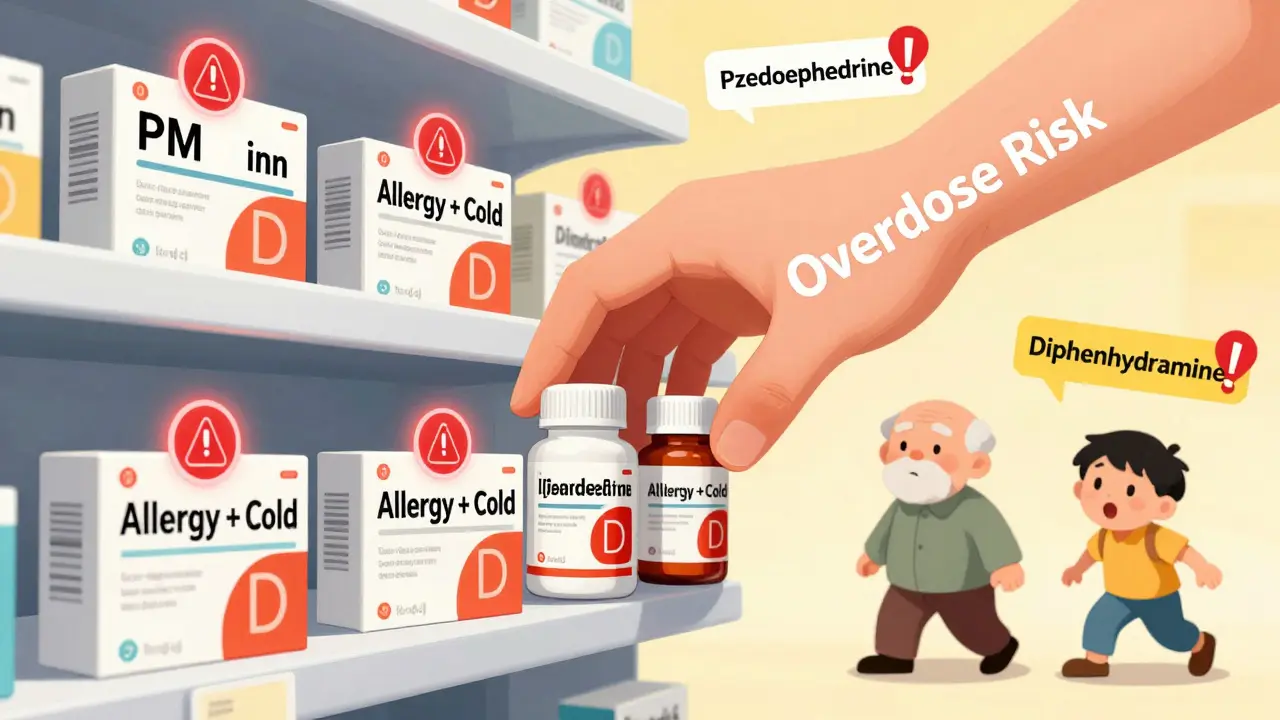
A lot of people don’t know they’re doubling up on antihistamines. Maybe you took Zyrtec in the morning. Then, at night, you grab Benadryl for trouble sleeping. Or you’re using a cold medicine that already has an antihistamine, and you add another one because your nose is still runny. That’s a recipe for trouble. The Poison Control Center warns: Do NOT take two different antihistamines at the same time. Mixing them can lead to extreme drowsiness, confusion, blurred vision, dry mouth, or even hallucinations. In severe cases, overdose can cause seizures, fast or irregular heartbeat, and-rarely-death. Even worse, many cold and flu products contain hidden antihistamines. You might think you’re just taking a pain reliever and decongestant, but if it says “PM” on the label, it likely has diphenhydramine. Take that with your daily allergy pill? You’re overloading your system.Who Should Avoid These Combos Altogether
These medications aren’t safe for everyone. If you have any of these conditions, you should talk to a doctor before using them:- High blood pressure
- Heart disease or irregular heartbeat
- Diabetes
- Enlarged prostate or trouble urinating
- Glaucoma
- Thyroid problems
The Real Numbers: How Often Do Problems Happen?
You might think, “I’ve taken this for years and never had an issue.” But that doesn’t mean it’s safe. A Cochrane review of multiple studies found that nearly 1 in 5 people taking antihistamine-decongestant combos experienced side effects-compared to 1 in 8 in placebo groups. That’s a 58% higher chance of trouble. And while most side effects are mild-drowsiness, dry mouth, dizziness-some aren’t. In 2022, the FDA’s MedWatch program received over 1,800 reports of adverse events linked to these exact combinations. That’s not just a number. Each one is someone who had a bad reaction: a racing heart, a fall from dizziness, a trip to the ER because they couldn’t urinate. And here’s something most people don’t know: phenylephrine, the decongestant in many “Sudafed PE” products, has been shown in multiple studies to be barely better than a placebo at relieving congestion. Yet it’s still sold everywhere. You’re paying for a drug that doesn’t work well-and still carries the same risks as pseudoephedrine.What to Do Instead
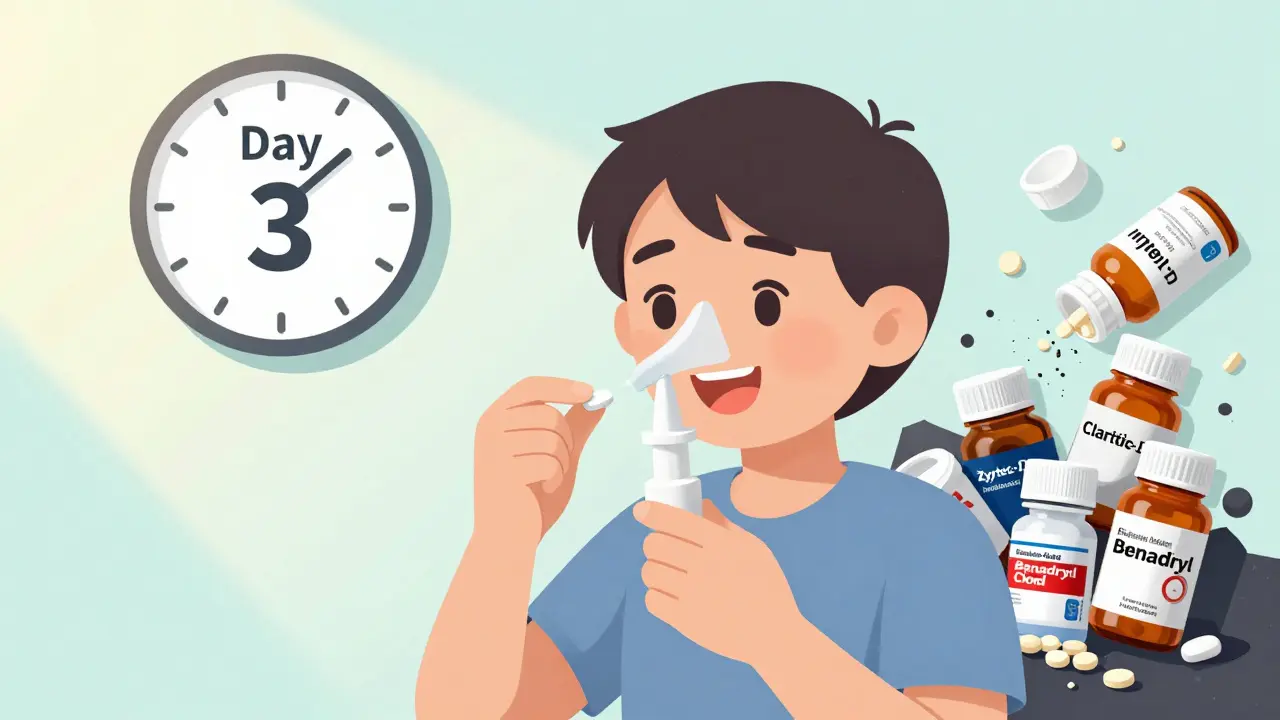
You don’t need a combo pill to feel better. Here’s what actually works:- For congestion: Use a saline nasal spray or a single decongestant like pseudoephedrine (behind the pharmacy counter) for no more than 3 days.
- For runny nose and sneezing: Take a non-sedating antihistamine like loratadine or fexofenadine alone.
- For both: Take them separately, at different times. Give yourself space between doses.
- For sleep: Don’t use Benadryl as a sleep aid. It disrupts deep sleep and can leave you groggy the next day.
How to Read Labels Like a Pro
Check the “Active Ingredients” section on the bottle. Look for these names:- Decongestants: pseudoephedrine, phenylephrine
- Antihistamines: cetirizine, loratadine, fexofenadine, diphenhydramine, chlorpheniramine







MARILYN ONEILL
This is why people die from OTC meds. I saw a lady at CVS last week buy three different cold pills and mix them like a cocktail. She said, 'I just need to feel better.' Honey, you're not making a smoothie. You're making a time bomb.
And don't even get me started on 'Sudafed PE'-it's just sugar water with a fancy label. The FDA knows it doesn't work. They just let it stay because people keep buying it. Sad.
I told my grandma this last year. She cried because she thought Benadryl was 'safe' for sleep. It's not. It's a chemical lobotomy for seniors.
Stop being lazy. Read the label. If it has 'D' or 'PM'-put it back. Your body isn't a lab experiment.
Steve Hesketh
Bro, this post is a gift. I've been telling my cousins in Lagos for years: don't mix your cold meds like you're making jollof rice with extra pepper. One time, my uncle took Zyrtec-D and then a 'sleep aid'-ended up in the ER with his heart pounding like a djembe drum.
We need more of this. Not just in the US. In Nigeria, Ghana, Kenya-people buy these pills like candy at the roadside stall. No one checks ingredients. No one knows what 'diphenhydramine' even means.
Please, share this with your auntie who thinks 'all medicine is good if it stops the sneezing.' We gotta save lives, one label at a time.
God bless you for writing this.
shubham rathee
you know what the real problem is the government lets these drugs be sold because big pharma owns them and they make billions from people being confused and buying 3 different bottles of the same thing and then getting sick and going to the hospital where they charge you 5000 dollars to fix what they sold you in the first place this is why i dont trust anything in america its all a scam and the labels are lies and they know it and they dont care and you think you're safe but you're not and they're laughing at you right now
Kevin Narvaes
it’s wild how we’ve turned healing into a performance art
we want to fix everything at once so bad we forget we’re not machines
you don’t need to ‘treat’ your nose and your sleep and your allergies in one gulp
it’s like trying to meditate while watching Netflix and texting your ex
we’re not broken we’re just overwhelmed
and the pills? they’re just bandaids on a soul that’s been running on caffeine and denial for 12 years
Dee Monroe
I’ve spent the last 20 years as a nurse and I’ve seen this exact pattern repeat over and over. A patient comes in after a weekend of ‘self-medicating’-they think they’re being smart by combining things to ‘get ahead’ of their symptoms. But the body doesn’t work like a to-do list. It doesn’t say, ‘Okay, I’ll fix congestion now, then sneezing, then sleep.’ It says, ‘I’m overwhelmed, I’m stressed, I’m being bombarded.’
And what’s worse? People think if they don’t feel immediate relief, they need more. More pills. More combos. More ‘boost.’
But healing isn’t about speed. It’s about rhythm. It’s about listening. It’s about letting your body do what it’s designed to do-rest, repair, recover.
These combo pills aren’t just dangerous-they’re a symptom of a culture that equates rest with laziness and patience with weakness.
Maybe the real cure isn’t in the bottle. Maybe it’s in the pause.
Take the single ingredient. Wait. Breathe. Let your body lead.
Melanie Pearson
While I appreciate the intent of this article, I must emphasize that the data presented is selectively curated to provoke alarmism. The Cochrane review cited indicates a 58% increase in side effects-but the absolute risk remains low for healthy individuals. Adverse event reports to MedWatch are voluntary and unverified. Many are anecdotal or involve polypharmacy beyond the scope of this discussion.
Furthermore, the recommendation to avoid phenylephrine entirely is misleading. While some studies suggest limited efficacy in oral form, it remains a critical component in formulations for those who cannot access pseudoephedrine due to legal restrictions.
Public health messaging must balance caution with practicality. Eliminating these products would deprive millions of accessible relief, particularly in rural and underserved areas where pharmacy access is limited.
Education, not elimination, is the responsible path forward.
Jerry Rodrigues
Been taking loratadine alone for years. No drowsiness. No jitters. Just quiet relief.
My dad used to take Zyrtec-D every winter. Last year he had a panic attack after one pill. Didn’t even know why.
Now he takes the plain Zyrtec at night. Uses saline spray in the morning.
Simple. Works. No drama.
Just sayin’.
Jarrod Flesch
Just wanted to say thanks for this 💯
I’m a pharmacist in Melbourne and I see this every day. People come in with 4 different bottles and say ‘I just need to feel normal again.’
So I sit with them. We read the labels together. We figure out what they really need.
90% of the time? They’re surprised how little they actually need.
And yeah, phenylephrine? It’s basically a placebo with a price tag. I tell people: ‘If it doesn’t say pseudoephedrine, it’s probably not doing much.’
Thanks for speaking up. This stuff needs to be louder.
Barbara Mahone
I’m from Japan, and here we rarely see combo meds like this. If you have a cold, you get one pill for congestion, one for cough, one for fever. No mixing. No ‘D’ or ‘PM’ labels.
It’s not about convenience. It’s about precision.
Our doctors teach us: treat one symptom at a time. Let the body heal, don’t force it.
I wish more Americans understood this. It’s not weakness to take things slow. It’s wisdom.