
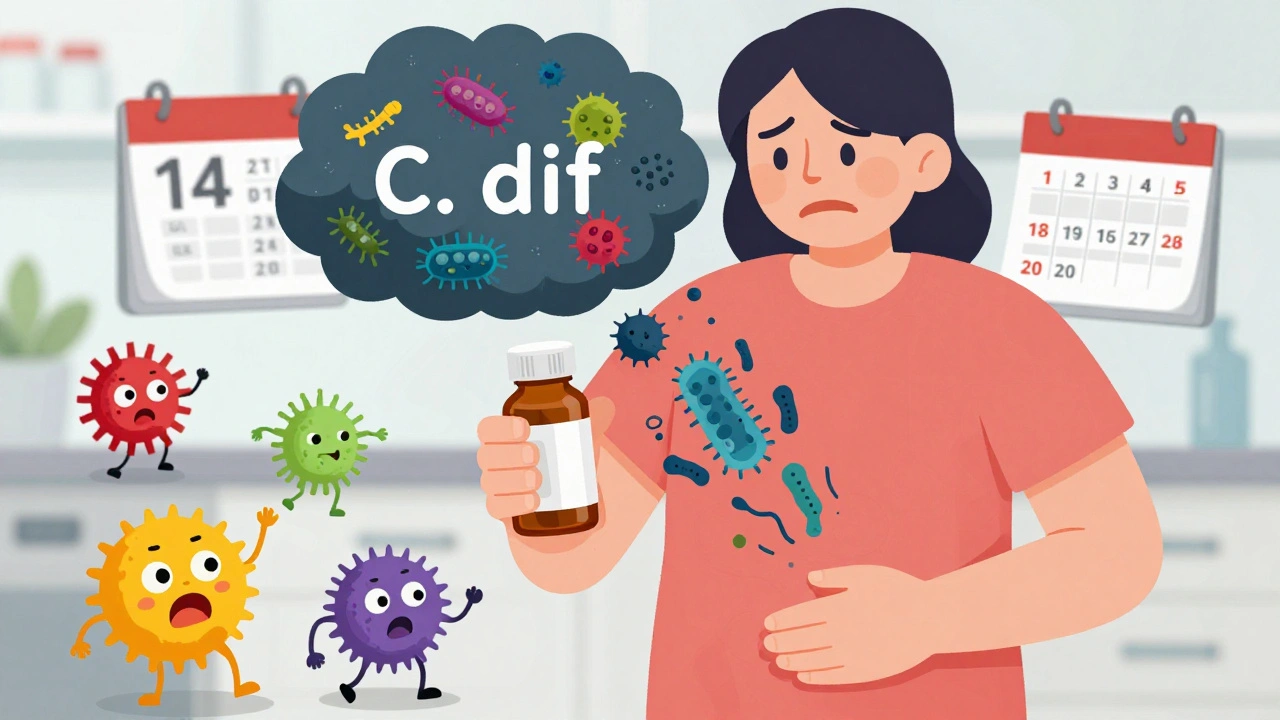
C. diff Risk Calculator
This tool calculates your risk of developing antibiotic-induced C. diff infection based on key factors from the article. Enter your details to see your personalized risk level and prevention recommendations.
When you take an antibiotic to treat a bacterial infection, you expect to feel better. But for many people, the side effect isn’t just an upset stomach-it’s antibiotic-induced diarrhea, and in some cases, it can spiral into a life-threatening infection caused by Clostridioides difficile, or C. diff. This isn’t rare. About 1 in 5 people who take antibiotics develop diarrhea, and 1 in 5 of those cases is actually C. diff. That means roughly 1 in 25 antibiotic users ends up with this serious infection. The good news? Most cases are preventable-and if it does happen, there are clear, proven ways to treat it.
Why Antibiotics Cause Diarrhea
Antibiotics don’t just kill the bad bacteria. They wipe out the good ones too. Your gut is home to trillions of bacteria that help with digestion, immune function, and even mood. When antibiotics disrupt this balance, harmful bacteria like C. diff can take over. C. diff isn’t normally a problem-it’s present in small amounts in many people’s guts without causing harm. But when antibiotics clear out the competition, it multiplies fast and releases toxins that damage the colon lining. That’s what causes severe diarrhea, cramping, fever, and sometimes life-threatening complications.Not all antibiotics carry the same risk. The biggest offenders are fluoroquinolones (like ciprofloxacin), clindamycin, and third- or fourth-generation cephalosporins (like ceftriaxone). Even common drugs like amoxicillin can trigger it. The longer you take them, the higher the risk. A 7-day course of antibiotics raises your chances by 20%. A 14-day course? It jumps to nearly 40%.
Who’s Most at Risk
Some people are far more likely to get C. diff than others. The biggest risk factors are:- Age 65 or older
- Recent hospital stay (especially longer than 72 hours)
- Recent surgery, especially involving the intestines
- Having a weakened immune system from cancer treatment, organ transplant, or chronic illness
- Using proton pump inhibitors (PPIs) like omeprazole for heartburn
- Previous C. diff infection
One surprising twist: C. diff is no longer just a hospital problem. About 24% of new cases now happen in people who haven’t been hospitalized in the past year. These are community-acquired infections, often linked to antibiotic use at home or in outpatient clinics.
How It’s Diagnosed
There’s no single perfect test. Doctors don’t just look at symptoms-they use a mix of tools. The most common approach starts with a stool test for glutamate dehydrogenase (GDH), which detects C. diff presence. If that’s positive, they follow up with a toxin test (enzyme immunoassay) or a nucleic acid amplification test (NAAT), which finds the bacteria’s DNA. Both are needed because some people carry C. diff without being sick-so finding the bacteria alone isn’t enough. You need proof it’s making toxins.Important: Your stool must be unformed. If you’ve taken a laxative in the last 48 hours, the test won’t work. And don’t take anti-diarrhea meds like loperamide (Imodium). They don’t help-and they can trap toxins in your colon, making things worse.
Treatment: What Works and What Doesn’t
Treatment depends on how severe your infection is. The guidelines changed dramatically after 2017, and many doctors still get it wrong.For mild to moderate cases: The first-line choice is either vancomycin (125 mg four times a day for 10 days) or fidaxomicin (200 mg twice a day for 10 days). Vancomycin costs about $1,650 for a full course. Fidaxomicin costs over $3,350-but it cuts recurrence rates in half. Studies show 13% of people on fidaxomicin get sick again, compared to 22% on vancomycin. If cost is an issue, vancomycin is still effective.
Metronidazole is no longer first-line. It used to be the go-to drug, but it fails more often now. Studies show 30-40% of patients don’t respond. The CDC says C. diff is becoming resistant to it. It’s only used now if vancomycin or fidaxomicin aren’t available.
For severe cases: If your white blood cell count is over 15,000 or your creatinine is above 1.5 mg/dL, you’re in the severe category. Treatment is the same-vancomycin or fidaxomicin-but you may need higher doses. In life-threatening cases (like toxic megacolon), doctors add intravenous metronidazole and may give vancomycin rectally if you can’t swallow.
What Happens When It Comes Back
One in five people who get C. diff will have it again. Two in five will have it twice or more. Recurrence is the biggest challenge.For the first recurrence, doctors often repeat the same treatment. But for a second or third recurrence, they switch tactics. One option is a vancomycin taper: take it four times a day for 10 days, then twice a day for 7 days, then once a day for 7 days, then every 2-3 days for up to 8 weeks. This slow withdrawal gives your gut time to rebuild its natural bacteria.
Another option is fecal microbiota transplantation (FMT). It sounds extreme, but it’s incredibly effective-85-90% success rate for people with multiple recurrences. In 2022, the FDA approved the first standardized FMT product, Rebyota, given as a single enema. In 2023, another FDA-approved option, Vowst, came out as a capsule you swallow. Both use carefully screened donor stool to repopulate your gut with healthy bacteria.
There’s also a new monoclonal antibody called bezlotoxumab (Zinplava). It doesn’t kill C. diff-it blocks the toxin it makes. When given with antibiotics, it reduces recurrence by 10%. It’s used for high-risk patients, like those over 65 or with prior recurrences.

Prevention: The Real Game-Changer
The best way to avoid C. diff is to never get it in the first place. That means two things: smarter antibiotic use and better hygiene.Antibiotic stewardship is the key. The CDC estimates that 30-50% of antibiotics prescribed in hospitals are unnecessary. If you don’t need them, don’t take them. For example, most sinus infections and bronchitis are viral. Antibiotics won’t help-and they might hurt you later.
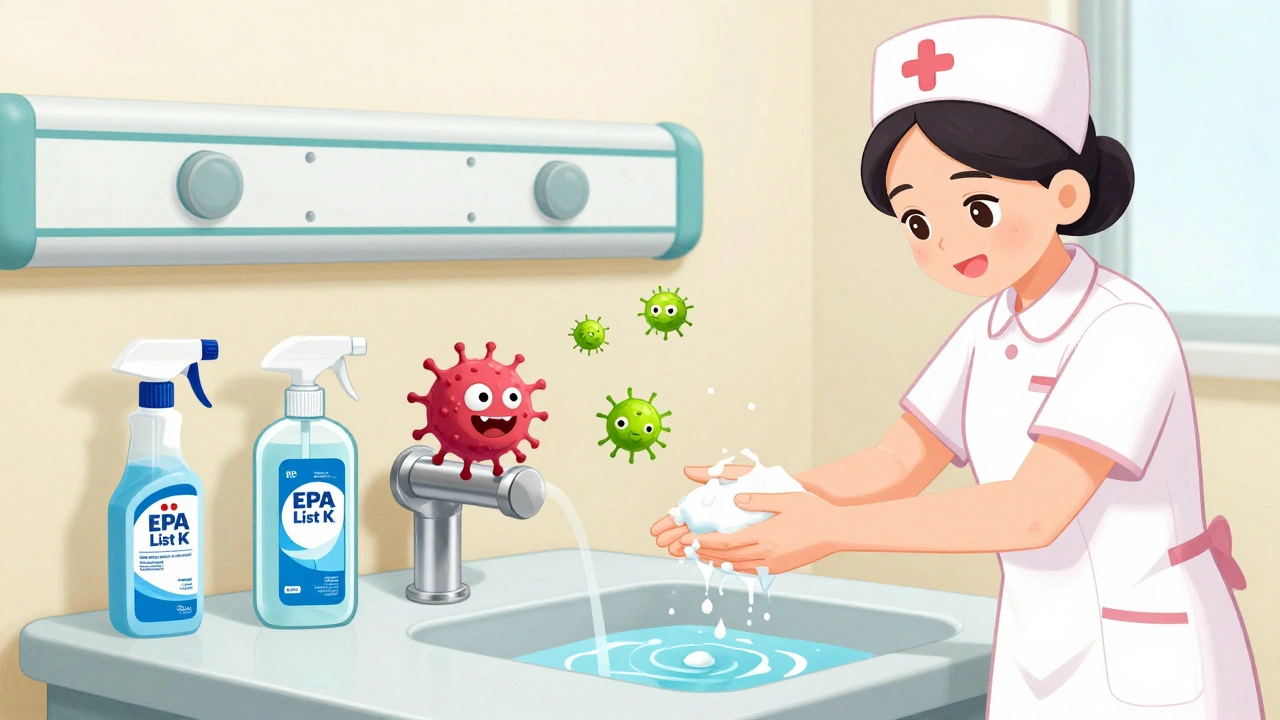
Handwashing matters more than you think. Alcohol-based hand sanitizers don’t kill C. diff spores. Only soap and water do. If you’re in a hospital or visiting someone who is, wash your hands thoroughly before and after touching surfaces or people.
Environmental cleaning is critical. C. diff spores can live on doorknobs, bed rails, and toilets for months. Hospitals use EPA-registered sporicidal cleaners (List K products). At home, bleach-based cleaners work best if you’re caring for someone with C. diff.
What about probiotics? Some people swear by them. Studies show Saccharomyces boulardii and Lactobacillus rhamnosus GG may reduce risk by up to 60% in certain groups. But the IDSA doesn’t recommend them routinely because the evidence isn’t strong enough across all populations. If you want to try one, talk to your doctor first.
Recovery and What to Expect
Symptoms usually improve within 3 days of starting vancomycin. But full recovery takes longer. Many people report lingering fatigue for weeks. One study of over 1,200 patients found 45% had “brain fog,” 37% felt exhausted long after diarrhea stopped, and 82% had to avoid certain foods like dairy, spicy meals, or caffeine during recovery.Some patients describe FMT as life-changing. One person on a patient forum wrote: “After seven recurrences over 18 months, one FMT cleared me permanently. I wish I hadn’t waited so long.”
On the flip side, many people get misdiagnosed. Nearly 40% of patients initially think they have a stomach virus or IBS. If your diarrhea started after antibiotics and lasts more than 48 hours, ask for a C. diff test. Don’t assume it’s just a side effect.
The Bigger Picture
C. diff isn’t just a personal health issue-it’s a public health crisis. In the U.S., it causes 500,000 infections and nearly 30,000 deaths each year. It costs the healthcare system $4.8 billion annually. But hospitals with strong antibiotic stewardship programs have cut C. diff rates by 26% in just six years.The future is promising. New drugs like ridinilazole (in phase III trials) show better results than vancomycin and fewer recurrences. Point-of-care tests are being developed to give results in under an hour. And microbiome-targeted therapies are moving from experimental to standard care.
For now, the message is simple: Use antibiotics only when truly needed. Wash your hands with soap and water. If you get diarrhea after antibiotics, don’t ignore it. Get tested. And if it comes back, know that help exists-FMT, bezlotoxumab, and smarter treatments are changing outcomes for people who once thought they were doomed to cycle through infection after infection.



Scott van Haastrecht
Let’s cut through the corporate fluff. The real reason C. diff is skyrocketing isn’t antibiotic misuse-it’s the pharmaceutical industry’s deliberate strategy to sell more drugs. Vancomycin? Expensive. Fidaxomicin? Even more. FMT? Too cheap to patent. They want you hooked on lifelong antibiotics and expensive biologics, not cured. The FDA approves these products not because they’re best-but because they’re profitable.
Rachel Bonaparte
Okay but have you ever stopped to think about how much of this is just the microbiome industry selling fear? Like, sure, antibiotics mess with your gut-but so does gluten, soy, processed sugar, and electromagnetic radiation from your phone. The real villain here is the modern world’s obsession with sterilization. We’re not supposed to be exposed to dirt anymore? That’s why our immune systems are broken. C. diff is just the symptom. The disease is modern medicine’s refusal to accept that humans evolved alongside bacteria, not in a sterile bubble. Also, probiotics work. People just don’t take the right ones. Saccharomyces boulardii isn’t some placebo-it’s a fungal warrior that outcompetes C. diff like a boss. Why isn’t this in every hospital? Because Big Pharma doesn’t own it.
Chase Brittingham
This is such an important post. I had C. diff after a course of amoxicillin for what turned out to be a viral sinus infection. I thought it was just food poisoning at first. Took me three weeks to get back to normal. The fatigue was brutal-like my brain was wrapped in cotton. I started eating fermented foods daily after that. Sauerkraut, kefir, miso. No magic cure, but my gut feels way more balanced now. Also, I wash my hands with soap after every bathroom trip. No exceptions. Even at home. It’s not paranoia-it’s just smart.
Bill Wolfe
Let’s be real: if you’re taking antibiotics for bronchitis or sinusitis, you’re not a patient-you’re a liability. The fact that 30-50% of prescriptions are unnecessary isn’t a system failure-it’s a cultural failure. People demand antibiotics like they’re candy. And then they cry when they get C. diff. You can’t have a culture that treats medicine like a vending machine and then act shocked when the machine breaks. Also, FMT? It’s not science. It’s medieval medicine with a lab coat. I’m glad they’re finally regulating it, but the fact that we’ve reduced a complex biological ecosystem to ‘poop in a tube’ is a tragedy. The FDA should be ashamed. And yes, I said that out loud.
Benjamin Sedler
So let me get this straight-you’re telling me the solution to a bacterial infection is to dump someone else’s poop into your colon? That’s not medicine, that’s a horror movie plot. And yet, here we are, treating it like a spa treatment. Meanwhile, we’re ignoring the real issue: antibiotics are being used like hand sanitizer. I mean, how many times have you heard someone say, ‘I feel a cold coming on, better take some azithromycin just in case’? That’s not healthcare. That’s Russian roulette with your microbiome. And don’t even get me started on PPIs. Those things are silent killers. You take them for heartburn, you get C. diff, then you take more drugs to fix the side effects. It’s a pyramid scheme built on gut bacteria.
zac grant
From a clinical microbiology standpoint, the shift away from metronidazole was long overdue. The resistance profiles in the US CDC surveillance data from 2018-2023 show >35% failure rates for metronidazole in community-onset cases. Fidaxomicin’s narrow spectrum and minimal disruption to the microbiome make it the optimal choice for first-line in high-risk populations. The real bottleneck isn’t efficacy-it’s access. Fidaxomicin is still formulary-restricted in 60% of community hospitals due to cost. And FMT? The regulatory pathway for Rebyota and Vowst is a masterclass in translational science, but we’re still missing standardized donor screening protocols across states. We need national microbiome registries.
Jordan Wall
Actually, the real issue here is that we’re still treating the gut like a black box. We’ve got all these fancy NAATs and GDH assays, but we’re not even looking at the metabolome. The toxins are just the tip of the iceberg. The real problem is the dysbiosis signature-reduced Faecalibacterium prausnitzii, overabundance of Enterobacteriaceae, and that’s before we even talk about bile acid metabolism disruption. FMT works because it restores the entire ecological network, not just the ‘good bacteria’. But no one wants to fund longitudinal metabolomic studies because it’s too expensive. So we keep patching the system with expensive drugs while the root cause rots in silence. Also, typo: it’s ‘Clostridioides’, not ‘Clostridium’. Just saying.
Gareth Storer
So you’re telling me the solution to a problem caused by medicine is more medicine? Brilliant. Let’s just inject people with poop capsules and call it progress. Next up: a 10-step algorithm to diagnose your soul’s imbalance. I’m sure the FDA will approve a ‘Gut Harmony™’ app next year. Meanwhile, my grandma took penicillin in 1952 and didn’t need a fecal transplant. Maybe we should ask why we’re so fragile now. Or is that too inconvenient?
Pavan Kankala
Antibiotics are a tool of the elite to control the masses. The pharmaceutical companies, the WHO, the CDC-they all work together to keep you dependent. They don’t want you healthy. They want you medicated. C. diff? Just a distraction. The real war is on your microbiome. They’ve been poisoning your gut with glyphosate in your food, fluoride in your water, and now antibiotics in your prescriptions. FMT? A placebo for the gullible. The truth? Your body can heal itself if you stop taking poison. Eat raw garlic, drink lemon water, and forget the doctors. They’re part of the system.
Jessica Baydowicz
I was terrified after my third C. diff recurrence. Felt like my body was breaking down. Then I got FMT. Honestly? It was the best decision I ever made. I cried after the first week. Not because I was sick-because I felt like myself again. No brain fog. No constant bathroom runs. Just… normal. If you’re reading this and you’re stuck in the cycle? Don’t wait. Talk to your doctor. FMT isn’t scary. It’s a second chance. You deserve to feel good again. I’m rooting for you.
Shofner Lehto
One thing I’ve learned from working in rural clinics: people don’t need more complex treatments. They need better education. Most folks don’t know that hand sanitizer doesn’t kill C. diff. They don’t know that diarrhea after antibiotics isn’t ‘normal’. We need community health workers going door-to-door with simple pamphlets: ‘If you took antibiotics and have loose stools for more than two days-get tested.’ No jargon. No fear. Just facts. And if we can get that out there, we can cut recurrence rates by half in five years. It’s not sexy. But it works.
Yasmine Hajar
My mom got C. diff after a hip replacement. She was 72. We were told it was ‘just a side effect’. We didn’t push for testing until she was in the ER with a fever of 103. That’s when we found out. I wish I’d known then what I know now. The real tragedy isn’t the infection-it’s how little we’re taught about gut health in school. We learn about the heart, the lungs, the brain-but not the gut? It’s like we’re all walking around with a secret organ we’re not allowed to talk about. Let’s change that. Talk to your kids about microbiomes. Teach them to wash hands with soap. Make it normal. It’s not just health-it’s dignity.
Karl Barrett
There’s a philosophical layer here that rarely gets discussed. We treat the body like a machine-break it, fix it, replace parts. But the gut isn’t a machine. It’s a living ecosystem. A city of trillions of organisms that co-evolved with us over millions of years. When we hit it with broad-spectrum antibiotics, we’re not just killing bacteria-we’re erasing a cultural heritage. FMT isn’t just a medical procedure. It’s a form of microbial rewilding. We’re restoring a lost civilization inside us. That’s not science. That’s poetry. And yet, we’re still measuring success in recurrence rates and cost-per-dose. Maybe we need to ask not just ‘how do we cure it?’ but ‘how do we honor it?’
Jake Deeds
Let’s be honest-FMT is just the latest fad in the wellness-industrial complex. People are lining up for poop capsules like they’re buying organic kale smoothies. Meanwhile, the real problem is that we’ve outsourced our health to doctors and corporations. You don’t need a $3,000 drug or a fecal transplant. You need to stop eating processed food, stop stressing, and stop taking antibiotics like they’re vitamins. Also, I read that the FDA approved Rebyota because of ‘market demand’-not because it’s superior. That’s not progress. That’s capitalism.
val kendra
I got C. diff after a 10-day course of amoxicillin. Took me 6 months to feel normal. FMT saved me. No drama. Just facts. Wash hands. Don’t take antibiotics unless you really need them.