
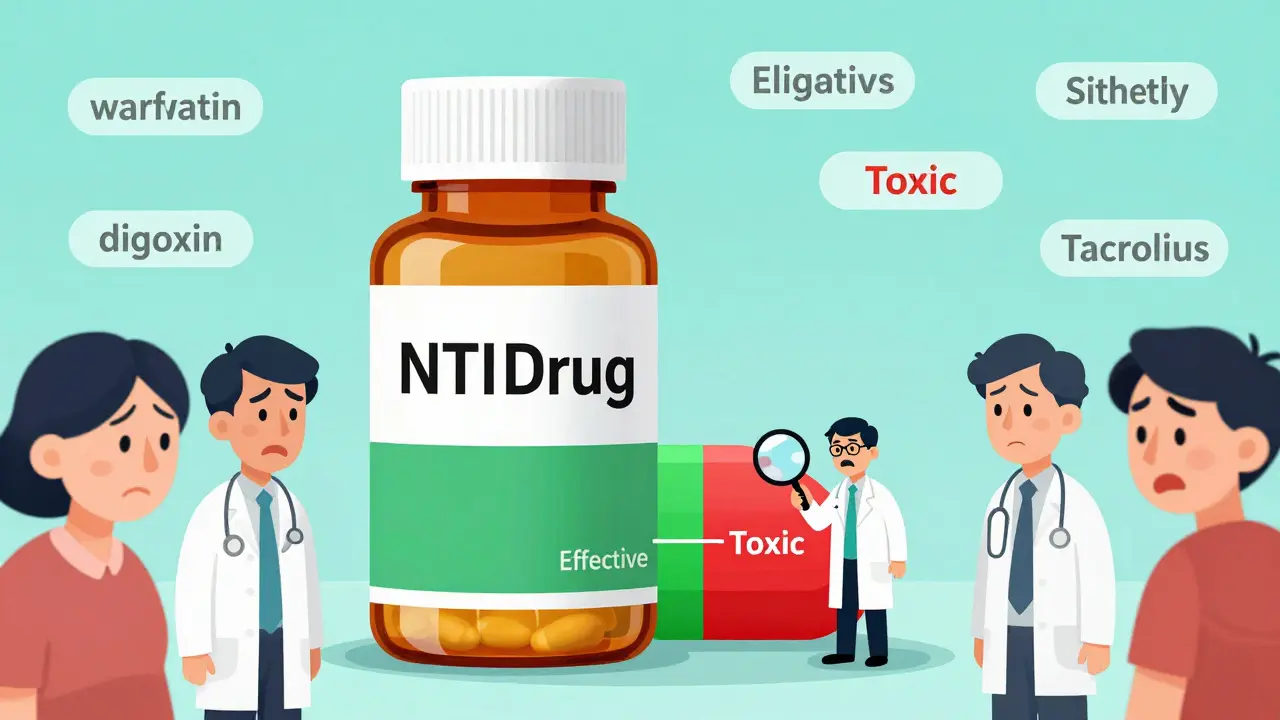
When a doctor prescribes a medication like warfarin, digoxin, or phenytoin, the difference between a life-saving dose and a dangerous one can be razor-thin. These are NTI drugs - narrow therapeutic index drugs - where even a small change in blood concentration can cause serious harm. That’s why the FDA doesn’t treat them like regular generic drugs. The rules for proving they work the same as the brand-name version are stricter, more complex, and designed to protect patients from avoidable risks.
What Makes a Drug an NTI Drug?
An NTI drug is defined by its narrow window between effectiveness and toxicity. The FDA uses a clear metric: if the ratio of the minimum toxic dose to the minimum effective dose is 3 or less, it’s classified as an NTI drug. This isn’t just a guess - it’s based on pharmacometric analysis of 13 key drugs, where 10 fell at or below this threshold. Drugs like carbamazepine, cyclosporine, lithium carbonate, and tacrolimus all meet this standard.
These aren’t just obscure medications. They’re used in critical situations: preventing organ rejection after transplants, controlling seizures, managing heart rhythm, and preventing blood clots. A 10% dip in blood levels might mean a seizure returns. A 10% spike could trigger toxic side effects like kidney damage or dangerous bleeding. That’s why the FDA doesn’t rely on the standard 80-125% bioequivalence range used for most generics.
How FDA Bioequivalence Rules Differ for NTI Drugs
For most generic drugs, the FDA requires that the average amount of drug absorbed into the bloodstream be within 80-125% of the brand-name version. That’s a 45% range - wide enough to allow for normal manufacturing variation.
For NTI drugs, that range is cut in half. The FDA now requires bioequivalence to fall within 90-111.11%. That’s not a suggestion - it’s a hard requirement. But it’s even more complicated than that.
The FDA uses a two-part test called reference-scaled average bioequivalence (RSABE). First, the generic must meet the tight 90-111% range. Second, it must also pass the standard 80-125% test. Why both? Because variability matters. If the brand-name drug itself varies a lot between doses in the same person (called within-subject variability), the FDA allows slightly more flexibility - but only if the generic is just as consistent.
There’s also a strict limit on how much the generic’s variability can exceed the brand’s. The upper 90% confidence interval of the ratio of within-subject standard deviations must be ≤ 2.5. In plain terms: if the brand drug’s levels jump around a bit in patients, the generic can’t jump around more than 2.5 times as much.
Quality Control Is Tighter Too
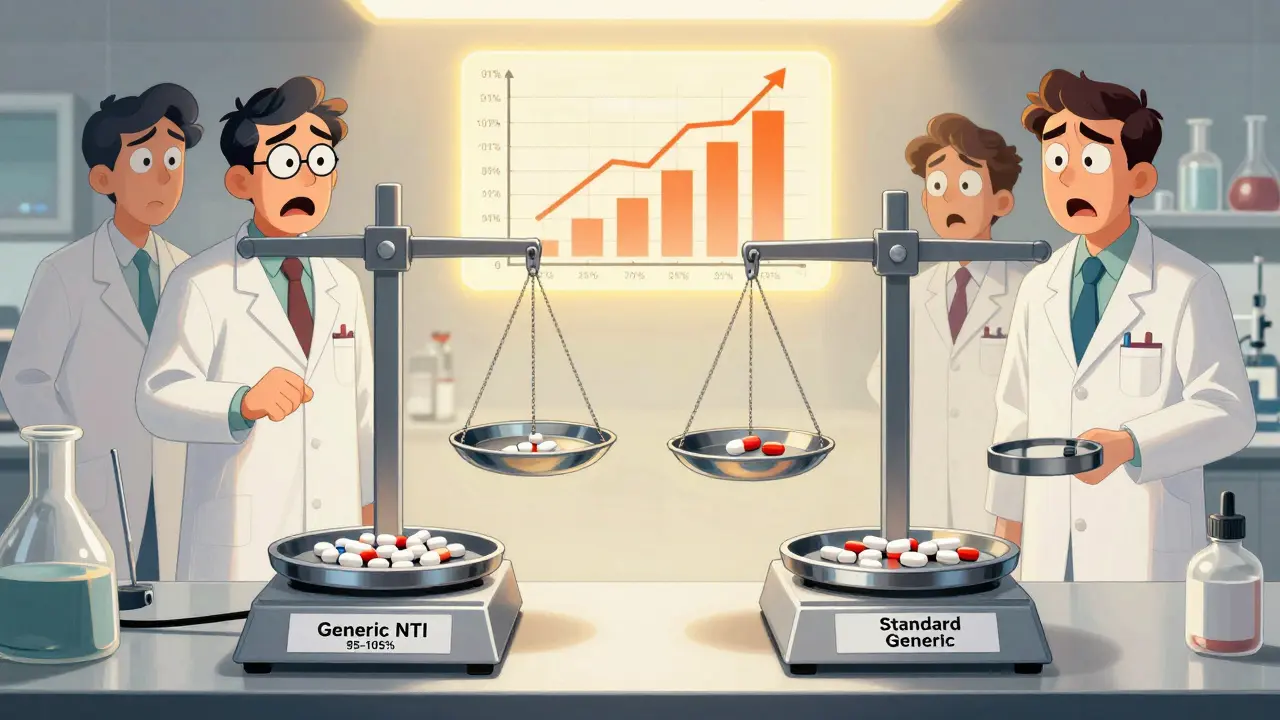
It’s not just about how much drug gets into the blood - it’s about how consistent each pill is. For regular generics, the active ingredient can vary between 90-110% of the labeled amount. For NTI drugs, that range shrinks to 95-105%. That’s a 10% window instead of a 20% one.
This means manufacturers must have far more precise production controls. A batch of pills can’t have a few tablets with 10% more or less drug. Even small shifts in manufacturing conditions - temperature, mixing time, compression pressure - must be tightly monitored. That’s why producing NTI generics is more expensive and technically demanding.
Study Design Must Be More Rigorous
Testing bioequivalence for NTI drugs isn’t done with a simple two-period crossover study. The FDA requires replicate designs - meaning each participant takes both the brand and generic versions multiple times. This gives researchers enough data to measure within-subject variability accurately.
These studies often need more participants and more blood draws. A typical NTI bioequivalence study might include 30-40 patients instead of the 24 used for standard drugs. The statistical analysis is also more complex, requiring specialized software to handle the scaled limits and confidence intervals.
One key insight from FDA research: to have an 80% chance of passing a bioequivalence trial for an NTI drug, the geometric mean ratio of the generic to brand must be no higher than 1.4. That’s a far tighter target than the 1.0-1.25 range often seen with non-NTI drugs.
Which Drugs Are Classified as NTI?
The FDA doesn’t publish a single public list of NTI drugs. Instead, each drug gets its own product-specific guidance. If you’re developing a generic version of one of these, you’ll find the exact requirements in that document.
Common NTI drugs include:
- Antiepileptics: carbamazepine, phenytoin, valproic acid
- Immunosuppressants: cyclosporine, tacrolimus, sirolimus, everolimus, mycophenolic acid
- Cardiac drugs: digoxin, digitoxin
- Anticoagulants: warfarin
- Mood stabilizers: lithium carbonate
Some drugs, like levothyroxine, are widely considered NTI in clinical practice, but the FDA hasn’t formally applied its strictest standards to them yet - a point of ongoing debate among experts.
Why This Matters for Patients and Pharmacists
Even though the FDA approves these generics as therapeutically equivalent, many doctors and patients still hesitate to switch. Why? Because of real-world reports. There are cases where patients on a generic version of tacrolimus experienced rejection episodes - not because the drug failed, but because the switch triggered a cascade of dosing adjustments that weren’t monitored closely enough.
Studies have shown that two generics that both meet FDA NTI standards can still behave differently in patients. One might have a slightly slower absorption rate, another might be more sensitive to food. In a stable transplant patient, that small difference can matter.
That’s why some states still require patient consent before substituting an NTI generic, or even ban automatic substitution entirely. The FDA acknowledges these concerns but points to large-scale real-world data showing that, overall, generic NTI drugs perform safely and effectively when used correctly.
Global Differences in Approach
The FDA’s method is unique. The European Medicines Agency (EMA) and Health Canada typically just tighten the bioequivalence range to 90-111% without using scaled limits. The FDA’s approach is more sophisticated - it accounts for how variable the original drug is. That’s why a generic for a highly variable NTI drug might have slightly wider limits than one for a stable one.
But this complexity creates challenges. A generic approved in the U.S. might not meet requirements in Europe, and vice versa. That’s why the FDA is pushing for global harmonization - a unified standard so patients aren’t affected by where their drug was made.
The Bigger Picture: Safety, Access, and Trust
Generic drugs save the U.S. healthcare system over $1 trillion annually. For NTI drugs, the savings are just as important - but the stakes are higher. The FDA’s goal isn’t to block generics. It’s to make sure that when a patient switches from brand to generic, they’re not trading cost savings for risk.
Over 15% of newly approved generic drugs in 2022 were NTI drugs. That number is growing. Manufacturers are investing in better technology, better testing, and better training to meet these standards. And the FDA continues to refine its methods - using more data, more modeling, and more transparency.
For patients, the message is simple: FDA-approved generic NTI drugs are safe and effective. But if you’ve had issues after a switch - like unexpected side effects or loss of control over your condition - talk to your doctor. Don’t assume all generics are the same. And if your pharmacist suggests a switch, ask if it’s the same brand that’s been working for you.
The system isn’t perfect. But the rules are there for a reason: to make sure that when your life depends on a precise dose, the medicine you get delivers it - every time.
What does NTI stand for in drugs?
NTI stands for Narrow Therapeutic Index. It means the difference between a drug’s effective dose and its toxic dose is very small. Even minor changes in blood levels can lead to treatment failure or serious side effects.
Why are bioequivalence limits tighter for NTI drugs?
Because small changes in blood concentration can cause serious harm. A 20% drop in warfarin levels might lead to a blood clot. A 20% rise might cause dangerous bleeding. The standard 80-125% range used for other drugs is too wide for these medications. The FDA uses 90-111% to reduce that risk.
Does the FDA have a list of NTI drugs?
No, the FDA does not publish a single public list. Instead, each NTI drug has its own product-specific guidance document that outlines the exact bioequivalence requirements. You can find these in the FDA’s database of drug approvals and guidances.
Can generic NTI drugs be substituted for brand-name versions?
Yes, the FDA approves generic NTI drugs as therapeutically equivalent to their brand-name counterparts. However, some states require patient consent or prohibit automatic substitution due to clinical concerns. Always check local laws and consult your doctor before switching.
What’s the difference between RSABE and ABE for NTI drugs?
ABE (Average Bioequivalence) uses fixed limits (80-125%) regardless of how variable the drug is. RSABE (Reference-Scaled Average Bioequivalence) adjusts the limits based on how much the brand-name drug varies in patients. For NTI drugs, RSABE is required to ensure the generic is as consistent as the original.
Are NTI generics more expensive to produce?
Yes. Because of stricter quality controls, more complex testing, larger clinical studies, and tighter manufacturing tolerances, producing NTI generics costs significantly more than standard generics. This is why fewer companies make them, and why some NTI generics are still only available as brand-name products.





Brady K.
Let’s be real - the FDA’s NTI rules aren’t just bureaucracy, they’re a fucking lifeline. You think a 10% swing in tacrolimus is no big deal until your transplant patient starts rejecting the damn organ. This isn’t aspirin, folks. We’re talking about people whose bodies can’t afford a typo in dosing. The 90-111% range? That’s not overkill - that’s basic human decency wrapped in pharmacokinetics.
Joy Nickles
ok so like... i read this and i'm like wow but also... why do they even bother?? like i got my warfarin generic and it's fine?? and then my friend switched and had a stroke?? but like... maybe that was just bad luck?? idk i'm confused now. also why is everything so complicated??
Marilyn Ferrera
Manufacturers can’t cut corners on NTI drugs - period. The 95-105% active ingredient tolerance? That’s not arbitrary. It’s the difference between a patient sleeping through the night and waking up with internal bleeding. Precision isn’t optional here.
Emma Hooper
Y’all act like the FDA is some saintly guardian of life, but let’s be honest - they’re just playing whack-a-mole with drug companies who’d rather save a dime than save a life. And don’t even get me started on how some generics pass the math but still feel ‘off’ in real life. I’ve seen patients cry because their ‘equivalent’ pill made them feel like a zombie. Equivalence my ass.
Kayla Kliphardt
I’ve been on cyclosporine for 8 years. My levels are stable, my kidneys are fine. I switched generics twice - once to a cheaper one, once back. I didn’t notice a difference. But I also had my blood drawn every two weeks and my doctor adjusted doses like a DJ mixing tracks. Maybe the problem isn’t the generic - it’s the lack of monitoring.
Stewart Smith
So the FDA says ‘90-111%’ and we all cheer… but then you read the fine print and realize they’re basically asking manufacturers to build a Swiss watch using a Walmart screwdriver. And somehow, they do it. Respect. But also… why is this still so damn hard to explain to patients?
Robb Rice
It’s fascinating how the RSABE model accounts for within-subject variability - a statistically elegant solution to a biologically messy problem. The FDA’s approach, while complex, is grounded in real pharmacodynamic data, unlike the EMA’s one-size-fits-all 90-111% threshold. This is science, not politics.
Darren Pearson
As someone who has reviewed over 40 bioequivalence dossiers for NTI drugs, I can tell you: most companies treat this like a box-ticking exercise. They optimize for statistical compliance, not clinical consistency. The FDA’s standards are rigorous - but enforcement? That’s where the rot sets in.
Harriet Hollingsworth
People are dying because some pharmacy chain is swapping out their meds to save $0.50 a pill. This isn’t ‘choice’ - it’s negligence. If your life depends on precision, you shouldn’t have to beg for the same brand. And if your doctor doesn’t fight for you? Find a new one. Period.
Deepika D
Let me tell you something from the frontlines - I work in a clinic in rural India, and we get generics from everywhere. Some of these NTI drugs? They’re made in places with zero quality control. But here’s the thing - even with all the flaws, the FDA’s standards are the only thing keeping people alive. We don’t have the luxury of fancy labs, but we still need to trust that the pill we give someone won’t kill them. That’s why I’m grateful for these rules - even if they’re not perfect. We need more of this kind of thinking, not less. And yes, it’s expensive - but so is burying people who didn’t have to die.
Retha Dungga
so like... if the drug is so sensitive why do we even make generics?? 😔 maybe we should just make them all brand?? 🤷♀️ but then who pays?? 🤔 money or life?? 🤯