
Every year, hundreds of thousands of people end up in the hospital because of dangerous drug interactions. Many of these cases are preventable. The right drug interaction checker can be the difference between a safe day and a medical emergency. Whether you’re taking five pills a day or just added a new supplement, knowing how to use these tools properly isn’t optional-it’s essential.
What Is a Drug Interaction Checker?
A drug interaction checker is a digital tool that scans your medications, supplements, and sometimes even foods to find dangerous combinations. It doesn’t guess. It uses real pharmacology data to spot when two or more substances might cause harmful side effects, reduce effectiveness, or create new risks. For example, mixing warfarin (a blood thinner) with ibuprofen can increase bleeding risk. A good checker will flag that before you even take the pill.
These tools come in many forms: apps on your phone, built-in features in electronic health records, or websites you can access from your browser. Some are made for doctors and pharmacists. Others are built for everyday people. The best ones don’t just say “warning.” They explain why it’s risky and what you should do next.
Why You Need One (Even If You Think You’re Fine)
You might think, “I only take a few things.” But here’s the truth: 44% of adults over 65 take five or more medications regularly. And it’s not just prescriptions. Over-the-counter painkillers, herbal supplements, and even grapefruit juice can mess with your meds. A 2022 study found that nearly 1 in 5 older adults had at least one dangerous interaction going unnoticed.
Even if you’re young and healthy, adding a new supplement like St. John’s Wort or magnesium can interfere with antidepressants, birth control, or blood pressure meds. And most people don’t tell their doctor about every supplement they take. That’s where a checker comes in-it catches what you forget.
How to Use a Drug Interaction Checker: A Simple 5-Step Process
Using a drug interaction checker isn’t complicated. But skipping steps leads to mistakes. Here’s how to do it right:
- Write down everything you take - Not just prescriptions. Include vitamins, herbal teas, CBD oil, and even antacids. If you take it regularly, it counts. Use a notebook or your phone’s notes app.
- Choose your tool - For most people, a trusted app like Medisafe or a website like the University of Liverpool’s DDI Checker works well. If you’re a healthcare provider, tools like Micromedex or Lexi-Interact are standard. Don’t use random sites-stick to ones backed by medical institutions or major pharmacies.
- Enter each drug exactly as it’s written - Type the full name: “amoxicillin 500mg” not just “amoxicillin.” Some tools don’t recognize abbreviations. If you’re unsure of the generic name, check the bottle. For supplements, use the full ingredient name (e.g., “ashwagandha root extract 600mg”).
- Review the results carefully - Results are usually color-coded: red = dangerous, orange = monitor closely, yellow = note it, green = safe. Don’t ignore yellow. A “weak” interaction can become serious if you’re on multiple meds or have kidney issues.
- Don’t act alone - If the checker flags something, take the report to your pharmacist or doctor. They’ll know if it’s a real risk or a false alarm. Never stop or change a prescription based on an app alone.
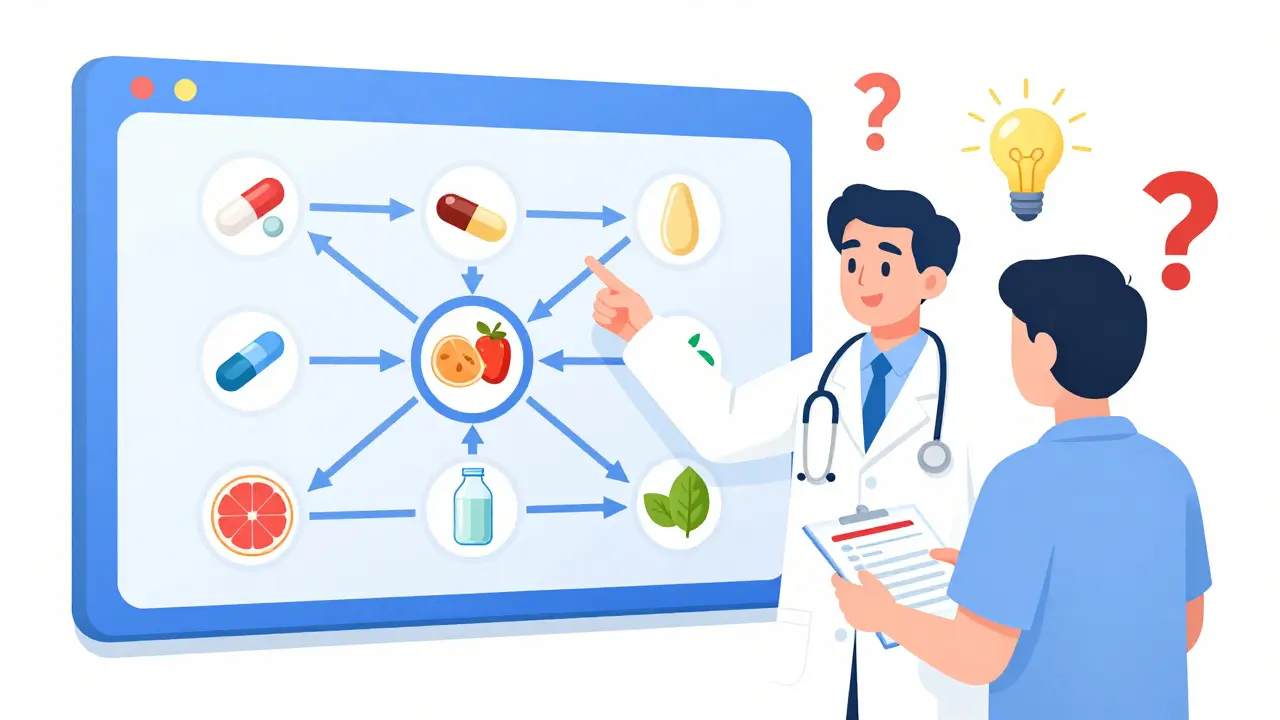
Top Tools You Can Trust (And Which One to Pick)
Not all checkers are created equal. Here’s what works best in 2026:
- Medisafe (Mobile App) - Best for everyday users. Simple interface. Lets you build a digital “Med Cabinet.” It’s free, available on iOS and Android, and has caught nearly 100,000 dangerous combinations since launch. Users report it helped them avoid bleeding risks with blood thinners.
- University of Liverpool DDI Checker (Website) - Free, no login needed. Great for checking common meds, especially if you’re on antivirals, heart drugs, or antidepressants. Uses a visual color system that’s easy to understand. No app needed.
- DrugBank (API/Professional Tool) - Used by hospitals and developers. Offers the most detailed data, including interactions with foods and supplements. Requires some technical know-how unless you’re using a platform that already integrates it.
- Lexi-Interact or Micromedex (Professional Systems) - Used in clinics and pharmacies. More accurate than consumer apps. But you won’t have access unless you work in healthcare. Still, if your doctor uses one, ask them to run a check for you.
For most people, start with Medisafe or the University of Liverpool tool. They’re free, reliable, and designed for non-experts.
Common Mistakes People Make (And How to Avoid Them)
Even when people use checkers, they still get burned. Here are the top errors:
- Only checking one new drug at a time - Interactions happen between all your meds. If you add a new supplement, check it against your entire list-not just the last thing you took.
- Ignoring “minor” warnings - A yellow flag might seem harmless. But if you’re on three other drugs, that weak interaction can become a major problem. Keep a log.
- Using outdated or vague names - Typing “aspirin” instead of “enteric-coated aspirin 81mg” can cause the tool to miss the interaction. Be precise.
- Thinking it’s foolproof - No checker catches 100% of interactions. Studies show even the best tools miss 15-40% of clinically important ones. That’s why you still need a pharmacist’s eye.
- Not updating when your meds change - If you stop one drug or start another, run the checker again. Interactions change with every addition or removal.
What to Do When a Checker Flags an Interaction
Seeing a red alert can be scary. But panic won’t help. Here’s what to do next:
- Don’t stop your medication - Stopping suddenly can be dangerous, especially for blood pressure, antidepressants, or seizure meds.
- Take a screenshot or print the results - Bring it to your pharmacist or doctor. They’ll know if it’s a real threat or a false positive.
- Ask: “Is there a safer alternative?” - Maybe your blood pressure med can be switched to another class that doesn’t interact. Your pharmacist can suggest options.
- Ask: “Do I need to monitor anything?” - Some interactions require blood tests or watching for symptoms like dizziness, nausea, or unusual bruising.
- Ask: “Can I space out the doses?” - Sometimes, taking two drugs 4-6 hours apart reduces the risk enough to make it safe.
Pharmacists see this every day. They’re trained to interpret these alerts. Use them.
The Bigger Picture: Why This Matters Beyond Your Own Safety
Drug interactions don’t just hurt individuals. They cost the U.S. healthcare system over $2.2 billion a year in preventable hospital visits. Hospitals that use advanced checkers reduce adverse events by up to 30%. But the real win is personal: fewer ER trips, less anxiety, and more confidence in your daily routine.
And it’s getting smarter. New tools now use AI to learn from real-world patient data. Some can even factor in your genetics, kidney function, or age to give personalized risk scores. By 2027, nearly every hospital will have systems that adjust alerts based on your medical history-not just your drug list.
But until then, you’re your own first line of defense. A drug interaction checker isn’t magic. It’s a flashlight in a dark room. You still have to walk forward-but now you can see the trip hazards.
Can I trust free drug interaction checkers?
Yes-if they’re from trusted sources like the University of Liverpool, Medisafe, or DrugBank. Avoid random websites or apps with no clear medical backing. Free doesn’t mean unreliable, but always check who runs it. Government and university sites are safest.
Do drug interaction checkers include supplements and herbal remedies?
Most good ones do. Tools like Medisafe, DrugBank, and the University of Liverpool’s checker include common supplements like St. John’s Wort, garlic, ginkgo, and magnesium. But not all do. Always double-check that your supplement is listed. If it’s not, search for the active ingredient (e.g., “curcumin” instead of “turmeric”).
Why do I get so many alerts on my app?
Too many alerts usually means the tool is too sensitive. This is called “alert fatigue.” Many professional systems let doctors lower the alert threshold, but consumer apps don’t. If you’re getting 20+ alerts for harmless combos, cross-check with another tool like the University of Liverpool’s checker. If it doesn’t flag the same thing, the first one is likely overreacting.
Can drug interaction checkers detect food interactions?
Sometimes. The best ones, like DrugBank and Lexi-Interact, include major food interactions (e.g., grapefruit with statins, dairy with antibiotics). Consumer apps like Medisafe are improving but still focus mostly on drugs. Always check your medication’s label for food warnings-it’s still the most reliable source.
Should I use more than one checker?
Yes-if you’re on complex meds or have chronic conditions. A 2016 NIH study found that using two checkers together catches more dangerous interactions than using just one. Try Medisafe for daily use and the University of Liverpool’s tool as a backup. It’s like double-checking your work.
What if my doctor says the interaction isn’t a problem?
Trust their judgment-but ask why. Doctors have experience and know your full history. But if you’re still unsure, ask: “Is this based on clinical evidence or just your experience?” If they can’t explain, get a second opinion from a pharmacist. They’re the drug experts.
Next Steps: Make This Part of Your Routine
Don’t wait for a problem to happen. Right now, open your medicine cabinet. Write down every pill, capsule, and supplement you take daily. Download Medisafe or go to the University of Liverpool’s DDI Checker. Enter your list. Run the check. Save the results. Share them with your pharmacist at your next visit.
It takes 10 minutes. But it could save you months of pain, hospital stays, or worse. In a world where we’re taking more meds than ever, this isn’t just smart-it’s necessary.

Marian Gilan
lol so now i gotta check if my coffee interacts with my tylenol? next theyll tell me breathing might cancel out my blood pressure meds. this app culture is wild. i just take what the doc says and hope for the best. 🤷♂️
Conor Murphy
This is actually super important. I used to ignore supplements until my grandma ended up in the ER from mixing St. John’s Wort with her antidepressant. A simple checker could’ve saved her months of pain. Seriously, take 10 minutes. It’s not just for old people. 😊
Conor Flannelly
There’s a quiet philosophy here: we’re all just data points in a vast pharmacological web. The checker doesn’t judge-it observes. And yet, we treat it like a oracle. But it’s not magic. It’s math. And math doesn’t care if you’re 22 or 72. It just calculates risk. We’re the ones who have to carry the weight of the result. 🌱
Patrick Merrell
You think this is about safety? Nah. Big Pharma wants you dependent on apps so they can sell you more meds. They don’t want you cured-they want you checked. Every alert is a profit margin. Trust your body. Not some algorithm written by a guy in a cubicle.
Henry Jenkins
I’ve used five different checkers over the past year because I’m on a cocktail of meds for autoimmune issues, and honestly? The only consistent thing is that they all disagree. Medisafe says one thing, Liverpool says another, DrugBank throws in a third. I’ve started printing all three and taking them to my pharmacist. She laughs and says, ‘Welcome to real medicine.’ It’s not perfect, but it’s the best we’ve got. Still, I wish they’d standardize the data sources.
TONY ADAMS
bro i just take my pills and go. why do i need an app to tell me not to mix aspirin with whiskey? i’m not a robot.
George Rahn
The modern individual, shackled by algorithmic surveillance under the guise of ‘safety.’ We outsource our agency to digital oracles, mistaking computational probability for divine wisdom. The true danger is not drug interaction-it is the erosion of personal responsibility. You do not need an app to know that grapefruit and statins are incompatible. You need wisdom. And wisdom cannot be downloaded.
Karen Droege
I’m a nurse and I can’t tell you how many times I’ve seen people panic because their app lit up like a Christmas tree. Half the time, the ‘red flag’ is for something harmless like taking ibuprofen with a glass of wine. But they show up at the ER terrified. Please, people-don’t let an app dictate your fear. Use it as a conversation starter with your pharmacist, not your therapist. 💪❤️
Napoleon Huere
What if the real problem isn’t the drugs? What if it’s the fragmentation of care? One doctor gives you this, another gives you that, your cousin recommends a ‘miracle herb,’ and you’re left piecing together a puzzle with half the pieces missing. The checker doesn’t fix the system-it just makes you aware of how broken it is. We need better communication between providers, not just better apps.
Neil Thorogood
So you’re telling me I need to spend 20 minutes entering every supplement I’ve ever taken just so an app can tell me my turmeric might interfere with my blood thinner? Bro. I’m not a pharmacist. I’m a guy who just wants to sleep without feeling like a science experiment. 😅
Jessica Knuteson
Most people don’t even know what’s in their supplements. Label says ‘ashwagandha’ but the actual ingredient is 30% fillers and 2% active compound. No app can fix bad regulation. Just stop buying random powders off Amazon.
Ashley Porter
The real MVP here is the Liverpool DDI checker. It’s got the cleanest interface and the most transparent methodology. Most consumer apps are just repackaged data from the same sources with flashy UI. If you’re serious, go straight to the source. No fluff, no ads, just pharmacokinetics.
Peter Sharplin
I’ve been using Medisafe for three years now. It saved me when I started a new antidepressant and didn’t realize it could interact with my magnesium supplement. I didn’t know the difference between ‘magnesium oxide’ and ‘magnesium glycinate’-the app flagged it. I called my pharmacist and we switched. No hospital visit. No panic. Just a quiet win. Honestly? It’s the most responsible thing I’ve done for my health in years. You don’t need to be a genius. Just be consistent.