
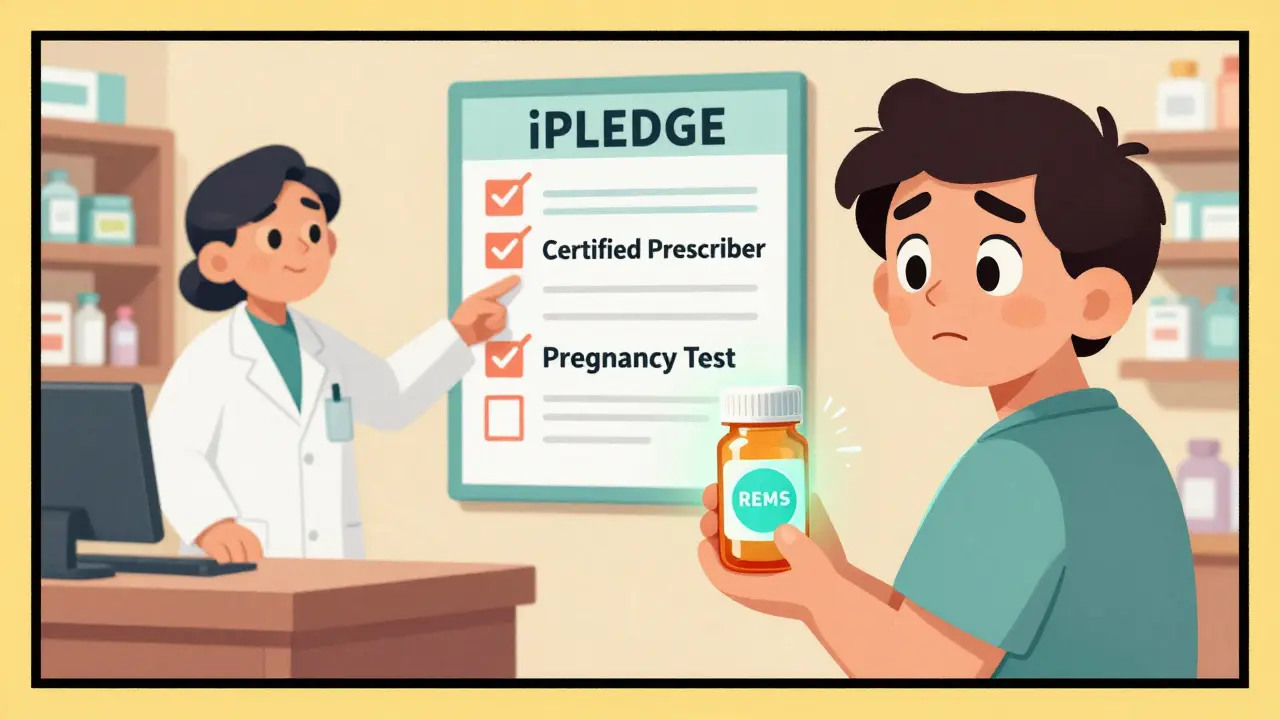
Starting a new medication can feel overwhelming. You’ve got the prescription, you know what it’s for, but there’s something else you might not be told about upfront: REMS. If your doctor prescribes a drug with serious risks-like birth defects, life-threatening side effects, or addiction potential-you’re likely dealing with a Risk Evaluation and Mitigation Strategy, or REMS. These aren’t optional. They’re legally required safety steps put in place by the U.S. Food and Drug Administration (FDA) to make sure the benefits of the drug outweigh its dangers. Skipping REMS checks can delay your treatment, put you at risk, or even lead to a pharmacy refusing to fill your prescription. Here’s exactly how to check REMS requirements before you start taking a new medication.
What Is REMS and Why Does It Matter?
REMS stands for Risk Evaluation and Mitigation Strategies. It’s a system the FDA created in 2007 to manage serious risks tied to certain medications. Not every drug needs it. But if a medication has risks so severe that it might not be approved without extra safeguards, the FDA requires a REMS program. Think of it as a safety net. Without REMS, drugs like isotretinoin (for acne), thalidomide (for multiple myeloma), or certain opioid painkillers simply wouldn’t be available. The goal isn’t to block access-it’s to make sure you get the drug safely.
There are 76 active REMS programs as of 2026. Some are simple. Others? They involve certification, mandatory training, lab tests, and even special clinics. For example, Zyprexa Relprevv, an injectable antipsychotic, can only be given in certified facilities because of the risk of sudden dizziness or loss of consciousness after injection. Isotretinoin, which can cause severe birth defects, requires both you and your doctor to be registered in the iPLEDGE system. If you don’t complete the steps, the pharmacy won’t dispense the drug.
Step 1: Look at the Prescription Label and Medication Guide
When you pick up your prescription, the pharmacist should hand you a Medication Guide. This is a printed sheet that comes with every REMS-required drug. It’s not marketing fluff-it’s a legal requirement. The guide will clearly state whether the medication is part of a REMS program and what you need to do. Look for phrases like:
- “This medication is subject to a REMS program”
- “Prescriber certification required”
- “Patient enrollment in registry mandatory”
If you don’t get a Medication Guide, ask for it. If the pharmacy says they don’t have one, that’s a red flag. The drug either isn’t supposed to be dispensed yet, or there’s a mistake.
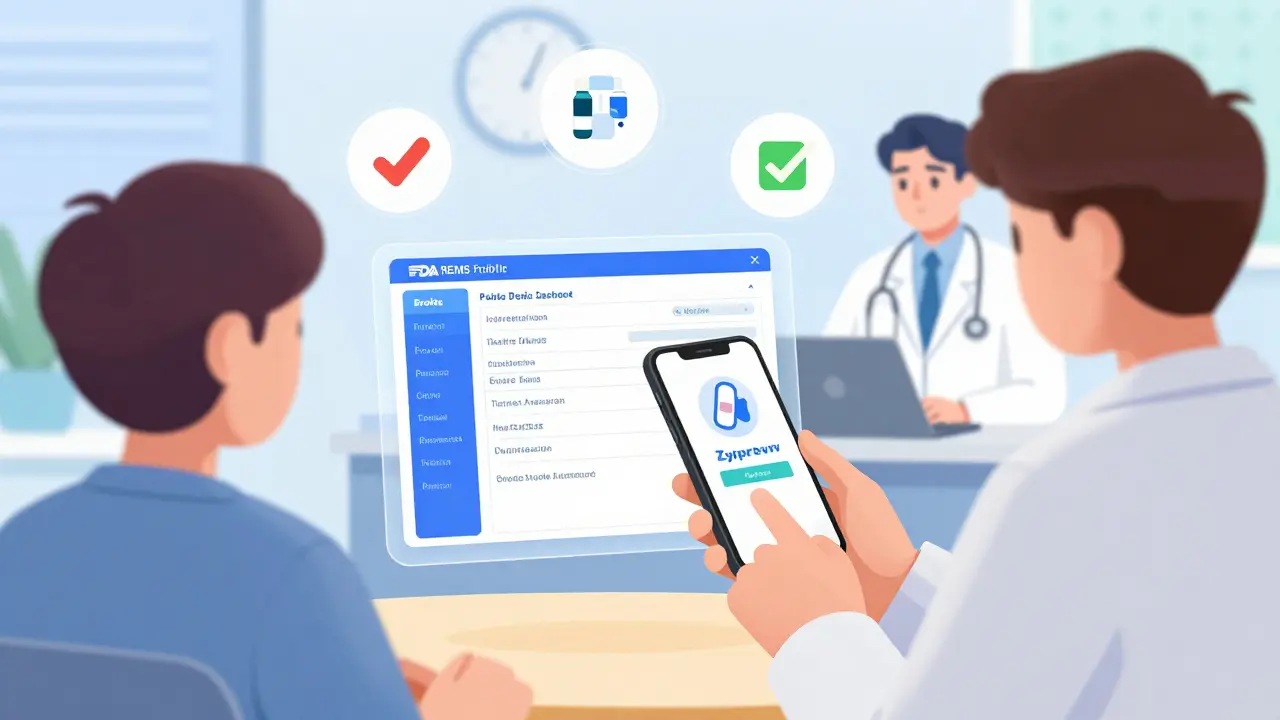
Step 2: Search the FDA’s REMS Public Dashboard
The FDA’s REMS Public Dashboard is the most reliable source for up-to-date REMS information. It’s free, public, and updated regularly. Go to fda.gov/drugs/rems and type in the drug name. You’ll see:
- Whether a REMS is active
- What elements are required (like prescriber training, patient registries, or restricted distribution)
- Links to the official REMS website for that drug
- When the REMS was last modified
As of March 2026, the dashboard includes real-time updates and filters by drug class, risk type, or required action. For example, if you search for “mycophenolate,” you’ll see it requires pregnancy testing for women of childbearing age and mandatory counseling. The dashboard also shows which REMS programs have been modified to reduce burden-like the 2022 update that removed unnecessary paperwork for some opioid education programs.
Step 3: Confirm With Your Pharmacy or Prescriber
Pharmacists are on the front lines of REMS verification. Many pharmacies now have internal checklists. Ask your pharmacist: “Does this medication have a REMS requirement? What do I need to do?” They can tell you if:
- You need to sign a form
- Your doctor needs to be certified
- You have to enroll in a patient registry
- There’s a mandatory waiting period
For drugs like isotretinoin or thalidomide, the pharmacy can’t fill the prescription until the prescriber has completed their certification and you’ve enrolled. If your doctor hasn’t done their part, the pharmacy will hold the prescription. Don’t assume they’ll call you. Follow up.
Doctors also need to complete REMS training. If your provider hasn’t been certified for a drug like Vyvanse or OxyContin ER, they won’t be able to prescribe it. Ask them: “Are you certified to prescribe this medication under REMS?” If they say no, they may need to complete a 60- to 90-minute online course-often free-before they can write the prescription.
Step 4: Check the Manufacturer’s REMS Website
Every REMS program has a dedicated website run by the drug manufacturer. These sites have the most detailed instructions. For example:
- iPLEDGEprogram.com for isotretinoin
- mycophenolaterems.com for mycophenolate
- opioidrems.com for extended-release opioids
These sites walk you through enrollment, download required forms, list certified prescribers, and even offer patient education videos. Some even have mobile apps now, thanks to a new FDA policy from April 2023 that requires REMS programs to include smartphone-friendly tools. If you’re on the go, use the app. It’s faster than printing forms.
What Happens If You Skip REMS Steps?
Skipping REMS requirements doesn’t just delay your treatment-it can be dangerous. Here’s what can happen:
- Your pharmacy refuses to fill the prescription
- Your insurance denies coverage
- You get the drug but miss critical safety steps (like pregnancy testing), putting you at risk
- You’re accidentally exposed to a drug that’s unsafe for your condition
A 2022 survey found that 42% of patients on REMS medications experienced delays averaging over six business days because they didn’t complete the required steps. For someone with a rare disease or chronic pain, that delay can be devastating. On the flip side, patients who completed REMS steps had 70% fewer adverse events compared to those who didn’t.
Common REMS Programs You Might Encounter
Here are a few of the most common REMS programs and what they require:
| Drug Name | Primary Risk | REMS Requirements |
|---|---|---|
| Isotretinoin (Accutane) | Severe birth defects | Patient and prescriber registration in iPLEDGE; monthly pregnancy tests; two forms of contraception |
| Thalidomide (Thalomid) | Birth defects, blood clots | Prescriber certification; patient enrollment; monthly pregnancy tests; no pregnancy allowed |
| Mycophenolate (CellCept) | Pregnancy loss, birth defects | Prescriber counseling; patient education; pregnancy testing before and during use |
| Extended-Release Opioids | Addiction, overdose | Prescriber education (CE); Medication Guide provided at each fill |
| Zyprexa Relprevv | Post-injection delirium | Administered only in certified clinics; 3-hour observation period after injection |
What to Do If You’re Delayed
If you’ve done everything right and still can’t get your medication, here’s what to do:
- Double-check that your doctor completed their certification
- Ask the pharmacy if they’ve received the REMS verification from the manufacturer
- Call the manufacturer’s REMS support line-they often have patient advocates who can help
- If it’s an emergency, ask your doctor about alternative medications without REMS requirements
Many patients don’t realize that REMS programs are supposed to be flexible. The FDA requires them to be effective but not unnecessarily burdensome. If your situation is urgent, you can request a waiver or temporary exception. It’s not automatic, but it’s possible.
How to Stay on Top of REMS Changes
REMS programs evolve. The FDA modifies them regularly. In 2022 alone, 14 REMS programs were simplified. One in five now uses digital tools instead of paper forms. To stay updated:
- Bookmark the FDA REMS Public Dashboard
- Sign up for email alerts from the manufacturer’s REMS site
- Ask your pharmacist to notify you if requirements change
- Check your Medication Guide every time you refill-it’s updated if the REMS changes
By 2026, blockchain-based verification systems are expected to be rolled out for high-risk drugs, making the process faster and more secure. You won’t need to fill out 10 forms anymore-you’ll just verify your identity digitally.
Bottom Line: Don’t Skip the REMS Steps
REMS programs are frustrating. They add time. They require paperwork. They can feel like bureaucracy. But they exist for a reason: to keep you safe. Skipping them doesn’t save time-it risks your health. The steps aren’t optional. They’re part of your treatment plan. Whether you’re a patient, caregiver, or provider, the key is to start early. Don’t wait until the day you’re supposed to pick up your prescription. Check REMS requirements as soon as you get the prescription. Talk to your doctor. Call your pharmacy. Visit the FDA site. It takes 10 minutes now to avoid a 6-day delay later.
Do all medications have REMS requirements?
No. Only medications with serious safety risks require REMS. Out of the thousands of drugs on the market, only about 15-20% of newly approved drugs have REMS programs. Common medications like statins, blood pressure pills, or antibiotics typically don’t need them. REMS is reserved for drugs with risks like birth defects, life-threatening side effects, or high potential for abuse.
Can I get a REMS medication if I live outside the U.S.?
REMS programs are U.S.-specific and enforced by the FDA. If you’re outside the U.S., your country’s health authority may have its own safety programs, but the U.S. REMS won’t apply. However, if you’re getting the drug from a U.S. pharmacy or using a U.S.-based provider, you still need to comply with REMS-even if you’re in New Zealand, Canada, or Australia.
Are REMS requirements the same for generics and brand-name drugs?
Yes. If a brand-name drug has a REMS, the generic version must follow the same requirements. For example, if isotretinoin (Accutane) requires iPLEDGE, then any generic version of isotretinoin also requires iPLEDGE registration. The FDA ensures that generics meet the same safety standards as the original.
What if my doctor doesn’t know about REMS?
Some providers, especially those who don’t regularly prescribe high-risk medications, may not be familiar with REMS. If this happens, give them the FDA REMS website link or the manufacturer’s REMS page. Many REMS programs offer free training modules that take under an hour. You can even print out the REMS requirements and hand them to your doctor. It’s your right to get safe care-and your doctor has a responsibility to comply.
Can I switch to a different drug to avoid REMS?
Sometimes. But not always. REMS drugs are often prescribed because they’re the most effective option for serious conditions. For example, isotretinoin is the only drug that can permanently clear severe acne. Switching may mean less effective treatment. Talk to your doctor about alternatives, but don’t assume another drug is safer or easier. Some alternatives may have their own REMS or worse side effects.




Donna Fogelsong
REMS is just the FDA's way of controlling us. They don't care if you need the drug. They care about liability. I got denied isotretinoin because my doctor's certification expired. No one told me. Now I'm stuck with topical crap. This isn't safety. It's bureaucracy with a badge.
Sean Bechtelheimer
LMAO imagine being this scared of a pill 😂 They literally make you fill out forms like you're applying for a mortgage. Next they'll require a blood oath and a signed waiver from your ancestors.
Seth Eugenne
I get how frustrating REMS can feel but honestly? It saved my life. I was on Zyprexa Relprevv and had a bad reaction once. The 3-hour observation saved me. It’s not perfect but it’s there because people got hurt. Take the steps. It’s not about trust - it’s about layers.
rebecca klady
I didn’t even know REMS existed until I had to get mycophenolate. My pharmacist walked me through it step by step. Took 20 minutes. No drama. Just care. Maybe we need more pharmacists like her.
Namrata Goyal
USA thinks its FDA is god. In India we just trust our doctors. No forms. No apps. No 'certified clinics'. You want a drug? You take it. Simplicity. Efficiency. This REMS nonsense is just american overcontrol.
Zola Parker
REMS is the system trying to pretend it’s protecting us while quietly letting Big Pharma write the rules. Who decides what’s a 'serious risk'? Who funds these programs? Who owns the iPLEDGE database? The FDA? Or the pharma giants who pay for the system? Think deeper.
florence matthews
I’m from the Philippines and my sister got thalidomide in the US. The REMS process felt overwhelming at first but the patient advocate from the manufacturer called her weekly. She cried. Said she felt seen. Not just a case number. Maybe we need more humanity in these systems, not less.
Kenneth Jones
You people are making this into a drama. If you don’t want to do the paperwork don’t take the drug. Simple. I’ve been on opioids for 12 years. I did the training. I passed the tests. I refill on time. No whining. No excuses. You want the drug? Do the work.
Mihir Patel
OMG I JUST SPENT 3 HOURS ON I-PLEDGE AND MY PHONE DIED AND I LOST EVERYTHING 😭😭😭 THEY NEED A BACKUP SYSTEM LIKE YALL ARE STILL USING PAPER FORMS FROM 2003
Kevin Y.
Thank you for this comprehensive overview. I work in healthcare compliance and can confirm that REMS programs have evolved significantly since 2018. The shift toward digital verification, mobile integration, and real-time audit trails has reduced administrative burden by an estimated 40% across major programs. The FDA’s 2023 policy update on smartphone-friendly tools was a pivotal milestone. We are moving toward a future where compliance is seamless, not siloed.
Raphael Schwartz
Why are we letting the government control our medicine? This is socialism. Just give me the pill. I don’t need a class. I don’t need a form. I’m an American. I should be able to take what I want.