
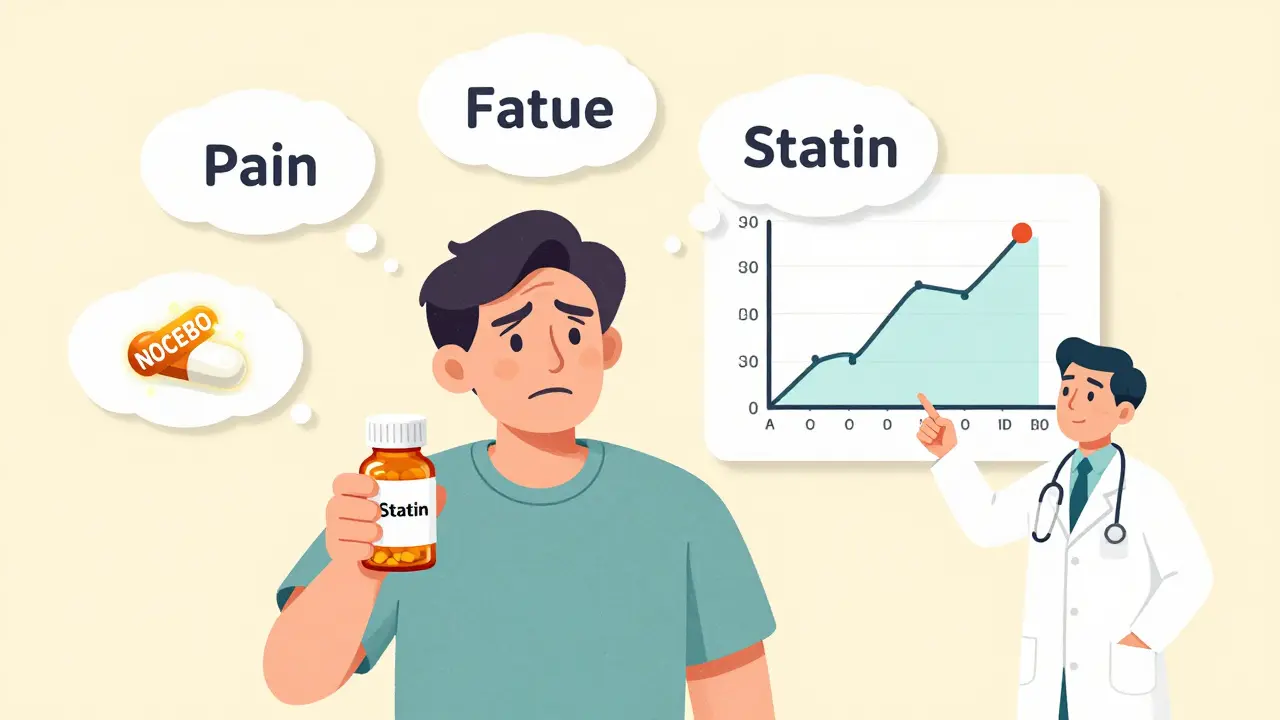
Many people stop taking statins because they feel muscle pain, fatigue, or weakness. They blame the drug. But what if the drug isn’t the real culprit? What if the problem isn’t the chemistry in the pill - it’s what’s happening in your mind?
Statins Are Safe. Most Side Effects Aren’t.
Statins save lives. They lower LDL cholesterol, reduce plaque buildup in arteries, and cut the risk of heart attacks and strokes by up to 30%. Yet, nearly half of people prescribed statins quit within the first year. Why? Because they say they feel awful.
But here’s the twist: in carefully designed studies, people taking a sugar pill (placebo) report almost the same symptoms as those taking real statins. That’s not a coincidence. It’s the nocebo effect - the dark twin of the placebo effect. Instead of feeling better because you believe a treatment works, you feel worse because you believe it will hurt you.
A landmark study called SAMSON, published in 2021, proved this. It tracked 60 people who had quit statins due to side effects. Each took three different types of pills over 12 months: real statin, dummy pill, and no pill at all. They logged daily symptoms on their phones. The results? Symptoms during the placebo month were almost identical to those during the statin month. And both were much worse than when they took nothing.
Here’s the kicker: 90% of the symptoms people blamed on statins were also triggered by the sugar pill. That means for most people, the drug itself isn’t causing the pain. The expectation of pain is.
How the Nocebo Effect Works
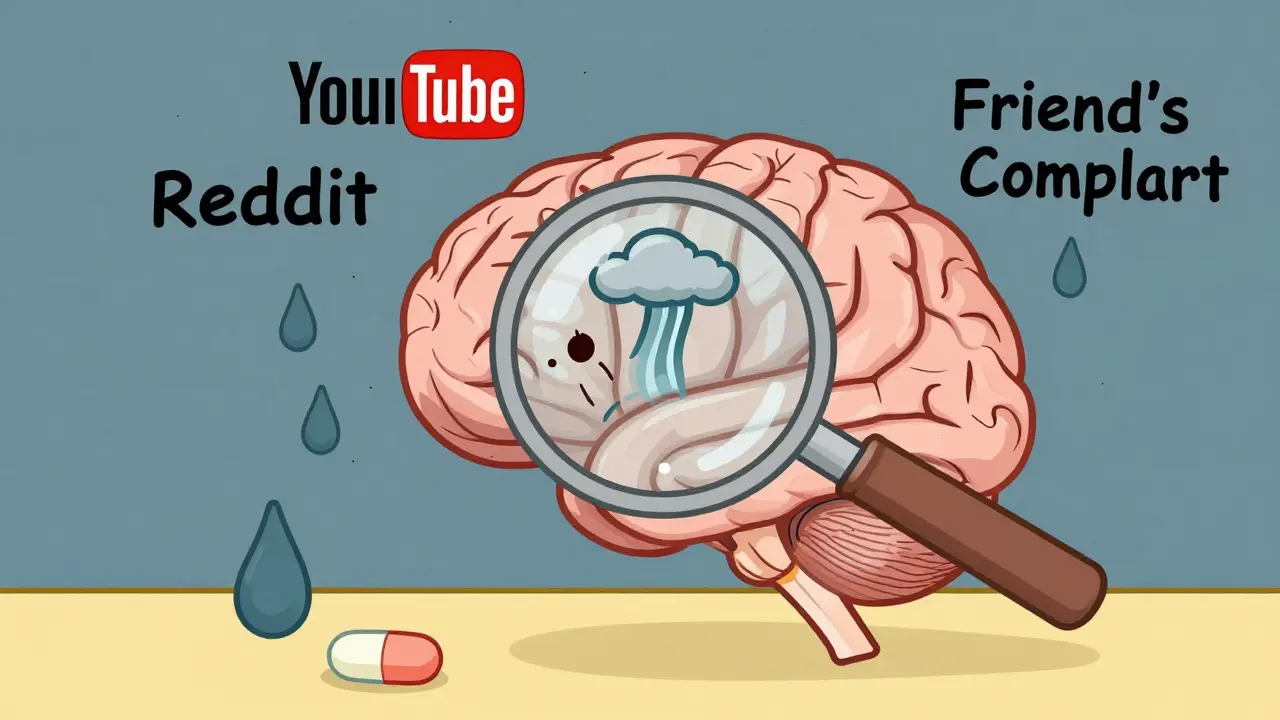
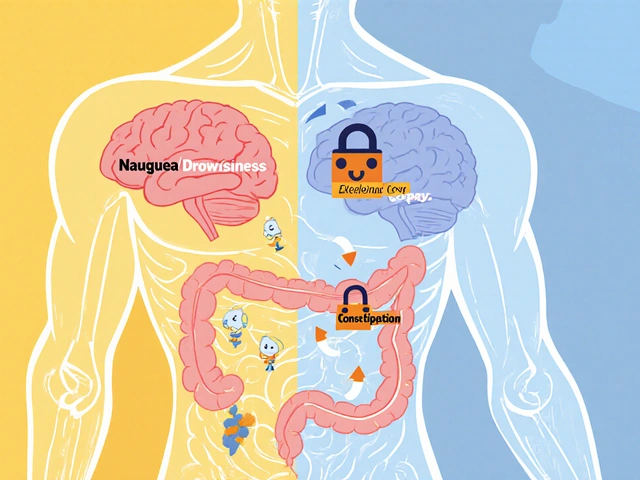
The nocebo effect isn’t "all in your head" - it’s real biology. When you read online that statins cause muscle pain, or hear a friend complain about them, your brain starts predicting discomfort. That prediction triggers real physical changes: stress hormones rise, muscles tense, nerves become hypersensitive. You don’t imagine the pain. You feel it - because your brain made it happen.
Think of it like this: if you’re told a new medication might make you dizzy, you start noticing every little wobble. You didn’t get dizzy because of the pill. You got dizzy because you were watching for it. Statins are especially vulnerable to this because side effects are widely publicized - often more than their benefits.
Compare that to other drugs. If you read the label for a common antibiotic, you might see a list of 20 possible side effects. But very few people stop taking antibiotics because of them. Why? Because no one talks about them. No viral Reddit threads. No dramatic TV ads. Statins? They’re the opposite. The fear is amplified.
What the Science Says About Muscle Pain
Let’s talk about the most common complaint: muscle aches. A 2021 meta-analysis of over 18,000 people in blinded trials found no difference in muscle symptoms between statin and placebo groups. The same study showed that objectively diagnosed muscle damage - like rhabdomyolysis - is extremely rare: fewer than 1 in a million people per year.
Meanwhile, in real-world settings - where people know they’re taking statins - up to 20% report muscle pain. That’s not because statins are dangerous. It’s because people expect to feel pain. The moment they start taking the pill, their brain goes on alert.
The SAMSON trial showed something even more telling: symptoms started within days of starting either the statin or the placebo - and faded just as fast when they stopped. If it were a true drug reaction, symptoms would build slowly and linger. They wouldn’t mirror the placebo pattern exactly. But they did. That’s not pharmacology. That’s psychology.
Real Cases: People Who Got Their Lives Back
After seeing their symptom data, half of the SAMSON participants restarted statins - and stayed on them. One 72-year-old man had stopped statins after three tries. He thought his leg pain was from the drug. When he saw his symptom tracker showed identical spikes on placebo and statin days, he realized: "It wasn’t the pill. It was me worrying about the pill." He restarted rosuvastatin at 5mg. His LDL dropped from 142 to 68. He’s been symptom-free for over a year.
Reddit threads are full of similar stories. Users write: "I thought I was intolerant. Then I saw my numbers. I restarted. No pain." Another: "I was convinced I had statin myopathy. Turns out I had anxiety about statins. I didn’t even know that was a thing."
These aren’t flukes. They’re data-driven reversals of a medical myth.
But What About the 10%?
Let’s be clear: 90% doesn’t mean 100%. There is a small group - about 1 in 10 - who truly react to statins. Their symptoms are real, and they don’t disappear on placebo. They might have genetic factors, thyroid issues, or actual muscle damage. Their CPK levels are high. Their pain doesn’t match the pattern.
Doctors aren’t saying everyone’s pain is fake. They’re saying: Don’t assume it’s the drug until you’ve ruled out the mind’s role. That’s why the American College of Cardiology now recommends a simple test for anyone who quits statins: try a blinded trial, even a short one. Track symptoms daily. See what happens without the pill. See what happens with a sugar pill. Only then decide.
How Doctors Are Changing Their Approach
Five years ago, if you said you had statin side effects, your doctor might have switched you to a different statin - or stopped the drug entirely. Now, many are doing something different. They’re handing patients symptom trackers. They’re showing them the SAMSON results. They’re saying: "Let’s test this together."
Cardiologists who use this method report that nearly 50% of patients who thought they couldn’t tolerate statins end up restarting them successfully. That’s a huge win. Statin non-adherence costs the U.S. healthcare system over $11 billion a year in preventable heart attacks and strokes. Fixing this one issue could save tens of thousands of lives.
Pharmaceutical companies are catching on too. Pfizer added nocebo education to its patient support programs. Amgen’s Repatha ads even say: "Unlike statins, which may cause symptoms due to expectation in many patients, Repatha has a different mechanism of action." That’s a direct nod to the science.

What You Can Do If You’re Stopped on Statins
If you’ve quit statins because of side effects, here’s what to try:
- Track your symptoms. Use a simple app or notebook. Rate pain, fatigue, or weakness daily on a scale of 0-10. Do this for one month without any pill.
- Try a placebo test. Ask your doctor for a short trial with dummy pills (placebo). Don’t tell yourself which is which. Track symptoms again.
- Compare the data. Are your symptoms worse on statin days? Or are they just as bad on placebo days? If they’re the same, the drug likely isn’t the cause.
- Restart slowly. If symptoms drop on no-pill days, try restarting with a low dose - like 5mg rosuvastatin or 10mg atorvastatin. Many people tolerate these fine once they’re not expecting pain.
- Stay informed. Avoid alarmist blogs. Stick to trusted sources like the American Heart Association or Mayo Clinic.
This isn’t about dismissing your experience. It’s about understanding it better. Your pain is real. But its source might not be what you think.
Why Statins Are Unique
Why does the nocebo effect hit statins so hard? Three reasons:
- High visibility. Statins are among the most prescribed drugs in the world. Millions take them. More people talk about side effects.
- Public fear. Media stories focus on risks, not benefits. "Statins cause muscle damage" gets clicks. "Statins prevent heart attacks" doesn’t.
- Timing mismatch. Muscle pain can come from aging, inactivity, or vitamin D deficiency - all common in the same people who take statins. The brain connects the dots backward: "I started statins, now I hurt - it must be the statins."
That’s why the nocebo effect is stronger for statins than for almost any other medication. It’s not the drug. It’s the story.
The Bigger Picture
Ignoring the nocebo effect doesn’t just hurt patients - it hurts medicine. It leads to unnecessary switching of drugs, more expensive alternatives, and missed prevention opportunities. It also makes patients feel blamed: "It’s all in your head." That’s not helpful. The right message is: "Your symptoms are real. But they might not be from the pill. Let’s find out why."
Cardiology is changing. More doctors now use the SAMSON method. More patients are getting their lives back. And the data is clear: when you separate expectation from biology, you often find that the medicine you feared is the one you need.
Are statin side effects real, or just in my head?
The symptoms are real - muscle pain, fatigue, and weakness are genuine experiences. But for most people, these symptoms occur just as often with a placebo pill as with the real statin. This means the drug itself isn’t causing them. The brain’s expectation of side effects triggers real physical responses. About 90% of reported symptoms are linked to the nocebo effect, not the medication.
How do I know if my symptoms are from the nocebo effect or a real reaction?
Track your symptoms daily for one month without any pill. Then, take a placebo pill (sugar pill) for a month, tracking symptoms again. Finally, take the statin. If your symptoms are nearly identical during placebo and statin phases - and much lower during the no-pill phase - the nocebo effect is likely responsible. True drug reactions usually persist or worsen over time and show up in blood tests (like elevated CPK). A doctor can help you interpret the pattern.
Can I restart statins after quitting because of side effects?
Yes - and many people do. Studies show about half of people who quit statins due to side effects can successfully restart them after understanding the nocebo effect. Start with a low dose, track symptoms daily, and work with your doctor. Most find they tolerate the drug well once they’re no longer expecting pain.
Is the nocebo effect just psychological?
No. The nocebo effect is biological. When you expect harm, your brain activates stress pathways, increases muscle tension, and heightens pain sensitivity. These are measurable, physical changes - not imagination. It’s not "you’re crazy." It’s your body reacting to what you’ve been told.
What should I do if I think I have true statin intolerance?
If your symptoms persist even during placebo and no-pill periods, or if blood tests show high CPK levels, you may have a true reaction. Talk to your doctor about alternatives like ezetimibe, PCSK9 inhibitors, or bempedoic acid. But don’t assume it’s the statin without testing - most people who think they’re intolerant aren’t.

Jamison Kissh
So let me get this straight - your brain can literally make you feel muscle pain just because you were told it might happen? That’s wild. Not ‘all in your head’ like people say - but actually, your head is sending real signals to your muscles. It’s like your nervous system got hacked by fear. I’ve seen this with anxiety and migraines. Same mechanism. The body doesn’t care if the threat is real or imagined - it reacts like it’s life or death.
Aliyu Sani
Yo this hits different. In Nigeria we got this thing called ‘joro’ - when you hear someone say ‘na this medicine dey kill am’ and suddenly everyone who takes it starts feeling weak. No lab test needed. Just vibes. Statins? Same energy. We don’t need double-blind trials to know the mind got power. The pill’s just the trigger. The real poison is the gossip.
Vikrant Sura
Interesting. But where’s the data on long-term adherence after the placebo test? Did they follow up for 5 years? Or is this just a shiny 12-month study with cherry-picked participants? Also, who funded SAMSON? Pharma? Because if they’re pushing this narrative, I’m skeptical.
Cara Hritz
ok so i read this and im like wow but then i remembered my aunt who took statins and her legs swelled up like balloons and she had to go to the er. so maybe its not all in the head? or maybe she just has bad genes? idk i’m confused now lol
Herman Rousseau
This is the most important thing I’ve read all year. 💪 Seriously - if you’ve quit statins because of ‘side effects,’ please, please do the symptom tracker thing. I did it. Thought I was intolerant. Turned out I was just scared. Restarted at 5mg. No pain. LDL down 40%. My cardiologist said I saved my own life. Don’t let fear steal your future. You got this.
Jeremy Hendriks
So the nocebo effect is just a fancy way for Big Pharma to gaslight patients into staying on drugs they don’t need? Brilliant. Next they’ll say your diabetes is caused by ‘fear of sugar’ and your hypertension is just ‘anxiety about clocks.’ This isn’t science - it’s corporate propaganda dressed up as enlightenment. Wake up.
Tarun Sharma
While the nocebo effect is well-documented, dismissing patient-reported outcomes without objective biomarkers is medically unsound. A subset of individuals exhibits true statin intolerance, and their suffering is not less valid because it does not conform to population-level statistics.
Jim Brown
There is a profound metaphysical truth here: the mind does not merely interpret the body - it co-creates it. The nocebo effect is not a flaw in human cognition, but a testament to the exquisite sensitivity of our biological architecture to narrative. We are not machines wired for chemical inputs; we are stories embodied. To reduce this to ‘expectation’ is to misunderstand the sacred interplay between belief and biology. Statins are not the enemy - fear, amplified by media and misinformation, is the true pathogen.
Kathryn Weymouth
It’s fascinating how the SAMSON study design isolates expectation from pharmacology. The fact that symptoms spiked identically during placebo and statin phases - and vanished during no-pill weeks - is statistically undeniable. This isn’t anecdotal. It’s reproducible. And yet, we still treat patients like they’re lying when they say they feel bad. We need to stop pathologizing the patient and start investigating the context.
Art Van Gelder
Let me tell you something - I’m from the Midwest, grew up on farm medicine: ‘if it hurts, take aspirin and pray.’ But when I started statins after my heart scare, I was reading Reddit threads at 2 a.m. about ‘statin myopathy’ and ‘muscle rot.’ I started feeling it. Every ache, every limp - I blamed the pill. Then I did the placebo thing. And guess what? Same exact pain. Same exact days. I cried. Not because I was weak - because I realized I’d been sabotaging myself with fear. I’m on statins now. My kids call me ‘the walking miracle.’ Don’t let fear write your medical story.
Candy Cotton
This is a classic example of Western medical arrogance. You assume that because a majority of people don’t react, the minority’s suffering is ‘psychological.’ But in America, you have the luxury of overdiagnosis and overmedication. In other countries, we don’t have statins - we have food, exercise, and respect for the body. Maybe the problem isn’t the nocebo effect - maybe it’s that you’re medicating normal aging.
Sam Black
As someone who’s helped dozens of patients restart statins using the SAMSON method, I can tell you - the transformation is real. People come in defeated, convinced they’re broken. They leave with their health back and a new understanding of their own mind. It’s not magic. It’s medicine. And it’s one of the most humane interventions we’ve got in cardiology right now. Shame more docs don’t use it.
Sai Keerthan Reddy Proddatoori
Statins are poison. They’re made by foreign labs. The FDA is corrupt. The nocebo thing is just a trick to make you take more pills. My cousin took one and his liver exploded. Don’t believe the lies. Eat turmeric. Drink lemon water. Your body knows better than some doctor with a clipboard.