
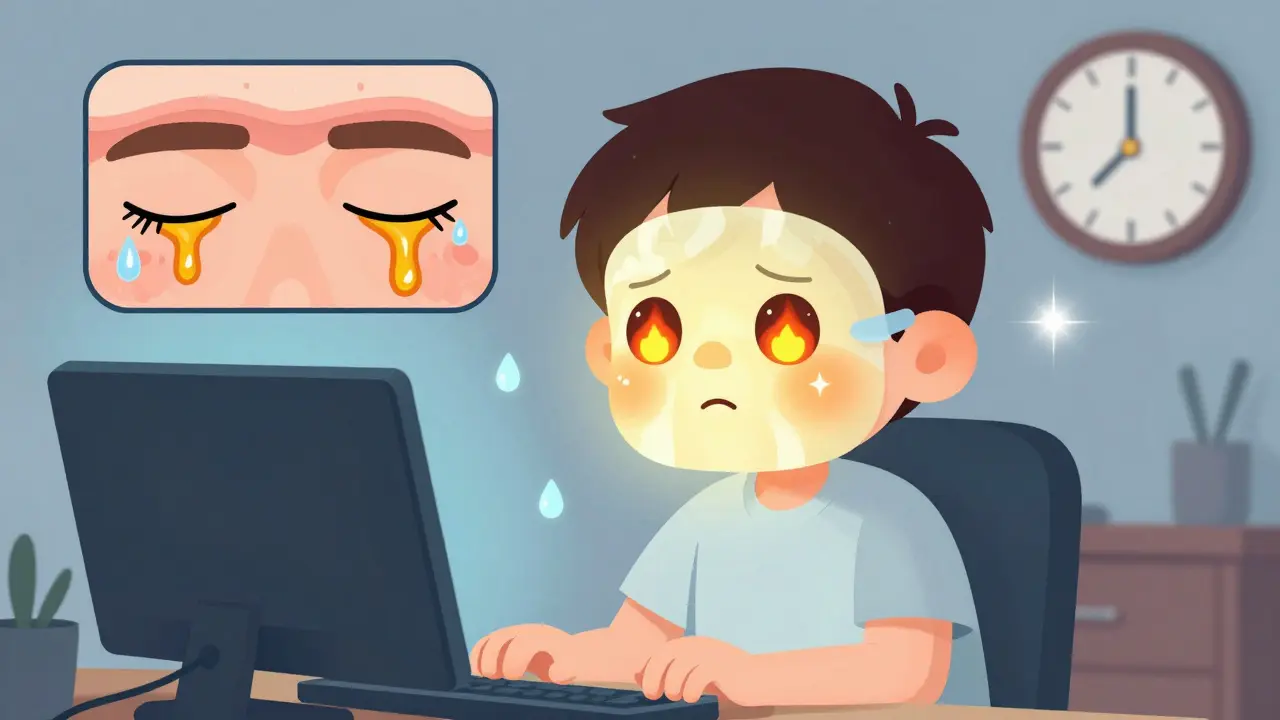
When your eyes feel gritty, burn after just a few hours on the screen, or water uncontrollably despite being dry - you’re not just tired. You might have meibomian gland dysfunction (MGD), the hidden cause behind most cases of dry eye. It’s not just discomfort. Left untreated, MGD can lead to permanent damage to the glands that keep your eyes lubricated. And it’s more common than you think: nearly half of all people visiting an eye doctor have it. The good news? There are proven ways to manage it - if you know where to start.
What Exactly Is Meibomian Gland Dysfunction?
Your eyelids have tiny oil glands - about 25 to 40 on each lid - called meibomian glands. They secrete a clear, oily fluid that forms the top layer of your tear film. This layer is critical. It stops your tears from evaporating too fast. When these glands get clogged or stop working right, your tears evaporate, leaving your eyes dry, irritated, and vulnerable to damage.
There are two main types of MGD. The first, obstructive MGD, is the most common. The glands are blocked - like pipes filled with thick grease - and can’t release oil. The second, hypersecretory MGD, is rarer. Here, the glands produce too much oil, but it’s poor quality - runny and ineffective. Both lead to the same outcome: evaporative dry eye.
Age plays a big role. By age 60, over 70% of people show signs of MGD. Screen use, contact lenses, and even makeup can make it worse. But the real problem? Most people think it’s just “dry eyes” and reach for artificial tears. Those help temporarily, but they don’t fix the root cause.
Why Home Care Isn’t Enough - But Still Essential
Doctors agree: daily home care is the foundation of MGD treatment. Skip it, and even the most expensive in-office procedures will fail within months.
The standard routine takes 10 to 15 minutes a day:
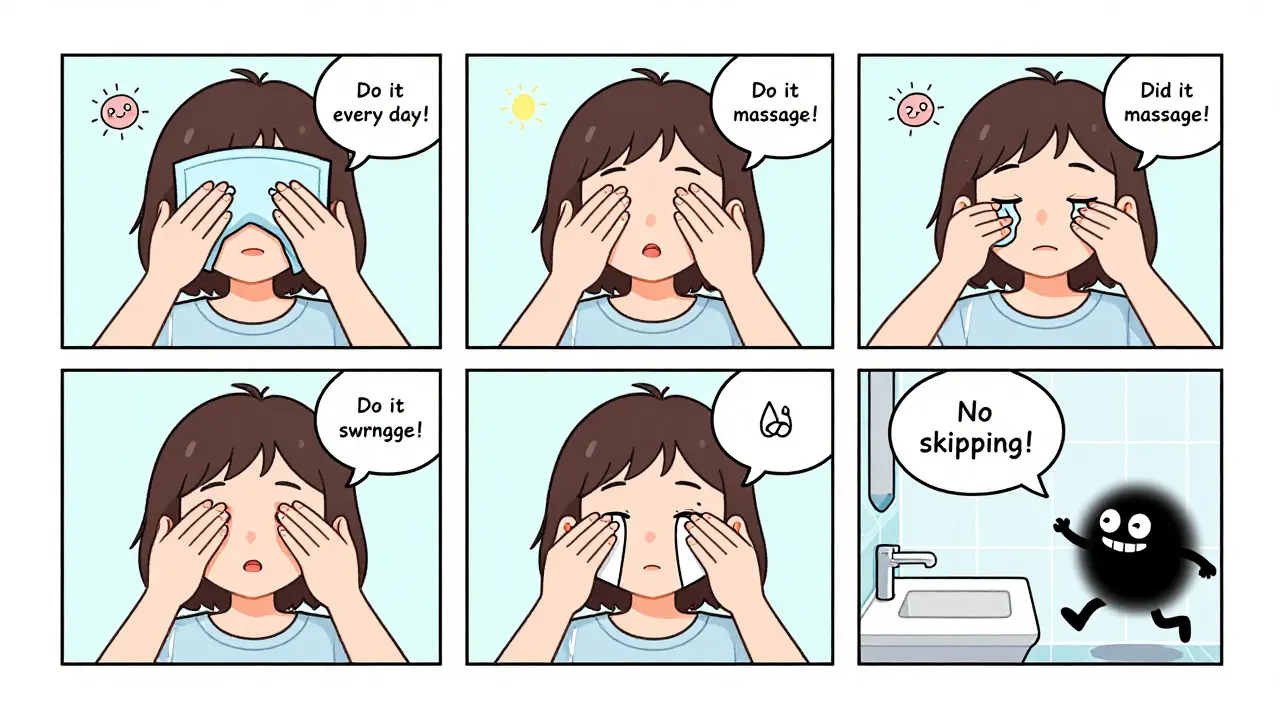
- Warm compresses - Use a heated mask like the Bruder Mask set to 40-42°C. Heat melts the hardened oil blocking your glands. Do this for 5 minutes.
- Lid massage - Gently slide your finger along your eyelid from the lash line toward the eye. This squeezes out the melted oil. Do this for 30 seconds per lid.
- Lid cleaning - Wipe the lid margins with a hypochlorous acid solution like OCuSOFT Lid Scrub. This removes bacteria and debris that cause inflammation.
Studies show you need at least 85% compliance to keep symptoms under control. That means doing this nearly every day. Many people start strong but quit after a few weeks. And that’s when symptoms come roaring back.
One patient, a 52-year-old graphic designer from Wellington, told me: “I did the warm compresses religiously for three months. My eyes felt better than they had in years. Then I skipped a week for a trip. Within days, the burning came back. I learned the hard way - this isn’t a cure. It’s maintenance.”
In-Office Treatments: What Actually Works
If home care isn’t enough, there are three main in-office options backed by solid research.
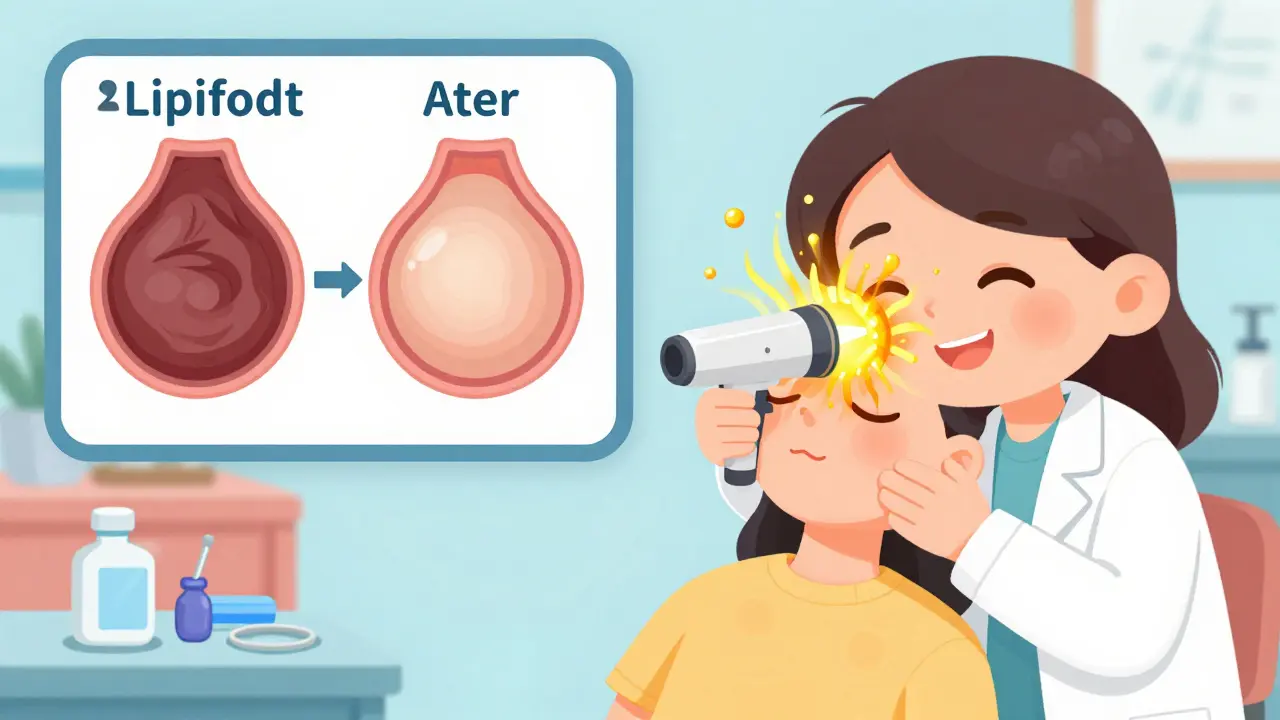
LipiFlow Thermal Pulsation
LipiFlow is the most studied device for MGD. It applies controlled heat (42.5°C) to the inner eyelid while gently massaging the outer lid. This melts blockages and expresses trapped oil. The whole process takes about 12 minutes per eye.
Clinical data shows it improves gland function significantly. In one study, patients went from a gland expressibility score of 1.8 to 2.7 on a 4-point scale - a 50% improvement. Results last up to 12 months, but only if you keep up with daily care afterward.
Cost? Around $1,500 to $2,500 per eye in the U.S. Insurance rarely covers it. Only 15-20% of commercial plans pay for LipiFlow. Many patients pay out-of-pocket.
Intense Pulsed Light (IPL)
IPL uses pulses of broad-spectrum light (500-1200 nm) to target tiny blood vessels near the eyelids. These vessels are often inflamed in MGD patients. The light heats them up, reducing inflammation and improving gland function.
It’s not a standalone fix. IPL works best when combined with manual gland expression. One study showed patients’ Ocular Surface Disease Index (OSDI) scores dropped from 32.6 to 18.3 after four IPL sessions - a 44% improvement. That’s better than expression alone.
Each session takes 15 minutes. Four sessions, spaced three weeks apart, are typical. Cost: $800 to $1,200 per session. Again, insurance coverage is rare.
Meibomian Gland Probing (MGP)
Probing is a more aggressive option, usually reserved for advanced cases. A thin, sterile probe is inserted into the gland duct to physically break up blockages deep inside - even fibrous scar tissue that heat alone can’t touch.
It’s done under local anesthetic and takes 30-40 minutes. Studies show combining probing with heat (like LipiFlow) gives the best long-term results - 85% of patients report sustained relief at one year.
Cost: $750 to $1,200 per session. Fewer clinics offer it because it requires specialized training.
Medications: When Pills and Drops Make a Difference
While heat and cleaning tackle the blockage, medications target the inflammation that makes MGD worse.
Oral azithromycin has become a go-to. A five-day course - 500 mg on day one, then 250 mg daily for four more days - reduces inflammation better than a full month of doxycycline. One study found 78.6% of patients had less redness with azithromycin versus 62.3% with doxycycline. Side effects? Only 3.2% reported nausea or upset stomach with azithromycin. With doxycycline? Nearly 30%.
Topical lifitegrast 5% is another option, especially for advanced MGD. It’s an eye drop that blocks inflammation signals. In clinical trials, corneal staining (a sign of surface damage) dropped from 12.4 to 5.7 after 12 weeks. It’s not a cure, but it helps the eye heal.
Both require a prescription. Neither is cheap. Lifitegrast can cost over $400 per month without insurance.
What Doesn’t Work - And Why
Not all treatments live up to the hype.
Some clinics push thermal devices as miracle cures. But the U.S. Veterans Affairs system labels them “investigational” due to insufficient long-term evidence. LipiFlow and IPL help - but only if you pair them with daily care.
Over-the-counter eye drops? They’re like putting a bandage on a broken bone. They soothe, but they don’t fix the blocked glands.
And don’t expect quick fixes. MGD is chronic. You can’t “cure” it in one visit. Even the best in-office procedure fails if you stop your daily routine.
Who Gets the Best Results?
Early intervention makes all the difference. Patients treated within a year of symptoms showing up have 37% better outcomes than those who wait five years or more.
Also, the more glands you still have, the better you respond. If over half your glands are already gone (called “gland dropout”), even the best treatments won’t fully restore function. That’s why getting diagnosed early matters.
Combination therapy wins. Using home care + one in-office procedure + medication gives a 79% success rate at 12 months. Single treatments? Only 48%.
And compliance is everything. In one study of over 3,000 patients, only 43% stuck with daily care after six months. Guess what happened to the rest? Symptoms returned.
The Future of MGD Care
Research is moving fast. Exosome therapy - using natural healing molecules from stem cells - is showing 92% symptom improvement in early trials. Nanomicellar cyclosporine (Cequa) delivers medication deeper into the eye with better results than older drops.
Even more exciting? The 2023 Dry Eye Workshop II now recommends treating MGD before cataract surgery - even in people with no symptoms. Why? Because untreated MGD causes 40% more inflammation after eye surgery.
Experts agree: MGD isn’t just a side note in dry eye. It’s the main event. Within five years, it’ll be the primary focus of all dry eye care.
What to Do Next
If you’ve been told you have dry eye and your drops aren’t helping:
- Start daily warm compresses and lid hygiene - today.
- See an eye doctor who specializes in dry eye or cornea issues. General ophthalmologists often miss MGD.
- Ask about meibography - an imaging test that shows the health of your glands.
- If symptoms persist, discuss LipiFlow, IPL, or probing. Ask about costs and insurance.
- Don’t ignore it. The longer you wait, the harder it is to fix.
MGD isn’t something you outgrow. It’s something you manage. But with the right approach, you can stop the burning, the grit, and the blurry vision - and see clearly again.



Teresa Marzo Lostalé
Been dealing with this for years. I used to think eye drops were magic. Turns out they’re just fancy water. My mom had MGD too - she’d rub her eyes like she was trying to start a fire. Then I found the Bruder mask. Game changer. Now I do it before bed like brushing my teeth. No more 3 a.m. blinking fits. 😅
ANA MARIE VALENZUELA
Everyone’s acting like this is groundbreaking. Newsflash: people have had dry eyes since the invention of screens. You think your 15-minute routine is ‘treatment’? It’s just hygiene. Like washing your hands before eating. No one’s giving awards for not going blind from neglect. And don’t get me started on LipiFlow - $2,500 to feel slightly less like a camel? Paying for a spa day for your eyelids.
Bradly Draper
I’m not a doctor, but I’ve had this for 5 years. The warm compresses? I didn’t believe them at first. But after two weeks, I could actually read without squinting. I didn’t even know how bad it was until it got better. Just do the stuff. It’s not glamorous, but it works. Seriously.
Vu L
LipiFlow? More like LipiFlow $$$$. And IPL? Sounds like someone took a tanning bed and told it to be a doctor. Meanwhile, I just blink slower and drink more water. My eyes are fine. Maybe the real problem is we’re all staring at screens like zombies. Fix that first.
James Hilton
So let me get this straight - you’re telling me the solution to modern eye pain is… doing chores? 😭 I paid $120k for college to learn how to apply heat to my eyelids? I could’ve just become a monk. At least monks don’t have to wipe their lids with chemical wipes. 🙏
Ryan Touhill
It’s fascinating how the medical-industrial complex has successfully repackaged basic hygiene as a high-cost, high-tech intervention. LipiFlow, IPL, probing - all of these are merely mechanized versions of what grandmothers did with warm cloths and gentle pressure. The real tragedy isn’t MGD. It’s that we’ve lost the cultural memory of simple, effective care - and now we’re monetizing our ignorance.
Celia McTighe
OMG I’m so glad someone wrote this!! I’ve been doing the warm compresses for 4 months now and my eyes actually feel like they’re not made of sandpaper 😭 I even bought those little eyelid wipes on Amazon - they’re like $8 for 60! So easy. Also, I started wearing blue light glasses and it’s like night and day. Thank you for not making this sound like a sci-fi movie 🙌
Nicole Beasley
Wait - so if I have MGD, does that mean my eyelashes are clogged like a drain? And why does makeup make it worse? I use that waterproof mascara that says ‘lasts 24 hours’… is that the enemy? 😅
sonam gupta
USA spending thousands on eyelid gadgets while kids in India still rub their eyes with cold water and survive. You think this is medicine? This is capitalism with a stethoscope. Do the 10 minutes. No device needed. Simple. Free. Done.
Julius Hader
Let’s be real - if you’re doing all this just to avoid a $2,500 procedure, you’re doing it wrong. You’re not healing. You’re performing. The real issue? We’ve turned self-care into a religion. And now we’re judging people who don’t have the time, money, or patience to worship at the altar of the Bruder Mask.