Antibiotic Stewardship: Why Proper Use Saves Lives and Stops Superbugs
When we talk about antibiotic stewardship, the coordinated effort to use antibiotics only when needed and in the right way. Also known as antimicrobial stewardship, it’s not just a hospital policy—it’s a daily choice that affects whether your next infection can be treated at all. Every time an antibiotic is used unnecessarily, it pushes bacteria to evolve into harder-to-kill strains. That’s how superbugs like MRSA and drug-resistant TB appear. And it’s not just about hospitals. It’s happening in your kitchen, your doctor’s office, and even in the meat you eat.
Antibiotic stewardship isn’t about avoiding antibiotics entirely—it’s about using them correctly. For example, if you have a cold or the flu, antibiotics won’t help because those are viral infections. But if you have a bacterial infection like strep throat or a urinary tract infection, the right antibiotic at the right dose can save your life. The problem? Many people expect a pill for every sniffle, and too many doctors still hand them out just to please patients. Studies show that up to half of all antibiotic prescriptions in outpatient settings are unnecessary. That’s not just waste—it’s a public health emergency.
What does good stewardship look like in practice? It means doctors take time to test before prescribing, patients ask if an antibiotic is truly needed, and pharmacies track usage. It also means avoiding broad-spectrum drugs unless absolutely necessary. For instance, if a simple infection can be treated with amoxicillin, why use a stronger, more expensive drug that wipes out good bacteria too? This isn’t theoretical. In the U.S., over 2.8 million antibiotic-resistant infections happen each year, and more than 35,000 people die from them. These aren’t distant statistics—they’re your neighbor, your parent, your child.
And it’s not just about individual choices. Antibiotic stewardship connects to everything from hospital protocols to farming practices. Livestock are given antibiotics to grow faster, not to treat illness—and those drugs end up in our food chain. That’s why some of the strongest resistance patterns show up in community settings, not ICUs. It’s a system problem, and fixing it needs everyone involved.
You don’t need to be a doctor to help. If you’re prescribed an antibiotic, ask: Is this really needed? What happens if I don’t take it? Are there safer alternatives? Never save leftover pills for next time. Never share them. And never pressure your doctor for a script when they say no. The next time you’re sick, remember: the best medicine might be waiting for your body to heal itself—with no pills at all.
Below, you’ll find real-world examples of how antibiotics are misused, how they affect other medications like blood thinners and thyroid drugs, and what you can do to protect yourself from the growing threat of resistance. These aren’t abstract ideas—they’re stories of people who got sick because the drugs stopped working, and others who learned how to use them right.
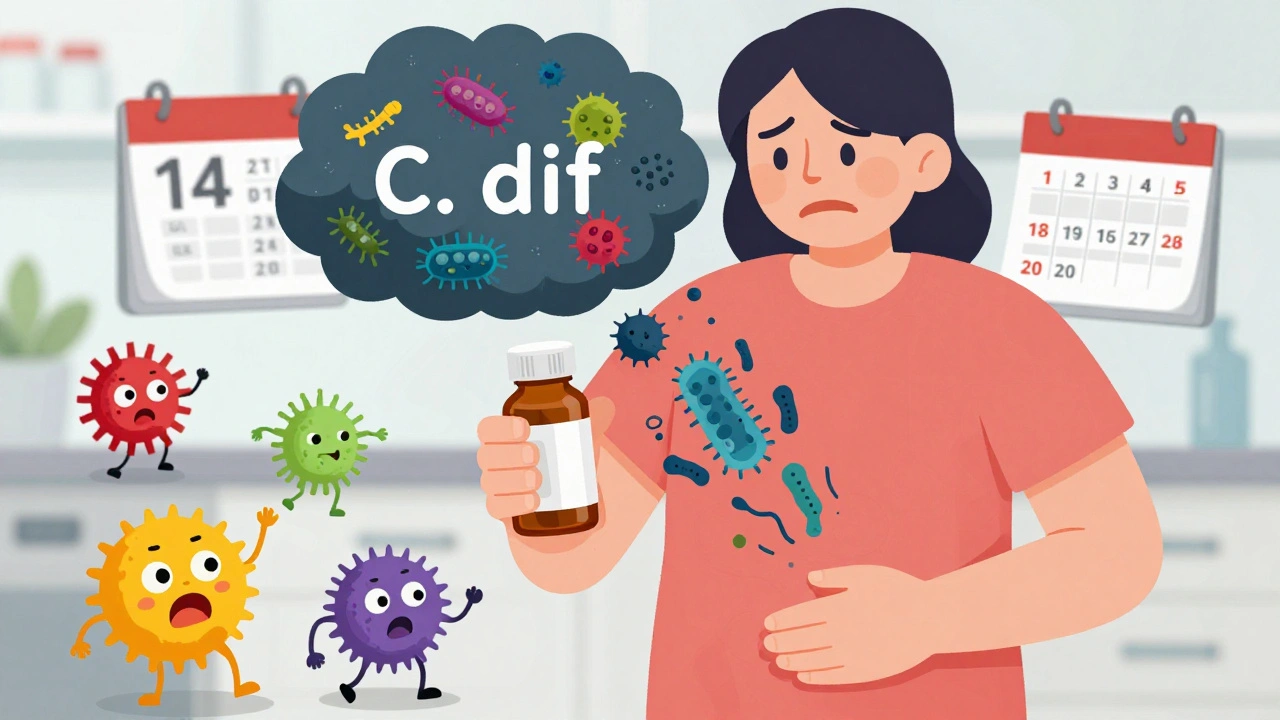
Antibiotic-induced diarrhea can lead to C. diff infection, a serious and often recurrent condition. Learn how to prevent it, recognize symptoms, and choose the right treatment based on current medical guidelines.