
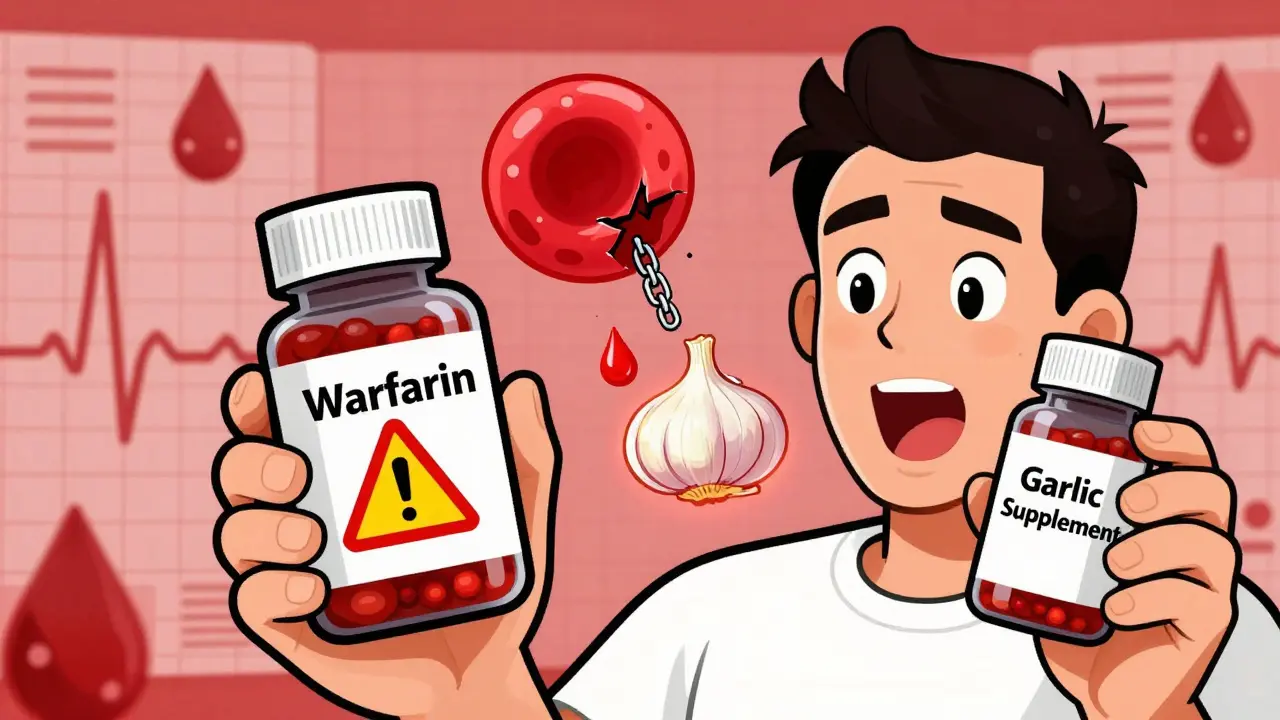
If you're taking a blood thinner like warfarin, apixaban, or rivaroxaban, and you're also popping garlic supplements for heart health, you could be putting yourself at serious risk. This isn't just a theoretical concern-it's a documented danger that shows up in emergency rooms, operating rooms, and hospital beds. Garlic supplements don't just help lower cholesterol or boost immunity. They thin your blood. And when that effect combines with prescription anticoagulants, it can lead to uncontrolled bleeding that turns minor procedures into life-threatening events.
How Garlic Actually Thins Your Blood
Garlic isn't just a flavoring in your pasta sauce. When taken as a supplement, it contains a compound called ajoene-a sulfur-based molecule that directly interferes with how your blood clots. Unlike aspirin, which temporarily blocks one pathway, ajoene binds irreversibly to platelets, the cells responsible for forming clots. Once a platelet is hit by ajoene, it's out of commission for its entire lifespan-about 7 to 10 days. Your body has to make new ones to restore normal function.
This isn't a minor effect. Studies show that standard garlic supplement doses-typically 600 to 1,200 mg of dried powder daily-can reduce platelet aggregation by 20% to 40%. That’s comparable to low-dose aspirin. But here’s the catch: you don’t know how much ajoene is in your bottle. Garlic supplements vary wildly. Oil-based extracts can contain up to 1.0 mg of ajoene per gram. Aged garlic extracts? Almost none. Powdered tablets? Just a fraction. Labels rarely tell you the difference. And if you're taking multiple pills a day, you could be ingesting enough to significantly impair clotting.
Why This Matters With Blood Thinners
Anticoagulants work in different ways. Warfarin slows down clotting factors made by the liver. DOACs like apixaban block specific enzymes in the clotting cascade. Garlic doesn't interfere with those mechanisms directly. Instead, it attacks the other half of the system: your platelets. So while your blood thinner is already making your blood slower to clot, garlic is making your platelets less able to stick together and form a plug. The result? A double hit.
Clinical evidence is clear. In one case series published in Chest, patients on warfarin who took garlic supplements saw their INR levels jump by 1.0 to 2.5 points. That’s enough to push someone from a safe therapeutic range (INR 2.0-3.0) into dangerous territory (INR >4.0), where spontaneous bleeding becomes a real threat. One patient developed a spinal epidural hematoma after taking 2,400 mg of garlic daily-no trauma, no injury, just supplements and blood thinners. Another had uncontrollable bleeding during routine colorectal surgery, forcing doctors to convert to open surgery and create a temporary ileostomy.
Real Stories, Real Consequences
It’s not just in medical journals. On Reddit’s r/anticoagulants community, a user wrote about nosebleeds lasting over 30 minutes after combining 900 mg of garlic supplements with apixaban. They ended up in the ER. Another patient, a 72-year-old woman on warfarin, started taking garlic pills for her blood pressure. Within weeks, she began bruising easily and had bleeding gums. Her INR went from 2.4 to 5.1. She didn’t tell her doctor she was taking garlic-she thought it was just a “natural remedy.”
Even people without a history of bleeding problems aren’t safe. In one study of patients undergoing surgery, 68% continued taking garlic supplements within 7 days of their procedure-even after being asked about herbal use. Most didn’t consider garlic a supplement. They thought of it as food. That’s the problem. People don’t connect garlic pills with blood thinning. But the risk is real.

Who’s at Highest Risk?
Not everyone who takes garlic and blood thinners will bleed. But some groups are far more vulnerable:
- People over 65: One in five older adults takes garlic supplements. Nearly a quarter of them are also on anticoagulants. That’s over 3 million Americans at risk.
- Those having surgery: Whether it’s a knee replacement, colon surgery, or even a simple dental extraction, garlic can turn routine procedures into emergencies. The American Society of Anesthesiologists says to stop garlic supplements at least 14 days before any surgery.
- People on warfarin: Garlic has the strongest documented interaction with warfarin, raising INR levels more than other supplements like fish oil or ginkgo.
- Those with kidney or liver disease: These conditions already affect how drugs and supplements are processed. Adding garlic increases unpredictability.
How Garlic Compares to Other Supplements
Garlic isn’t the only supplement that interacts with blood thinners-but it’s one of the most dangerous because of how common it is and how long its effects last.
| Supplement | Antiplatelet Effect | Duration of Effect | Reported Severe Bleeding Cases | Recommended Discontinuation Time |
|---|---|---|---|---|
| Ginkgo biloba | 30-50% inhibition | 2-4 days | High | 14 days |
| Garlic supplements | 20-40% inhibition | 7-10 days (until new platelets form) | High | 14 days |
| Fish oil (omega-3) | 10-20% inhibition | 1-3 days | Moderate | 7 days |
| Ginseng | 10-15% inhibition | 2-5 days | Low | 7 days |
| St. John’s wort | Minimal | None | Very low | Not required |
Ginkgo has stronger effects, but garlic is more widely used-and its impact lasts longer because it permanently disables platelets. Fish oil is safer at standard doses, but high doses (over 3 grams daily) still carry risk. The key difference? Garlic’s effect is irreversible. You can’t just stop taking it and expect your blood to return to normal the next day.
What You Should Do
If you're on a blood thinner, here’s what you need to do right now:
- Stop taking garlic supplements immediately. Even if you feel fine. The risk isn’t about how you feel-it’s about what’s happening inside your blood.
- Talk to your doctor or pharmacist. Don’t assume they know you’re taking garlic. Many patients don’t mention it because they don’t think of it as a drug. Ask specifically: “Is it safe to take garlic pills with my blood thinner?”
- Check your labels. Look for terms like “aged garlic extract,” “garlic oil,” or “standardized garlic.” These are different. Aged garlic extract has little to no ajoene and is likely safer. But don’t assume-ask your pharmacist to verify.
- Wait 14 days before any surgery or dental work. Even a tooth extraction can bleed uncontrollably if garlic is still in your system. Tell your dentist you’re on blood thinners-and that you’ve stopped garlic supplements.
- Monitor for signs of bleeding. Unexplained bruising, nosebleeds lasting more than 10 minutes, blood in urine or stool, or unusually heavy menstrual bleeding are red flags.
The Bigger Problem: Lack of Awareness
A 2022 survey found that 83% of people taking garlic supplements didn’t know they could interact with blood thinners. Two-thirds never discussed it with their doctor. That’s not negligence-it’s a system failure. Supplement labels don’t warn you. Doctors don’t always ask. Pharmacists are overwhelmed. And patients assume “natural” means “safe.”
The FDA issued a warning in 2021 about inconsistent garlic supplement potency-some products had 15 times more active ingredient than others. Yet only 42% of manufacturers follow labeling standards. The European Medicines Agency now requires garlic supplements to carry a clear warning about bleeding risk. In the U.S.? Still no mandatory labeling.
What’s Changing
There’s hope. The FDA is drafting new rules that would require garlic supplements to list ajoene content on the label-expected to be finalized in 2024. Some companies are already responding. Kyolic’s aged garlic extract claims a 98% reduction in antiplatelet activity. But without independent testing, it’s hard to trust those claims.
The NIH is funding a $2.4 million study to measure exactly how different garlic products affect apixaban users. Results won’t be out until late 2024, but they could finally give us clear, science-backed guidance instead of guesswork.
Bottom Line
Garlic supplements are not harmless. If you’re on a blood thinner, they’re a serious risk. The benefits-slight blood pressure drops, minor cholesterol improvements-are not worth the chance of a stroke from a brain bleed, a life-threatening surgery complication, or a spontaneous spinal hematoma. There’s no safe dose if you’re taking anticoagulants. The only reliable advice is this: stop them. Talk to your provider. Don’t rely on labels. Don’t assume natural equals safe. Your blood doesn’t care if it came from a clove or a capsule. It only cares whether it can clot when it needs to.
Can I still eat garlic if I’m on blood thinners?
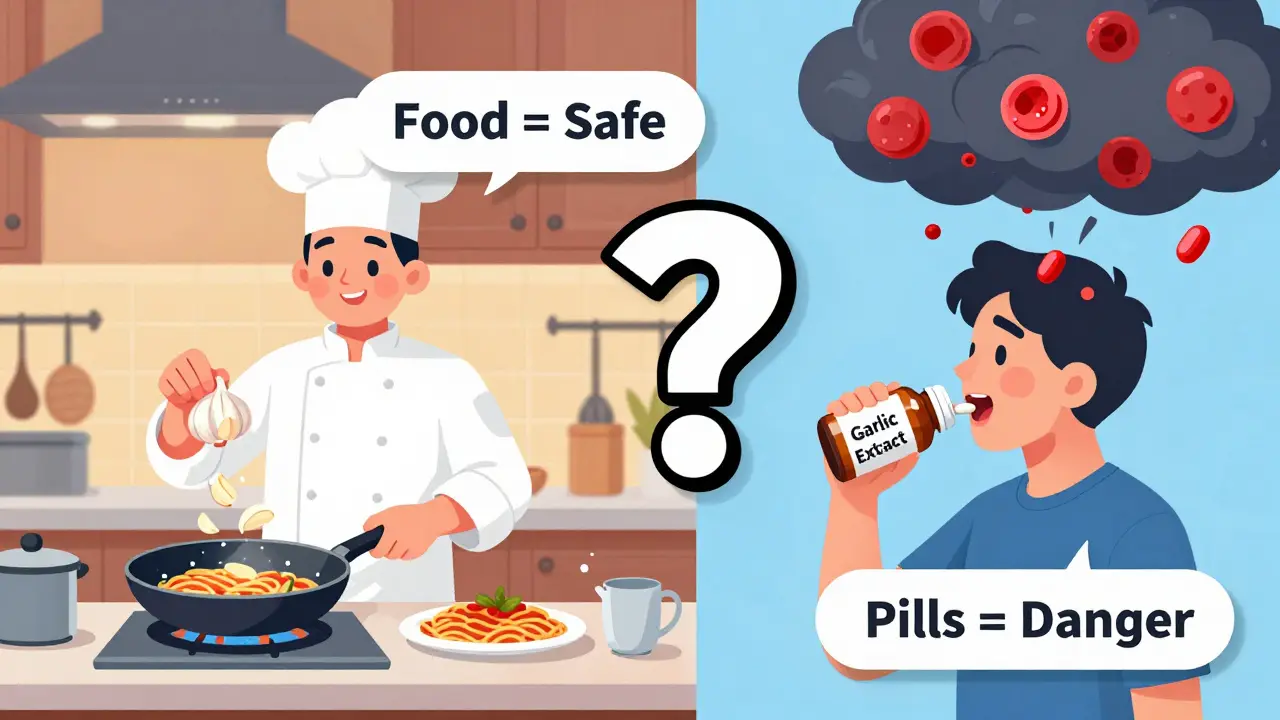
Yes. Eating garlic in food is generally safe. The problem is with concentrated supplements. A clove or two in your cooking won’t affect your blood clotting. But taking pills, oils, or extracts that deliver 600-2,400 mg of garlic per day can. The dose makes the poison.
Is aged garlic extract safer than regular garlic supplements?
Yes, significantly. Aged garlic extract undergoes a long fermentation process that breaks down ajoene, the main antiplatelet compound. Most studies show it has little to no effect on platelet function. If you want garlic’s benefits without the bleeding risk, aged garlic extract is the only form worth considering-but still check with your doctor.
How long does garlic stay in my system?
The antiplatelet effect lasts as long as the affected platelets live-7 to 10 days. Even if you stop taking garlic today, your blood won’t return to normal until your body replaces those damaged platelets. That’s why doctors recommend stopping supplements at least 14 days before surgery.
What should I tell my surgeon or dentist?
Tell them you’re on a blood thinner and that you’ve stopped all garlic supplements at least 14 days before your procedure. Mention the exact name of your medication and the name of any supplement you took-even if you stopped it. Many complications happen because patients don’t disclose supplement use, thinking it’s irrelevant.
Are there any garlic supplements that don’t interact with blood thinners?
Aged garlic extract is the only form with strong evidence of minimal interaction. Other forms-including garlic powder, oil, and standardized extracts-contain ajoene and carry risk. Always look for “aged garlic extract” on the label and avoid anything that says “standardized to X% allicin” or “garlic oil.” Those are high-risk.


Naomi Walsh
Let’s be real-this post is basically a public service announcement disguised as a blog. The fact that people still think ‘natural’ means ‘safe’ is why we have a healthcare crisis. Garlic supplements aren’t tea. They’re pharmacologically active compounds with irreversible platelet effects. If you’re on a DOAC and popping garlic pills like they’re M&Ms, you’re not being ‘holistic,’ you’re being reckless. The FDA’s inaction here is criminal. Aged garlic extract? Fine. Standardized allicin powder? That’s a blood thinner by another name. Stop pretending supplements are harmless.
And yes, I’ve seen the ER logs. I work in clinical pharmacology. I’ve seen the spinal hematomas. I’ve seen the ORs turned into chaos because someone thought ‘garlic is food.’ It’s not. It’s a drug. Label it like one.
Sami Sahil
bro i was takin garlic pills for my cholestrol and my bp and now i read this and im like… oh shit. i just had a nosebleed last week that lasted 20 mins. i thought it was just dry air. but now im thinkin… maybe? i stopped the pills yesterday. no more garlic for me. thanks for the wake up call 😅
franklin hillary
Garlic supplements are the perfect metaphor for modern health culture-people take them because they want to feel in control, but they don’t want to actually understand what they’re doing. You think you’re being proactive by popping pills labeled ‘natural’ but you’re just outsourcing your responsibility to a label that says ‘1000mg garlic’ with zero context. The body doesn’t care if it came from a clove or a capsule. It only cares if it can clot. And if you’re on anticoagulants, your blood is already walking a tightrope. Don’t hand it a chainsaw.
Stop romanticizing ‘natural remedies.’ The only thing natural about this is the bleeding.
And yes-I’m that guy who reads the FDA warning labels. You’re welcome.
Bob Cohen
So let me get this straight-you’re telling me that the same garlic I put in my pasta sauce is fine, but if I grind it up, put it in a capsule, and call it a ‘heart health supplement,’ now it’s a potential blood thinner? Wow. That’s like saying water is safe to drink, but if you freeze it into ice cubes and call it ‘hydration pellets,’ now it’s a weapon.
Meanwhile, my doctor asks me about fish oil and ginkgo but never says a word about garlic. Why? Because it’s ‘just garlic.’ That’s the problem. We’ve normalized dangerous stuff because it smells like dinner. This post should be mandatory reading before you buy anything labeled ‘herbal’ or ‘natural.’
Ishmael brown
Okay but what if I take garlic AND warfarin and just… monitor my INR like a boss? 🤔
Also I saw a guy on TikTok who said he takes 3 garlic pills a day and his cholesterol dropped 40%. He’s 87 and still does push-ups. So… maybe? 🤷♂️
Aditya Gupta
my grandpa took garlic pills for 10 yrs with warfarin and never had a problem. maybe its not that bad? i think the real issue is people dont tell their dr. not the garlic itself. also i eat garlic every day. no pills. just food. thats fine right?
Nancy Nino
While I appreciate the clinical rigor of this post, I must respectfully challenge the tone of alarmism. The data presented is compelling, yet the framing implies a binary outcome-either you take garlic supplements and bleed out, or you don’t. The reality is more nuanced. For many patients, particularly those with stable INR levels and minimal supplementation, the risk is statistically low. What’s more concerning is the systemic failure of provider education. Rather than demonizing supplements, we should be training clinicians to ask better questions. Natural doesn’t mean safe. But neither does pharmaceutical mean risk-free. The solution lies in dialogue, not fear.
June Richards
Wow. This is the most overblown, fear-mongering, pseudo-medical nonsense I’ve read all week. You act like garlic supplements are the new heroin. I’ve been taking them for years. My INR is fine. My doctor knows. I eat garlic bread daily. You think your article is going to stop people? Nah. People will keep taking them because they feel better. And guess what? They might be right. Meanwhile, you’re just selling anxiety wrapped in a PDF. 🙄