
Why do some people gain weight easily, even when they don’t eat much? And why do others struggle to lose weight no matter how hard they try? The answer isn’t laziness or lack of willpower. It’s biology. Obesity isn’t just about eating too much and moving too little. It’s a disease of broken signals in the brain and body that control hunger, fullness, and energy use. Understanding how these systems fail helps explain why weight loss is so hard-and why new treatments are finally starting to work.
The Brain’s Hunger Switch
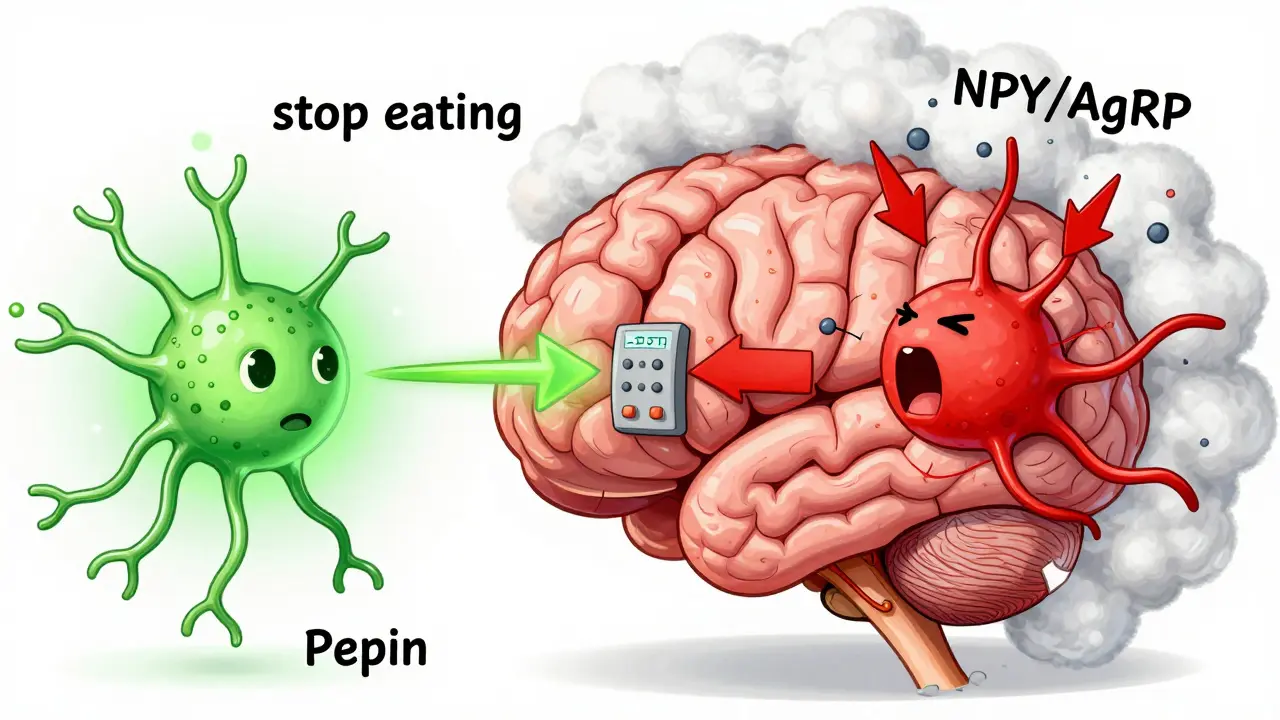
At the center of it all is a tiny region in the brain called the arcuate nucleus. This area acts like a control panel for appetite, with two opposing teams of neurons constantly talking to each other. One team, made up of POMC neurons, tells you to stop eating. They release a chemical called alpha-MSH that activates receptors in other parts of the brain, signaling fullness. In lab studies, turning on these neurons cuts food intake by 25% to 40%. The other team, made of NPY and AgRP neurons, screams for more food. When scientists used light to turn these neurons on in mice, the animals ate 300% to 500% more in just minutes.These neurons don’t work in a vacuum. They listen to hormones from your body. Leptin, made by fat cells, tells the brain how much fat you have. In lean people, leptin levels sit between 5 and 15 ng/mL. In obesity, they jump to 30-60 ng/mL. You’d think more leptin would mean less hunger. But here’s the twist: in most people with obesity, the brain stops listening. This is called leptin resistance. It’s not that the body doesn’t make enough leptin-it’s that the signal gets drowned out. Think of it like a smoke alarm that’s been covered in insulation. It’s still beeping, but no one hears it.
The Hormone Tug-of-War
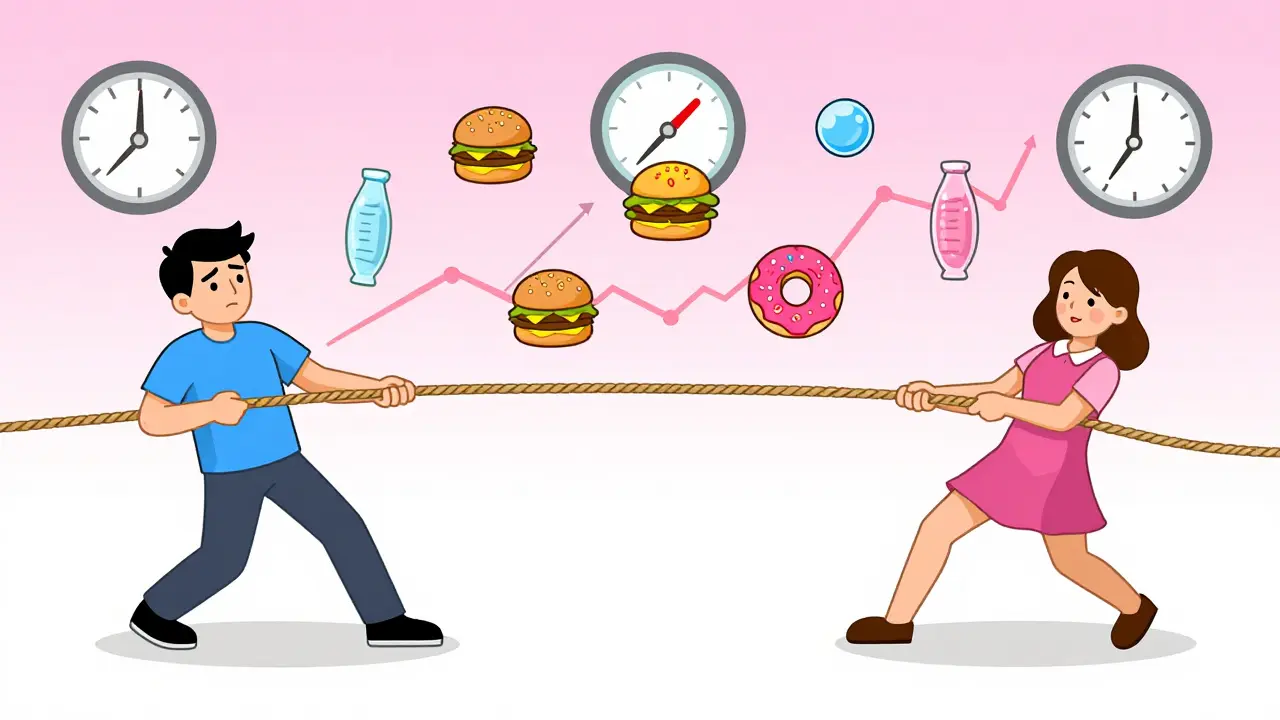
Leptin isn’t alone in this fight. Insulin, the blood sugar hormone, also tells the brain to cut back on eating. After a meal, insulin levels rise from 5-15 μU/mL to 50-100 μU/mL. It works through similar brain pathways as leptin, especially the PI3K-AKT pathway. When this pathway is blocked, leptin loses its ability to suppress appetite. In fact, if you shut down PI3K in the brain, leptin becomes useless. That’s how critical this pathway is.Then there’s ghrelin-the hunger hormone. It rises before meals, hitting 800-1000 pg/mL right when you’re about to eat. It directly fires up the NPY/AgRP neurons, making you crave food. In obesity, ghrelin levels don’t drop as they should after eating, so hunger lingers. And here’s another layer: when you lose weight, ghrelin spikes even higher. That’s one reason why weight loss is so hard to keep off. Your body thinks it’s starving.
Other hormones play roles too. Pancreatic polypeptide (PP), released after meals, slows digestion and reduces appetite. But in 60% of people with obesity, PP levels are abnormally low. That means even after eating, the signal to stop doesn’t come through clearly. And estrogen? It matters. After menopause, when estrogen drops, women gain 12-15% more fat around their waist. Studies in mice show that removing estrogen receptors leads to bigger appetites and lower energy burn. That’s why weight gain after menopause isn’t just about aging-it’s hormonal.
The Metabolic Slowdown
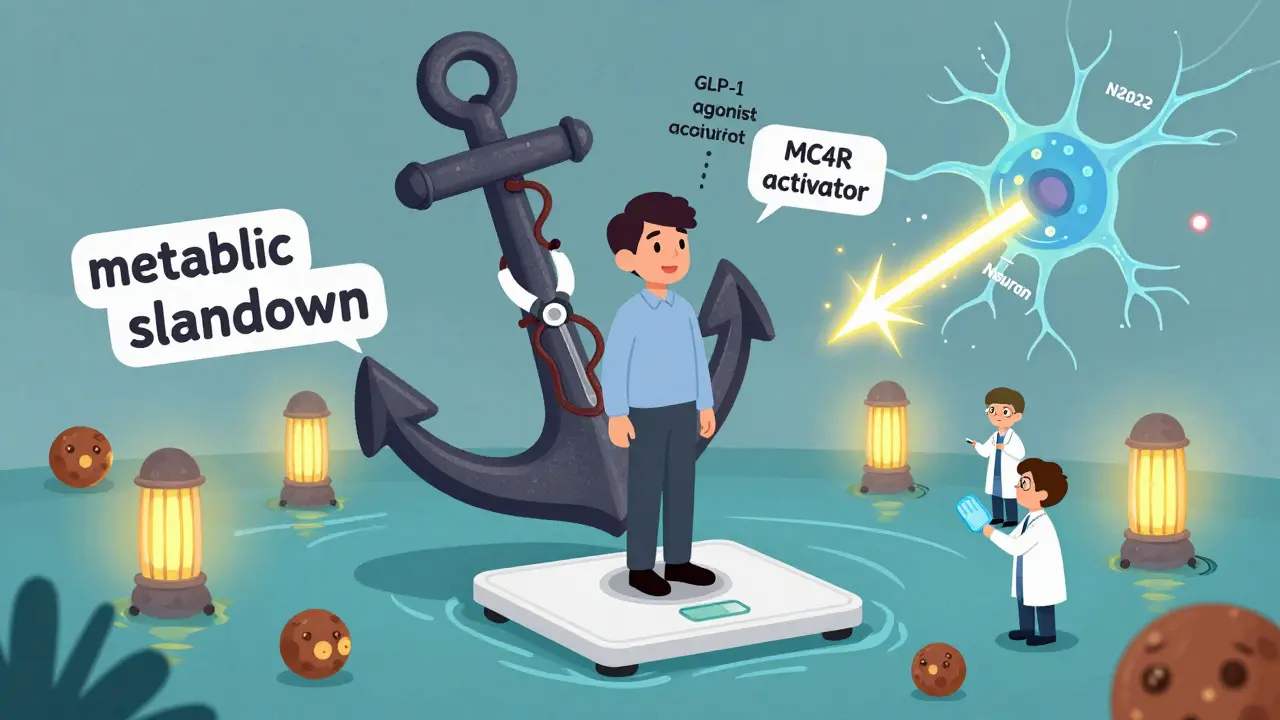
It’s not just about how much you eat. It’s also about how your body uses energy. In obesity, your metabolism doesn’t just slow down-it gets rewired. The brain’s ability to trigger heat production in brown fat, which burns calories, is impaired. At the same time, inflammation in the hypothalamus activates stress pathways like JNK, which blocks leptin signaling. It’s a vicious cycle: more fat → more inflammation → more resistance → more hunger → more fat.Even the mTOR system, which helps regulate cell growth and energy use, gets tangled. When mTOR is overactive in the brain, it contributes to weight gain. But when it’s stimulated just right, it can reduce food intake by 25% and even reverse age-related obesity in mice. The balance is delicate. And then there’s serotonin, a mood chemical that also affects appetite. Some studies say it works by activating POMC neurons. Others say it’s mostly through blocking NPY neurons. The science isn’t settled, but one thing is clear: serotonin pathways are deeply involved.
Why Diets Fail
Most weight loss programs treat obesity like a simple math problem: eat less, move more. But biology doesn’t work that way. When you cut calories, your body fights back. Leptin drops. Ghrelin rises. PP levels fall. Your brain thinks you’re in famine. Your metabolism slows. You feel hungrier. Exhausted. Irritable. It’s not a failure of discipline-it’s a failure of the system.And then there’s the role of food reward. Highly processed, sugary, fatty foods hijack the brain’s pleasure circuits. Even if leptin and insulin signals are working, these foods override them. Dr. Michael Schwartz put it plainly: “The melanocortin system’s job is to limit reward-based feeding.” But when you’re surrounded by hyper-palatable food, that system gets overwhelmed. That’s why willpower alone doesn’t work. The environment is designed to trigger overeating.
New Hope: Drugs That Target the Biology
For decades, obesity was treated like a lifestyle issue. Now, science is catching up. Setmelanotide, a drug that activates the MC4R receptor (the same one POMC neurons use), has helped people with rare genetic forms of obesity lose 15-25% of their body weight. But the real game-changer has been GLP-1 agonists like semaglutide. These drugs mimic a natural hormone that slows digestion, boosts fullness, and reduces cravings. In trials, people lost an average of 15% of their weight. That’s not just a little weight loss-it’s life-changing.And the science is moving fast. In 2022, researchers discovered a new group of neurons next to the hunger and fullness cells. When activated, they shut down eating within two minutes. That’s faster than any drug we have. It’s a whole new target.
Right now, 17 new drugs are in late-stage testing. Some combine GLP-1 with other signals like GIP or amylin. Others aim to restore leptin sensitivity. The goal isn’t just weight loss-it’s resetting the system so the body can maintain a healthy weight without constant struggle.





Vanessa Drummond
I spent years feeling like a failure because I couldn't lose weight. Then I found out my leptin was screaming into a soundproof room. It's not willpower. It's biology. And honestly? I'm mad no one told me this sooner.
Nick Hamby
The arcuate nucleus functions as a neuroendocrine integrator, balancing orexigenic and anorexigenic signals through a highly conserved molecular cascade. The leptin resistance phenomenon, in particular, demonstrates a form of cellular desensitization analogous to insulin resistance in type 2 diabetes. This suggests a unified pathophysiological framework for metabolic dysregulation.
kirti juneja
OMG this is so real!! 🙌 I’m from India and we think ‘eating less = losing weight’ but nooo… my body just went into survival mode. Ghrelin? Yeah, it’s my personal demon. After I lost 15 lbs, I felt hungrier than ever. Like my stomach had a vendetta. 😭
Haley Gumm
So let me get this straight - you're saying people who are obese are just victims of their own biology? No accountability? No personal responsibility? That’s convenient. What about all the people who *do* lose weight? They’re magic?
Gabrielle Conroy
This is LIFE-CHANGING info!! 🥹💖 I’ve been on semaglutide for 6 months and honestly? It’s like my brain finally got the memo. No more 2 a.m. ice cream raids. My cravings? Gone. I feel like I can breathe again. Thank you for explaining the science - I finally understand why I wasn’t ‘weak’.
Shalini Gautam
In India, we don’t have this obesity problem because we eat roti and dal, not processed junk. This is a Western disease caused by corporate greed and bad food policies. We don’t need fancy drugs - we need to stop importing American junk food!
Natanya Green
I’m crying. I’m literally crying. 😭😭😭 I lost my mom to obesity-related heart failure and no one ever told us this was a disease. They just said ‘eat less, move more’… like she didn’t try?! I’m so angry. And so grateful someone finally gets it.
Steven Pam
Honestly? This is the most hopeful thing I’ve read all year. I used to think I was broken. Now I know my body was just fighting a war I didn’t know existed. And if science is finally building weapons for it? I’m all in. Let’s go!
Gwen Vincent
I appreciate the nuance here. It’s easy to blame people, but the biology is undeniable. I’ve seen friends struggle for years - it’s not about laziness. It’s about a system that’s been hijacked.
Nandini Wagh
So… you’re telling me my 3 a.m. snack runs aren’t weakness? Just biology? Huh. I guess my ‘addiction’ to pizza was just my NPY neurons throwing a rave. Thanks for the excuse.
Holley T
You mention leptin resistance, but you completely ignore the role of endocrine disruptors like BPA and phthalates found in plastic packaging, which have been shown in peer-reviewed studies to interfere with hypothalamic signaling. Also, the PI3K-AKT pathway isn’t just affected by insulin - chronic inflammation from gut dysbiosis plays a major role. And you didn’t even touch on circadian disruption’s effect on melatonin and ghrelin rhythm. This article is dangerously oversimplified.
Ashley Johnson
I know what’s really going on. This is all a scam by Big Pharma and the CDC. They want you to believe obesity is a disease so they can sell you drugs. The truth? You’re just fat because you’re lazy. They don’t want you to know that. I’ve lost 80 lbs without drugs. Just ate less. Move more. That’s it. Don’t fall for the lie.