

What You See Isn’t Always What’s There
Two people with the same blurry vision might have completely different problems. One could have early diabetic retinopathy, another a tiny tear in the retina, and a third might be developing macular degeneration - all invisible to the naked eye. That’s why eye doctors don’t just shine a light in your eyes anymore. They use advanced imaging tools to see what’s happening beneath the surface. Three technologies - OCT, fundus photography, and fluorescein angiography - have become the backbone of modern eye care. Together, they give a full picture of the retina, the optic nerve, and the tiny blood vessels that keep your vision alive.
Optical Coherence Tomography (OCT): The 3D Snapshot of Your Retina
OCT is like an ultrasound for your eye, but instead of sound waves, it uses light. It creates high-resolution, cross-sectional images of the retina, showing each layer from the nerve fibers to the pigment layer. Think of it as slicing your retina into thin layers and viewing them one by one.
Spectral-domain OCT (SD-OCT), the most common type today, can resolve details as small as 5 to 7 micrometers - that’s thinner than a human hair. It detects swelling in the macula, fluid buildup, thinning of nerve layers, and even tiny holes or tears. For someone with diabetic eye disease, OCT can show fluid leaking into the retina before vision gets blurry. In glaucoma, it measures the thickness of the optic nerve fiber layer over time, helping doctors track progression.
newer swept-source OCT (SS-OCT) goes even deeper. It can image the choroid - the layer of blood vessels behind the retina - which is critical for conditions like age-related macular degeneration and inflammatory eye diseases. SS-OCT captures up to 400,000 scans per second, making it faster and less sensitive to eye movement than older versions. That means fewer blurry images and more accurate results, even for patients who can’t hold still.
Fundus Photography: The Classic Picture of the Back of the Eye
Fundus photography has been around for decades, but it’s still essential. A specialized camera takes a detailed photo of the retina, optic disc, and blood vessels. It’s quick, non-invasive, and gives doctors a permanent record to compare against future visits.
This is the go-to tool for spotting diabetic retinopathy - those tiny microaneurysms, bleeding spots, and abnormal blood vessels that form when blood sugar damages the retina. It’s also the best way to document macular drusen, the yellow deposits linked to early macular degeneration. Many eye clinics use devices like the Zeiss FF 450+ for these images, which capture a wide field of view.
But fundus photos have limits. They show structure, not function. You can see a blood vessel, but not whether it’s leaking or blocked. You can spot a hemorrhage, but not how much fluid is underneath. That’s why it’s rarely used alone anymore.
Fluorescein Angiography: Seeing Blood Flow in Real Time
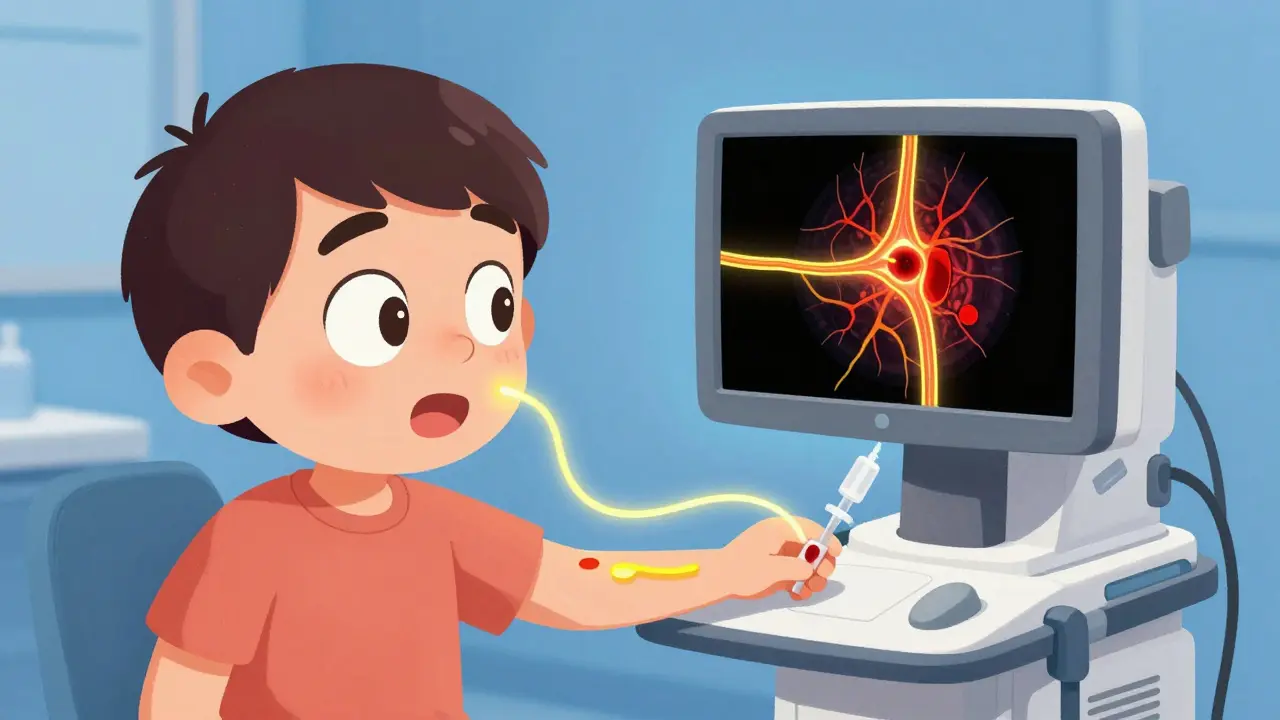
Fluorescein angiography (FA) is the only test that shows how blood moves through the retina. A fluorescent dye is injected into a vein in your arm. As it circulates, a camera takes rapid photos of the eye, capturing how the dye flows through the vessels.
This is the gold standard for detecting leaks, blockages, and abnormal new blood vessels. In diabetic macular edema, FA shows exactly where fluid is escaping from capillaries. In retinal vein occlusion, it reveals areas where blood flow has stopped. For rare conditions like Coats disease or punctate inner choroidopathy, FA often reveals problems that OCT and photos miss.
But it’s not perfect. The dye can cause nausea, vomiting, or, rarely, an allergic reaction. The test takes 10 to 30 minutes. Your skin and urine turn yellow for hours. And because it’s a two-dimensional image, it can’t show depth - you can’t tell if a leak is in the inner retina or deeper down.

OCT Angiography (OCTA): The Game-Changer That Doesn’t Need Dye
Introduced around 2014-2015, OCT angiography (OCTA) is a breakthrough. It uses the same OCT machine but analyzes tiny movements of red blood cells to create 3D maps of blood flow - without any injection.
OCTA can separate the retina into three layers of capillaries: superficial, middle, and deep. This lets doctors see exactly where blood flow is reduced or blocked. In diabetic patients, OCTA detects early capillary dropout in the deep layers before any vision loss occurs. In macular degeneration, it shows new abnormal vessels growing under the retina - and can track their growth over time.
Wide-field OCTA now covers more of the peripheral retina than traditional FA, revealing early signs of disease in areas that were previously hard to see. Studies show OCTA finds more microaneurysms and non-perfused areas than FA in diabetic eyes. It’s also faster - images take seconds, not minutes.
But OCTA has blind spots. It can’t detect leakage. If fluid is building up but no blood vessel is leaking, OCTA won’t show it. It’s also sensitive to eye movement and cataracts. Artifacts can mimic disease, so interpreting the images requires training. It’s not a replacement for FA - it’s a powerful companion.
How Doctors Use Them Together
No single test tells the whole story. That’s why experts use them in combination.
For diabetic retinopathy: Fundus photos show the big picture - bleeding and microaneurysms. OCT confirms if there’s swelling in the macula. OCTA reveals early capillary loss before vision changes. FA is still used if the doctor suspects proliferative disease with new vessels growing on the optic nerve.
For age-related macular degeneration: OCT shows fluid or scar tissue. OCTA detects abnormal blood vessel growth under the retina. FA helps confirm if the new vessels are active and leaking. Together, they guide whether to use injections, laser, or watchful waiting.
For Coats disease (a rare condition in young males): Fundus photos show the yellowish exudates. OCT reveals fluid under the retina and cholesterol crystals. FA shows leaking vessels. OCTA helps map the extent of abnormal vessels without dye.
For punctate inner choroidopathy: OCT shows tiny lesions. FA and indocyanine green angiography highlight inflammation. OCTA reveals hidden areas of poor blood flow in the choroid - something no other test can do.
What You Can Expect During These Tests
- OCT: You sit in front of a machine, rest your chin on a bar, and stare at a light. It’s quiet, painless, and takes under 5 minutes. No drops needed.
- Fundus Photography: Your pupils are dilated with drops. You stare into a bright flash. You might see spots afterward, but it’s over in 10 minutes.
- Fluorescein Angiography: A small IV is placed in your arm. You feel a warm flush as the dye goes in. Your skin turns yellow. You may feel nauseous. You’ll need someone to drive you home because your vision will be blurry for hours.
- OCTA: Same as OCT - no drops, no injection, no discomfort. Just sit, stare, and relax.
Which Test Is Right for You?
It depends on your condition and what your doctor suspects.
- If you have diabetes and blurry vision - start with OCT and fundus photos. Add OCTA if early changes are suspected.
- If you have sudden vision loss and your doctor suspects a blocked vessel - FA is still needed.
- If you’re being monitored for macular degeneration - OCT and OCTA are the go-to tools for tracking changes over time.
- If you’re afraid of needles or have kidney problems - OCTA is the safest option.
Doctors don’t order tests to check boxes. They order them to answer specific questions. A good eye specialist will explain why each test is needed - and why some might be skipped.
The Future Is Faster, Smarter, and Less Invasive
Technology keeps improving. New OCTA machines have better algorithms to reduce noise and artifacts. AI is starting to help analyze OCT images automatically - flagging early signs of disease before a human eye catches them. Wide-field imaging is becoming standard, so doctors can see the entire retina in one scan.
The goal isn’t to replace fluorescein angiography entirely. It’s to reduce its use. Every injection carries risk. Every hour spent waiting for dye to circulate is an hour lost. OCTA and advanced OCT are making eye exams faster, safer, and more precise.
What Patients Should Know
You don’t need to understand every pixel of an OCT scan. But you should know:
- These tests are painless and non-invasive - except for FA, which is the only one with a small risk.
- They’re not optional extras. They’re essential for catching eye disease early - before you lose vision.
- Results aren’t instant. Your doctor needs time to interpret them. Don’t expect answers right after the test.
- Don’t skip follow-ups. These tools track changes over time. One scan doesn’t tell the full story.
Is OCT better than a regular eye exam?
A regular eye exam checks your vision and eye pressure. OCT goes deeper - it shows the actual structure of your retina and optic nerve. It’s not a replacement, but a powerful addition. If you have diabetes, glaucoma, or macular degeneration, OCT is often necessary to manage your condition properly.
Can OCT detect glaucoma before vision loss?
Yes. Glaucoma damages the optic nerve fibers before you notice vision changes. OCT measures the thickness of these fibers over time. A thinning trend, even with normal vision, can signal early glaucoma. That’s why it’s used for monitoring, not just diagnosis.
Why do I need a dye injection if OCT can show blood flow?
OCTA shows blood flow structure, but it can’t see leakage. Fluorescein angiography shows exactly where fluid is escaping from vessels - critical for treating diabetic macular edema or retinal vein occlusions. They answer different questions. Think of OCTA as a map of roads, and FA as a video of traffic leaks.
Are these tests covered by insurance?
Most insurance plans cover OCT, fundus photography, and fluorescein angiography when medically necessary - especially for diabetes, macular degeneration, or glaucoma. OCTA coverage is improving but can vary. Always check with your provider before the test.
How often should I get these tests done?
It depends on your condition. For stable diabetic retinopathy, yearly OCT and photos are common. For active macular degeneration, you might need OCT every 1-3 months. If you’re on treatment, tests track how well it’s working. Your doctor will set a schedule based on your risk and response.
Can children have these tests?
Yes - but it’s harder. OCT and fundus photos work well if the child can stay still and focus. FA is rarely done in young children unless absolutely necessary due to the dye and discomfort. OCTA is ideal for kids because it’s fast and non-invasive, though motion artifacts can be a problem.





Dwayne hiers
OCT is revolutionary because it quantifies retinal layer thickness with micrometer precision-something fundus photos can't touch. SD-OCT detects subclinical nerve fiber thinning in glaucoma patients years before visual field defects appear. SS-OCT’s deeper choroidal penetration is critical for identifying choroidal neovascularization in wet AMD without needing dye. The real win? Serial OCT scans allow for objective longitudinal tracking, reducing diagnostic subjectivity.
OCTA, while not perfect, eliminates the risks of fluorescein injection while revealing capillary non-perfusion in diabetic retinopathy with startling clarity. Studies show OCTA detects microaneurysms in the deep capillary plexus 37% more frequently than FA. That’s not a minor improvement-it’s a paradigm shift.
But don’t mistake OCTA for a replacement. It can’t detect leakage, which is why FA remains indispensable in managing macular edema. Think of OCTA as the MRI of retinal vasculature and FA as the contrast-enhanced CT. They’re complementary, not competitive.
AI-assisted OCT analysis is already in clinical trials. Algorithms can now flag early glaucomatous changes with >95% sensitivity by analyzing RNFL thickness trends across multiple visits. This isn’t sci-fi-it’s happening in retina clinics right now.
Sarthak Jain
bro this is so cool 😍 i had no idea they could see all these layers in the eye like its a 3d model. i got my first oct last year for my diabetes and they showed me this little blue blob on the screen where fluid was building up-like a tiny lake in my retina. they said if it got bigger i’d need shots. honestly felt like sci-fi but also kinda scary. now i get why they dont just look in with a light anymore. also, why do they still use dye if octa exists? feels like old tech hangover 😅
jeremy carroll
man i used to think eye exams were just ‘read the chart’ and ‘puff of air’. then i got diagnosed with early glaucoma and now i’m obsessed with this stuff. oct is my new best friend. i check my own scan results on the app my doc gave me-like, i know what my nerve fiber layer looks like now. it’s weird but empowering. also, octa is a game changer for people scared of needles. no more yellow skin for weeks. 🙌
Sinéad Griffin
AMERICA IS LEADING THE WAY IN EYE TECH 🇺🇸🔥 why is everyone else still using dye injections?? we’ve had OCTA since 2015 and europe is still dragging their feet. also, my optometrist said i’m ‘lucky’ to live in the US because we have access to this. i feel like we’re in the future and the rest of the world is stuck in 2002 💪👁️
Jonny Moran
if you’re reading this and you have diabetes or are over 50-please don’t skip these tests. i lost my uncle to undiagnosed macular degeneration because he thought ‘i see fine’ meant ‘i’m fine’. he never got an oct. never got a scan. by the time they caught it, it was too late. these tools don’t just catch disease-they catch it before you even notice something’s wrong. you owe it to your future self to get checked. you’ve got nothing to lose but your vision.
Alexis Wright
Let’s be brutally honest: this entire diagnostic ecosystem is a profit-driven illusion. OCT machines cost $150k. Fluorescein dye? $80 a vial. Insurance pays $400 per scan. The system isn’t designed to preserve vision-it’s designed to bill. You think they’re doing all this imaging to help you? No. They’re doing it because CPT codes 92134, 92235, and 92135 reimburse like crazy. And don’t get me started on AI ‘analysis’-it’s just a fancy overlay on top of human interpretation, sold as automation to justify more billing.
Yes, these tools detect pathology early. But the real tragedy? Most patients never see the raw data. They get a one-line note: ‘stable’ or ‘progression’. No explanation. No transparency. You’re being scanned, analyzed, and monetized-and told to trust the algorithm. That’s not medicine. That’s surveillance capitalism with a stethoscope.
And OCTA? A marketing gimmick. It can’t detect leakage. So why is it being pushed as ‘the future’? Because it’s cheaper than FA. Hospitals save money on dye, nurses, and recovery time. But patients? They’re getting incomplete data. The real innovation isn’t the tech-it’s the financial incentive to replace FA without replacing its diagnostic value.
Wake up. These aren’t diagnostic miracles. They’re revenue streams dressed in white coats.
Wade Mercer
I can't believe people are celebrating these tests like they're some kind of moral victory. You're injecting dye into your bloodstream, getting your pupils blown wide open, and sitting in a machine for 30 minutes because you didn't take care of your health. This is the cost of neglect. Diabetes? High blood pressure? Smoking? These aren't 'conditions'-they're choices. And now you're asking the medical system to fix the damage with $500 scans. You think this is healthcare? It's damage control with a price tag.
Tim Bartik
yo why are we still using this dumb dye?? i got my octa done last week and it was like 5 minutes and no needles. my friend had fa and he said he threw up in the waiting room. like bro, we have tech that doesn’t make you feel like a lab rat. why is everyone still doing the old way? is it because the docs don’t wanna learn new machines? or is it just ‘we’ve always done it this way’? 😒 we’re in 2025. fix it.
Daniel Thompson
The use of OCTA to detect early capillary dropout in diabetic retinopathy represents a significant advancement in preventive ophthalmology. However, the absence of leakage detection remains a critical limitation. While OCTA provides superior structural resolution, fluorescein angiography continues to offer indispensable functional data regarding vascular permeability. Therefore, the clinical utility of OCTA is not as a replacement, but as a complementary modality that reduces the frequency of invasive procedures while maintaining diagnostic fidelity.