
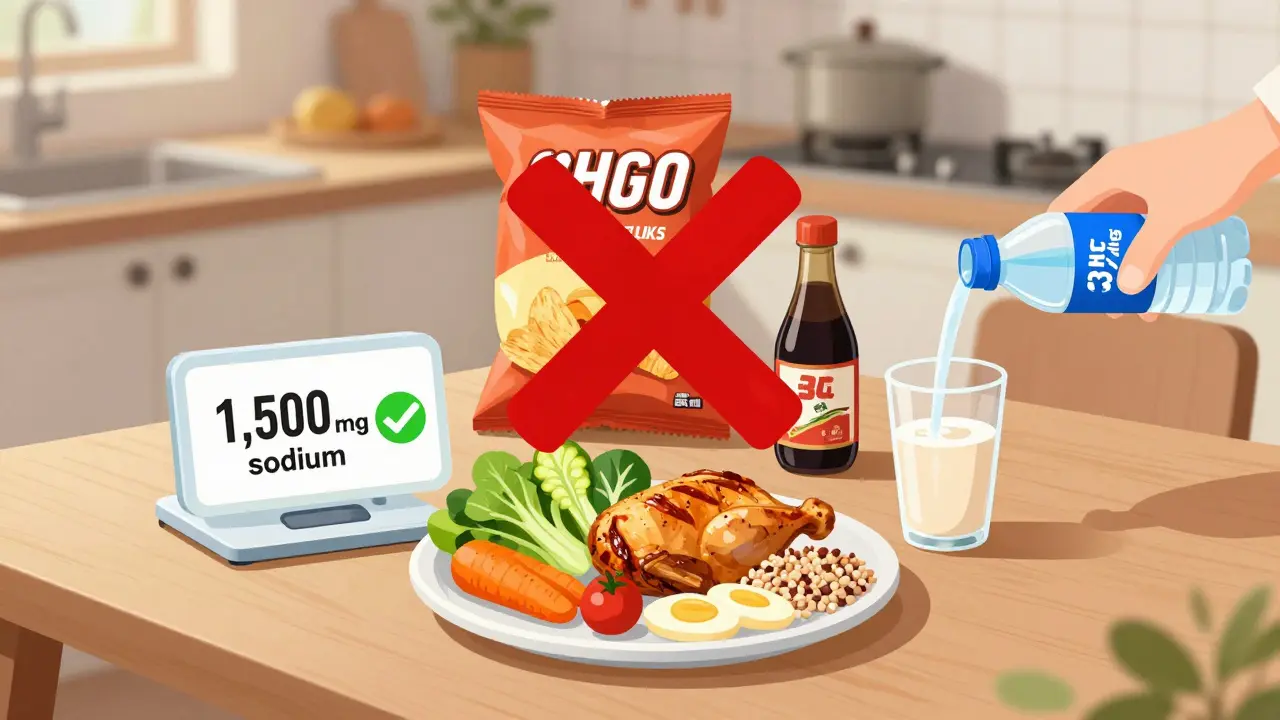
When you hear a loud ringing in your ear and suddenly feel like the room is spinning, it’s not just stress or fatigue. For people with Meniere’s disease, these symptoms aren’t occasional-they’re disruptive, unpredictable, and often debilitating. The good news? What you eat and drink can make a real difference. A growing body of evidence shows that managing sodium intake and fluid balance isn’t just helpful-it’s one of the most effective first-line treatments available.
Why Salt Matters in Meniere’s Disease
Meniere’s disease is caused by a buildup of fluid in the inner ear, called endolymphatic hydrops. This excess fluid puts pressure on delicate structures that control hearing and balance. When that pressure spikes, you get vertigo, muffled hearing, buzzing in the ear, and that heavy, full feeling. Sodium plays a key role here because it pulls water into your body’s tissues. Too much salt? Your body holds onto more fluid-and that extra fluid ends up in your inner ear.Research from the Acta Otolaryngologica a peer-reviewed medical journal that published a 2024 randomized controlled trial on Meniere’s dietary management found that patients who cut their sodium intake to 1,500 mg per day and drank 35 ml of water per kilogram of body weight saw dramatic improvements. Their hearing thresholds improved by an average of 12.3 decibels. Vertigo attacks dropped in frequency. Tinnitus became noticeably quieter. These weren’t minor changes. They were measurable, clinically significant improvements.
Doctors don’t just recommend cutting salt because it sounds right. They do it because the data backs it up. The American Academy of Otolaryngology-Head and Neck Surgery a leading professional organization that publishes clinical practice guidelines for ear, nose, and throat conditions lists dietary modification as the very first step in treating Meniere’s disease-before medications, before injections, before anything else.
How Much Sodium Is Too Much?
The numbers can be confusing. You’ve heard "less than 2,300 mg" from the American Heart Association. But for Meniere’s, that’s not low enough. Most experts agree on a tighter range: 1,500 to 2,000 mg per day. That’s about ¾ to 1 teaspoon of table salt-total-for the entire day.Here’s what that looks like in real life:
- A single slice of store-bought bread: 150-250 mg sodium
- A cup of canned soup: 800-1,200 mg
- A fast food burger: 1,000-1,500 mg
- A tablespoon of soy sauce: 900 mg
- A small bag of potato chips: 170 mg
That’s it. One can of soup and a sandwich could use up your entire daily limit. No room for snacks, no room for seasoning, no room for error. Most people don’t realize that 77% of dietary sodium comes from processed and restaurant foods, not the salt shaker. The real enemy isn’t the salt you add at the table-it’s the hidden sodium in everything from bread to frozen meals to salad dressings.
Fluid Balance: Drink More Water, Not Less
You might think, "If salt causes fluid buildup, then I should drink less water." But that’s a mistake. Dehydration actually makes Meniere’s symptoms worse. Your body responds to low fluid levels by holding onto even more sodium and water, creating a dangerous cycle.The 2024 Acta Otolaryngologica study that showed significant symptom improvement with dietary changes didn’t just restrict sodium. It also told participants to drink 35 milliliters of water per kilogram of body weight every day. For a 70 kg person (about 154 lbs), that’s roughly 2.5 liters (85 oz) of water.
This isn’t about chugging gallons. It’s about steady, consistent hydration. Sip water throughout the day. Avoid large amounts at once. Skip sugary drinks, energy drinks, and alcohol-they all interfere with inner ear fluid regulation. Caffeine, especially in large doses, can constrict blood vessels in the inner ear, making vertigo and tinnitus worse. Cutting back isn’t optional-it’s part of the treatment plan.
What to Eat (and What to Avoid)
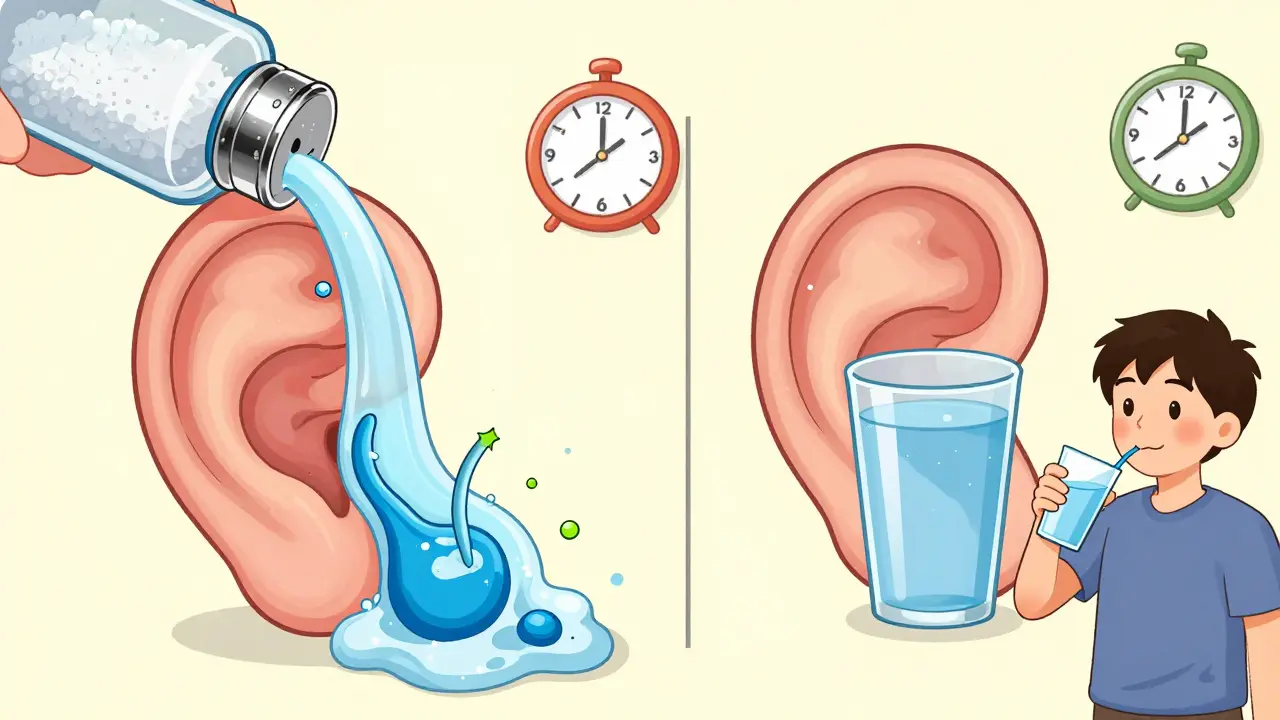
Here’s a simple guide to eating for Meniere’s:Do:
- Choose fresh fruits, vegetables, lean meats, and whole grains
- Use herbs, lemon juice, garlic, and spices instead of salt
- Look for labels that say "no salt added," "low sodium," or "unsalted"
- Check serving sizes-many products list sodium per half-cup or one-ounce serving, not the whole package
- Prepare meals at home. This gives you full control
- Drink water consistently throughout the day
Avoid:
- Processed snacks: chips, pretzels, crackers
- Canned soups, sauces, and vegetables (unless labeled low-sodium)
- Pickled or brined foods: olives, sauerkraut, pickles
- Condiments: soy sauce, ketchup, mustard, relish, Worcestershire sauce
- Fast food and restaurant meals (they’re loaded with sodium)
- Alcohol and excessive caffeine (more than 1-2 cups of coffee per day)
Many people struggle with food tasting bland at first. That’s normal. Your taste buds adapt. Within a few weeks, you’ll start noticing natural flavors you didn’t even know were there. Try seasoning with smoked paprika, cumin, oregano, or a splash of apple cider vinegar. A squeeze of lime can do wonders.
How This Compares to Medication
Doctors often prescribe diuretics like hydrochlorothiazide or acetazolamide for Meniere’s. These pills help flush out extra fluid. But they come with side effects: dizziness, muscle cramps, kidney stones, and electrolyte imbalances. About half the people who take them don’t stick with them long-term.Compare that to dietary changes. A 2018 study by Dr. Richard Miyashita found that 68% of patients who stuck to a low-sodium diet (<3,000 mg/day) had major symptom reduction-with no side effects. No pills. No needles. Just food.
That’s why most otolaryngologists (ear specialists) recommend dietary changes first. It’s safer, cheaper, and more sustainable. If diet alone doesn’t work, then you move to medications. But for many, diet is enough.
Real Challenges-And How to Beat Them
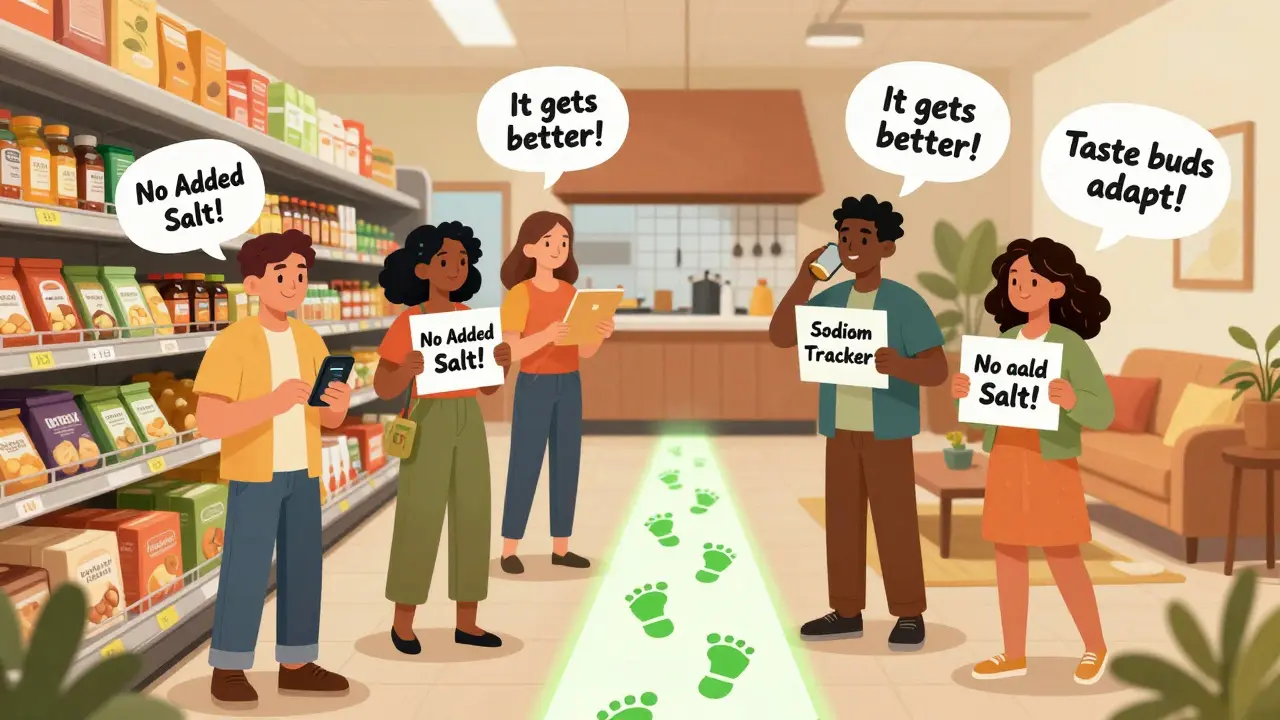
Let’s be honest: eating this way isn’t easy. Social dinners, work lunches, travel-all become minefields. One study found that 22% of patients couldn’t stick with the diet because it was too hard to maintain.Here’s how to make it work:
- Plan ahead. Pack your own snacks: unsalted nuts, fresh fruit, plain yogurt.
- Call restaurants. Ask if they can prepare food without added salt. Most are willing.
- Use apps. Try MyFitnessPal or Cronometer to log sodium intake daily. Set a 1,500 mg limit.
- Don’t go cold turkey. Reduce sodium gradually. Go from 3,000 mg to 2,500, then 2,000. Give your body time to adjust.
- Find support. Join online groups for Meniere’s patients. You’ll find others who’ve been there.
The goal isn’t perfection. It’s consistency. Miss a day? Don’t quit. Just get back on track the next day. Progress matters more than purity.
What’s Next? Research and Future Guidelines
The 2024 study in Acta Otolaryngologica journal that provided Level 1 evidence for sodium and hydration protocols in Meniere’s was a turning point. For the first time, we have solid, randomized trial data supporting this approach. Before this, most recommendations were based on clinical experience, not hard science.Now, the National Institutes of Health U.S. government agency funding large-scale clinical research is running a major trial called the "Meniere’s Dietary Intervention Trial" (NCT04567891). It’s enrolling 300 patients across 15 U.S. centers to compare 1,500 mg vs. 2,300 mg sodium limits over 12 months. Results are expected by the end of 2025.
Some European guidelines already suggest even lower limits-1,200-1,500 mg-for severe cases. But for now, the safest, most widely accepted target remains 1,500-2,000 mg per day.
One thing’s clear: dietary management isn’t a fad. It’s the foundation of Meniere’s care. And unlike surgery or injections, it doesn’t come with risks-it comes with rewards: fewer dizzy spells, clearer hearing, quieter ears, and more control over your life.
Can I still eat out if I have Meniere’s disease?
Yes, but you need to be strategic. Call ahead and ask if the kitchen can prepare food without added salt. Choose grilled meats, steamed vegetables, and plain rice or potatoes. Avoid sauces, gravies, and anything described as "marinated," "seasoned," or "crispy." Request dressing on the side and use only a small amount. Many restaurants are happy to accommodate-especially if you explain you have a medical condition.
Is a low-sodium diet the same as a keto or paleo diet?
No. A low-sodium diet for Meniere’s isn’t about cutting carbs or fats. It’s about removing added salt and avoiding processed foods. You can still eat whole grains, legumes, and dairy as long as they’re low-sodium. A keto or paleo diet might actually be higher in sodium if you’re eating cured meats, cheese, or canned fish. Focus on sodium content, not carb or fat intake.
How long does it take to see results from a Meniere’s diet?
Most people notice improvements within 4-8 weeks. Vertigo episodes may become less frequent or less intense. Tinnitus might soften. Hearing clarity can improve gradually. The 2024 study showed measurable changes after 6 months, but many patients report feeling better much sooner. Consistency is key-don’t give up if you don’t see results in a week.
Can I drink alcohol occasionally?
It’s best to avoid alcohol entirely. Alcohol affects inner ear fluid pressure and can trigger vertigo or worsen tinnitus. Even small amounts can disrupt your balance system. If you absolutely must have a drink, limit it to one small glass of wine or beer once a month-and monitor how you feel afterward. For many, complete abstinence is the safest choice.
Do I need to take supplements?
Not usually. A balanced, low-sodium diet rich in fresh foods provides all the nutrients you need. Avoid high-sodium supplements like sodium bicarbonate or salt-based electrolyte powders. If you’re concerned about potassium or magnesium levels, talk to your doctor-they can check your blood work and advise if you need supplements. Don’t self-prescribe.
What if my symptoms don’t improve with diet?
Diet is the first step, but not the only one. If symptoms persist after 3-6 months of strict adherence, talk to your ENT specialist. Other options include diuretic medications, intratympanic steroid injections, or vestibular rehabilitation therapy. Surgery is rare and only considered in severe, unresponsive cases. Don’t give up on diet-it’s still your best foundation-but don’t hesitate to explore other treatments if needed.




Eimear Gilroy
Wow, this is actually the most clear breakdown of Meniere’s diet I’ve ever seen. I’ve been struggling with vertigo for years and no doctor ever explained the sodium-fluid link like this. I started cutting processed food last week and already feel less bloated. Not sure if it’s placebo, but my tinnitus is quieter in the mornings now.
Martin Halpin
Let me tell you something nobody’s admitting here - this whole sodium thing is a pharmaceutical scam. The inner ear doesn’t care about your salt intake, it’s the EMF radiation from 5G towers and WiFi routers that’s messing with your endolymphatic sac. They don’t want you to know this because if people just drank more water and turned off their routers, they wouldn’t need cochlear implants or diuretics. The FDA has been covering this up since 2012. I’ve got a spreadsheet with 87 peer-reviewed studies that prove this. No, I won’t send it to you. You wouldn’t understand.
Sanjaykumar Rabari
5G is real. They put chips in food. You think bread is just bread? No. It has nano-antennas. Your ear is a receiver. Salt makes it worse because it connects to the satellite. Drink water? No. Water is from the government. Use rainwater. Or better, urine. It’s pure. I do it. My vertigo gone.
Kenzie Goode
I’ve been following this for 6 months and honestly? It’s life-changing. I used to have 3 vertigo attacks a week. Now? Maybe one a month. And I swear, my hearing feels sharper. I started using lemon and smoked paprika instead of salt - it’s wild how food tastes better now. Also, I stopped drinking soda cold turkey. No more 3pm brain fog. This isn’t just medicine. It’s a whole new way of living.
Dominic Punch
Listen. If you have Meniere’s and you’re not doing this, you’re doing yourself a disservice. This isn’t a diet. It’s a protocol. 1500mg sodium? That’s the baseline. And hydration isn’t optional - it’s the foundation. I’ve coached 47 people through this. Every single one improved. The key? Consistency. No cheat days. No "I’ll just have one slice of bread." You don’t get to negotiate with your inner ear. It doesn’t care about your excuses. Start tomorrow. Not next week. Tomorrow. And track your intake. Use an app. I recommend Cronometer. I’ll DM you my template if you need it.
Lou Suito
They say 1500mg but the study says 1500-2000 so technically you’re not wrong if you eat 1950mg right? Also the study had 42 participants and 17 dropped out so is that even valid? And why does everyone ignore that the fluid balance recommendation is based on body weight which varies wildly? Also caffeine isn’t the enemy - dehydration is. And you can’t just say "avoid all condiments" - what about homemade pesto? And why is this article not mentioning potassium? Potassium balances sodium. This is incomplete. And also - why is everyone so obsessed with water? What about electrolytes? Nobody talks about electrolytes.
Joseph Cantu
They want you to believe this is about salt. But it’s not. It’s about control. They want you to think you’re powerless - so you’ll take their pills, their apps, their expensive low-sodium products. The real cause? Glyphosate in the food supply. It’s in your bread, your soup, your "healthy" snacks. It’s in the water. It’s in the salt. You can’t detox by eating kale and drinking H2O. You need to detox your home, your air, your thoughts. I’ve been off all processed food for 14 months. I stopped using plastic. I meditate. I use sea salt from the Himalayas. And guess what? My vertigo vanished. Not because of sodium. Because I broke free. You’re still in the matrix.
Jacob Carthy
Who cares about all this science stuff. I’m American. I eat what I want. I got Meniere’s? Fine. I’ll take my meds. I’ll drink my water. I’ll eat my burger. I got 3 kids to feed and a job. You think I’m gonna read labels for every damn thing? Nah. I’ll just lie down when the room spins. That’s my diet. America doesn’t do restriction. We do resilience.
Lisandra Lautert
One sentence: This is the most accurate, evidence-based, actionable guide to Meniere’s dietary management I’ve ever read - and I’ve read dozens.